One of the most common questions business owners ask when starting SEO is deceptively simple: What actually happens in the first three months? It's a fair question, especially given how much conflicting advice exists about SEO timelines some providers imply results in weeks, others stay frustratingly vague about what you're actually paying for during that early period.
This roadmap breaks down, month by month, what legitimate SEO work looks like during the first 90 days what gets fixed, what gets built, and realistically what kind of results to expect by the end of it. Whether you're managing this in-house or evaluating outside seo services, this gives you a concrete benchmark to measure any provider's plan against.
Why the First 90 Days Matter So Much
SEO is often described as a slow channel, and that's true relative to paid advertising but slow doesn't mean nothing happens. The first three months set the technical and structural foundation everything afterward depends on. Skipping or rushing this phase is one of the most common reasons SEO campaigns underperform: content and link building poured on top of unresolved technical issues or a poorly structured site simply doesn't compound the way it should.
Think of these 90 days less as waiting for rankings and more as building the machine that will eventually produce rankings reliably.
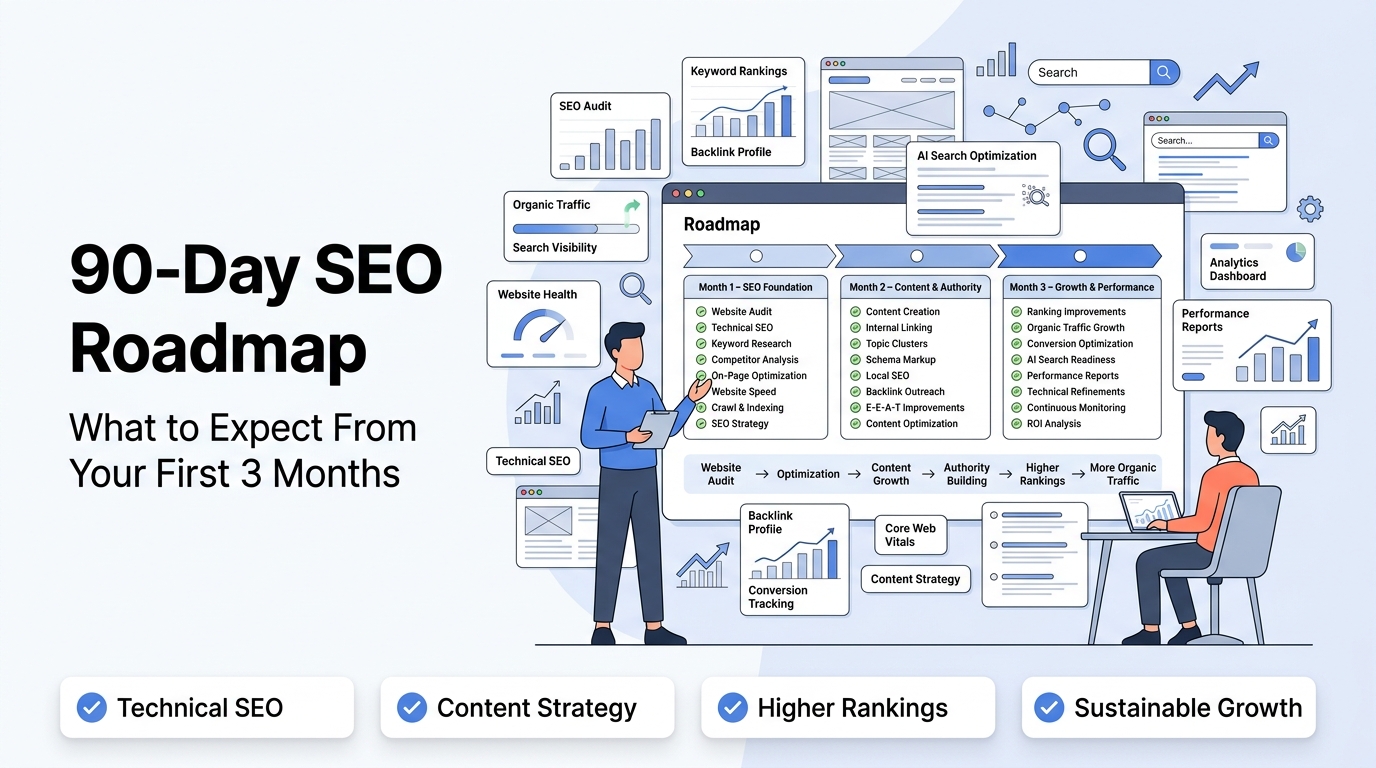
Month 1: Foundation and Technical Audit
The first month is almost entirely about understanding where you're starting from and fixing what's broken before building anything new on top of it.
Week 1-2: Comprehensive technical SEO audit
Everything begins with a proper technical seo audit service engagement a full review of crawlability, indexing, site speed, mobile usability, and existing structured data. This is genuinely foundational work: content and link building rarely perform well layered on top of a technically broken site.
A thorough seo technical audit service typically covers:
Crawl errors and broken links
Indexing issues, including accidental noindex tags or blocked pages
Site speed and Core Web Vitals performance
Mobile usability problems
Existing schema markup accuracy
URL structure and internal linking patterns
Duplicate content issues
For platform-specific sites, this stage looks a little different. A shopify technical seo audit service expert will check for Shopify-specific issues like app-related script bloat, theme rendering problems, and URL structure quirks unique to the platform. Similarly, wordpress seo services providers should flag plugin conflicts and page-builder bloat that generic audits sometimes miss entirely. If your business operates in a specialized, higher-stakes industry, insurance technical seo services or similar regulated-industry audits should additionally check for accuracy and compliance-related content issues alongside the standard technical checklist.
Businesses without in-house technical capacity often choose to outsource technical seo audit services at this stage specifically, since a proper audit benefits from tools and experience most internal marketing teams don't maintain regularly.
Week 2-3: Fixing priority technical issues
Once the audit identifies problems, month one typically involves fixing the highest-priority issues the ones actively preventing proper crawling and indexing, or causing meaningfully poor user experience through slow load times or broken mobile rendering.
Week 3-4: Keyword research and strategy planning
With the technical foundation stabilizing, attention shifts to keyword research identifying realistic, winnable terms rather than broad, highly competitive ones a smaller site has little near-term chance of ranking for. This is also when the overall content and local SEO plan for months two and three gets mapped out.
What to expect by the end of Month 1
Don't expect ranking movement yet. The realistic outcome of month one is a technically sound website, a clear list of fixed issues, and a documented strategy for what comes next. If a provider promises visible ranking gains within the first few weeks, that's a signal worth questioning rather than celebrating.
Month 2: Content, Structure, and Local Foundations
With the technical groundwork in place, month two shifts toward building out the content and structural elements that will eventually earn visibility.
On-page optimization across existing pages
Existing pages get optimized titles, meta descriptions, header structure, and internal linking based on the keyword research completed in month one. This is also when relevant schema markup gets implemented across key page types.
New content development begins
Depending on your business, this phase might include new service pages, blog content, or category pages targeting the keyword opportunities identified earlier. Quality seo content writing services or seo copywriting services work matters enormously here content that genuinely answers real questions performs meaningfully better than content built purely around keyword insertion.
Local SEO setup and optimization, if relevant
For businesses with a physical location or defined service area, month two is typically when dedicated local seo services work ramps up in earnest. This includes:
Google Business Profile optimization and verification
Consistent citation building across relevant directories
Location-specific landing pages, if you serve multiple areas
Review generation strategy setup
Businesses searching for local seo services near me or comparing local seo service company options should expect this phase to be where that relationship actually starts producing visible groundwork profile completeness, citation consistency, and early review activity, even before rankings shift.
Pricing here varies by market and competitiveness; if you're researching local seo services pricing, this month-two phase is generally where the bulk of setup-related billing occurs, with monthly seo services retainers shifting toward maintenance and content in subsequent months.
For businesses operating in a specific metro area, this is also where local seo services usa-based providers typically tailor citation and content strategy to your specific market whether that's local seo services florida, local seo services los angeles, or another region entirely, since local competition and directory relevance genuinely differ by geography.
Ecommerce-specific work, if applicable
Ecommerce seo services and shopify seo services work during month two typically focuses on product and category page optimization, resolving duplicate content across product variants, and implementing Product schema distinct from the general technical work completed in month one.
What to expect by the end of Month 2
You should see a site with meaningfully improved on-page structure, new content published or in progress, and for local businesses a completed, optimized Google Business Profile with growing citation consistency. Early, minor ranking movement for very low-competition, long-tail terms sometimes begins appearing here, though it's not the primary expectation yet.
Month 3: Authority Building and Early Signals
The third month introduces the piece of SEO work that depends most heavily on external factors: building genuine authority and third-party trust signals.
Link building begins in earnest
With a technically sound site and solid content foundation in place, month three is typically when active outreach and link building work starts. This timing matters earning links to a site that isn't yet technically sound or well-structured wastes the value of those links, since they're pointing traffic and authority toward pages that may still have underlying issues.
Continued content expansion
Content production continues, often building out topic clusters around the keyword strategy established earlier, reinforcing topical authority rather than relying on isolated, disconnected pages.
First reporting cycle with meaningful data
By month three, there's usually enough accumulated data indexed pages, initial ranking positions, early traffic patterns to produce the first genuinely meaningful performance report, distinct from the setup-focused updates of the first two months.
What to expect by the end of Month 3
Some early ranking movement for lower-competition, long-tail keywords is a reasonable expectation by this point. Meaningful movement on your primary, more competitive target keywords typically still requires additional months beyond this window 90 days builds the foundation; it doesn't usually complete the climb.
How This Roadmap Adapts by Business Type
The general structure above holds across most businesses, but the emphasis shifts depending on your specific situation.
Small businesses
For seo services for small businesses, the 90-day window often concentrates more heavily on local SEO and a smaller, focused set of high-intent keywords rather than a broad content campaign, since limited budgets are usually better spent winning a handful of realistic terms than spreading thin across many competitive ones.
Ecommerce businesses
Seo services for ecommerce typically front-load more technical work in month one, given how much product catalog structure, duplicate content, and platform-specific issues (particularly on Shopify) can undermine everything else if left unresolved.
B2B companies
B2B seo services often extend the content-planning phase in month two, since B2B buying journeys are typically longer and more research-driven, requiring content that addresses multiple stages of a more complex decision process rather than quick, transactional queries.
Local and regulated professional services
Dental seo services and similar local professional practices tend to weight local SEO work more heavily throughout all three months, alongside careful attention to patient-facing content accuracy particularly relevant for insurance technical seo services and other regulated industries where content accuracy carries real compliance stakes.
International businesses
International seo services typically add a localization layer across every phase of this roadmap technical work needs to account for hreflang implementation and regional site structure, content needs genuine local-market adaptation rather than direct translation, and link building often needs to prioritize region-specific sources.
Choosing the Right Support for Your 90-Day Plan
If you're evaluating outside help rather than managing this in-house, a few distinctions are worth understanding.
Organic seo services, and specifically an organic seo services company with genuine technical depth, should be able to walk you through a plan resembling this structure not vague promises, but a specific sequence of technical, content, and authority-building work tied to realistic timelines.
White label local seo services are worth considering if you're an agency wanting to offer this kind of structured local SEO roadmap to your own clients without building every piece of local-market expertise internally.
When comparing best local seo services or evaluating affordable local seo services, ask specifically how the first 90 days are structured a provider who can't clearly separate foundational technical work from later content and authority-building work may be applying a generic, undifferentiated process regardless of your actual starting point.
For technical work specifically, look for a technical seo services company or technical seo auditing services provider who produces a clear, prioritized list of issues tied to specific pages, rather than a generic scorecard. If you're comparing multiple technical seo audit service company options, ask each to walk through exactly how their month-one findings would translate into month-two priorities a strong provider should have a clear, logical answer.
SEO reseller services and seo content services offerings should be scrutinized carefully within this roadmap context too, since reselling arrangements can sometimes mean generic, templated execution that doesn't genuinely adapt to your specific month-one audit findings.
Monthly seo services retainers should reflect this shifting emphasis explicitly in their reporting technical progress in month one, content and structural progress in month two, and early authority-building metrics in month three rather than an identical report template every month regardless of what phase of work is actually happening.
Common Mistakes That Derail a 90-Day Plan
Starting link building too early, before technical and content foundations are solid, which wastes the value of earned authority pointing toward an unfinished site.
Expecting competitive-term rankings within 90 days. This window builds the foundation; genuine movement on harder, more valuable keywords typically takes longer.
Skipping the technical audit entirely to jump straight into content or link building, which frequently undermines everything built afterward.
Inconsistent reporting that doesn't clearly explain what phase of work is happening and why, leaving business owners unsure whether progress is actually being made.
Treating all 90 days identically, rather than recognizing that technical, content, and authority-building work each have their own appropriate sequencing.
What a Realistic First Report Should Include
By the end of month three, a genuinely useful report should cover:
A summary of technical issues found and resolved in month one
New or optimized content published, with a clear connection to the keyword strategy
Local SEO progress, if relevant Google Business Profile completeness, citation consistency, review activity
Early link building activity and outreach results
Any initial ranking movement, clearly framed as early-stage rather than final results
A clear plan for months four through six, since 90 days is a foundation-setting phase, not a complete campaign
A Practical Example: What This Looks Like for a Real Business
It helps to see this roadmap applied to an actual scenario rather than as an abstract sequence. Consider a mid-sized dental practice with three locations, working with a provider offering combined dental seo services and general local seo marketing services.
Month one starts with a full technical audit across all three location pages plus the main site, uncovering a handful of issues: duplicate content between near-identical location pages, missing schema markup for medical practice information, and a slow-loading homepage due to unoptimized images. These get fixed within the first few weeks, and keyword research identifies realistic target terms emergency dentist [city], dental implants [city], and similar location-specific, patient-intent terms rather than broad, highly competitive national dental keywords the practice has little realistic chance of ranking for quickly.
Month two shifts toward rebuilding the three location pages with genuinely unique, locally relevant content instead of the near-duplicate versions found in the audit, alongside a dedicated Google Business Profile optimization push for each location updated hours, photos, service lists, and a structured review-request process. A monthly blog post begins addressing common patient questions, doubling as both content marketing and local SEO material.
Month three introduces outreach for local backlinks a sponsorship mention from a local youth sports team, a guest contribution to a regional health and wellness publication, a citation correction across a handful of previously inconsistent directory listings. By the end of month three, one or two of the lower-competition, location-specific keywords begin showing early ranking movement, while the practice's Google Business Profile completeness and review volume have visibly improved across all three locations genuine, measurable progress, even though the more competitive terms are still several months away from meaningful movement.
This example illustrates the core principle behind the entire roadmap: each month's work depends on the previous month's foundation being solid, and the visible results compound gradually rather than arriving all at once.
Final Thoughts
A genuine 90-day SEO roadmap isn't about promising fast results it's about sequencing the right work in the right order, so that whatever comes after those first three months actually has a solid foundation to build on. Technical fixes first, content and structure second, authority-building third: skip or rush any of these phases, and everything built afterward performs worse than it should. Measure any provider's plan against this structure, and you'll have a far clearer sense of whether what you're paying for in those first 90 days is genuine groundwork or just activity.
Frequently Asked Questions
Will I see ranking improvements within the first 90 days?
Some early movement on low-competition, long-tail keywords is realistic by month three, but meaningful improvement on your primary, more competitive target keywords typically requires additional months beyond this initial window.
Why does month one focus so heavily on technical work instead of content?
Because content and link building built on top of an unresolved technical foundation poor crawlability, slow load times, indexing issues rarely performs as well as it should, making technical work the highest-leverage starting point.
Is a 90-day roadmap different for local businesses versus ecommerce sites?
Yes, meaningfully. Local businesses typically see more emphasis on Google Business Profile and citation work in month two, while ecommerce sites often need more front-loaded technical work in month one due to product catalog complexity.
How much does a 90-day SEO engagement typically cost?
This varies significantly by business size, industry competitiveness, and scope of work, spanning modest monthly retainers for small, local-focused campaigns up to substantially higher investment for larger, more competitive, or technically complex sites.
What happens after the first 90 days?
Months four through six typically build directly on this foundation expanding content, continuing authority-building work, and beginning to show more meaningful ranking movement on your primary target keywords as the accumulated technical, content, and authority work compounds.
Get a free audit and see exactly how this applies to your site.