AI agents are software systems that use large language models to interpret a goal, decide their own sequence of actions, and adapt that sequence in real time based on what happens along the way. Traditional automation including RPA (robotic process automation) executes a fixed, pre-programmed sequence of steps and cannot deviate from that script when conditions change. The core difference isn't smart vs. dumb it's who decides the next step: a human-authored rule, or the system itself.
How Different Sources Frame the Distinction
Not everyone draws the line the same way, and the framing you use changes how you should evaluate a vendor's claims.
Gartner frames it around autonomy tiers: task-specific AI agents (the 2026 mainstream category), followed by agentic ecosystems where multiple agents coordinate without a human orchestrating each handoff. Gartner's own research notes that only a small fraction of vendors claiming agentic AI roughly 130 out of the thousands making that claim actually meet that bar, with the rest engaged in what Gartner calls agentwashing.
McKinsey frames the distinction operationally, around deployment maturity rather than architecture: whether a system is merely piloted, actively scaled into production, or abandoned. Their data shows a wide gap between experimentation and real deployment useful if you're trying to benchmark your own company against peers rather than classify a specific tool.
Deloitte, in its RPA research, frames the distinction from the automation side: RPA as rule-based execution against a stable, structured interface (a form, a spreadsheet, an ERP screen), versus AI-driven processes that can handle exceptions RPA scripts would otherwise break on.
Each framing answers a different question. Gartner's is best for vendor evaluation, McKinsey's for internal benchmarking, and Deloitte's for deciding whether your existing RPA investment needs replacing or just augmenting.
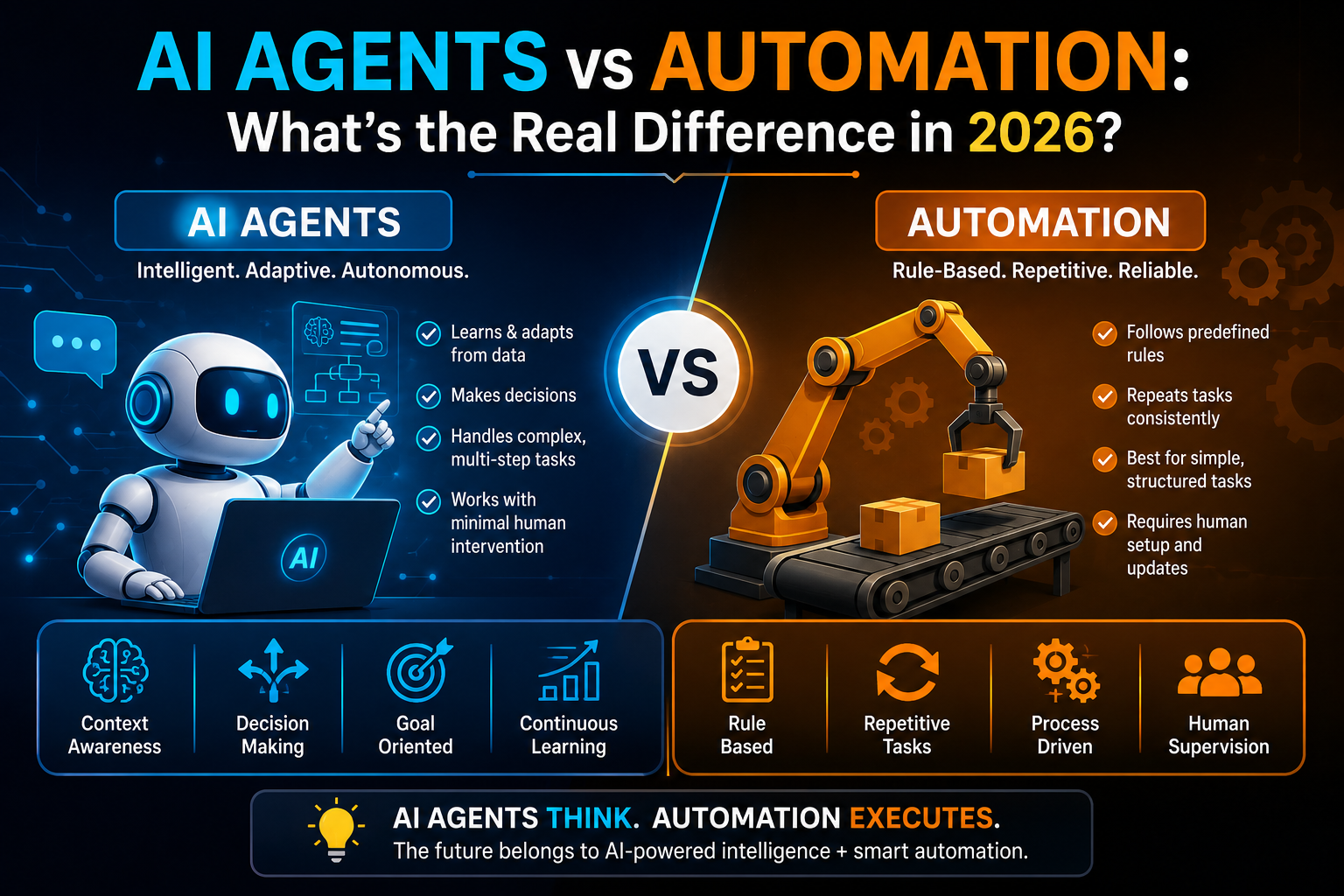
AI Agents vs. Automation: The Comparison
The surface-level differences agents use AI, automation doesn't, agents are flexible, automation is rigid all trace back to one structural fact: automation requires a human to pre-map every possible path through a process; an agent maps its own path at runtime, using the model's reasoning instead of a flowchart.
That single distinction explains why automation breaks the moment an input format changes, and why agents can (in principle) handle a novel exception and it also explains why agents are harder to audit and more expensive to run per task.
Traditional Automation (RPA) | AI Agents | |
Decision logic | Fixed rules, coded in advance | Reasoned in real time by an LLM |
Handles exceptions | No breaks or routes to a human | Often yes, within the scope of its training and tools |
Best data environment | Structured, stable interfaces | Unstructured or variable inputs |
Auditability | High every step is predictable | Lower reasoning path can vary run to run |
Setup cost | Lower, but brittle to UI/format changes | Higher, but more resilient to change |
Typical task length | Single, narrow task | Multi-step, cross-system task |
Failure mode | Stops or errors out | Can proceed confidently down a wrong path |
What Makes an AI Agent an Agent Not Just a Script
Four criteria separate a genuine agent from a chatbot wrapper or a relabeled automation:
1. Goal-directed reasoning. The system is given an objective, not a procedure, and uses a language model to work out the steps this is the core capability Gartner points to when it defines task-specific agents as the evolution beyond simple AI assistants.
2. Tool and API use. An agent can call external systems a database, a calendar, a CRM as part of executing its plan, rather than only generating text.
3. Multi-step adaptation. If step two of a plan fails or returns something unexpected, the agent revises its next action instead of halting. This is the trait McKinsey's adoption research uses to separate organizations that have merely piloted a chatbot from the smaller share that have actually scaled an agentic system into production the latter figure sits around 23%.
4. Bounded autonomy with oversight. Mature agent deployments still include human-in-the-loop checkpoints for high-stakes actions. Gartner's infrastructure-and-operations research projects that the share of IT workflows requiring human sign-off will fall from 95% in 2025 toward 40% by 2028 a decline, not an elimination.
How Organizations Actually Adopt Agentic AI: The Typical Path
1. Pilot a narrow, contained task. Most agent deployments start with something low-risk and well-scoped drafting customer support replies, summarizing tickets, or querying internal knowledge bases rather than a full end-to-end process.
2. Add tool access incrementally. Once the agent's reasoning is trusted on read-only tasks, teams grant it write access to specific systems, one integration at a time.
3. Introduce human checkpoints at high-stakes steps. Rather than removing oversight, mature deployments insert it selectively approval gates before financial transactions or customer-facing commitments, for instance.
4. Measure before scaling further. Organizations track error rates and cost-per-task before expanding an agent's scope, since Gartner's own projection is that a large share of agentic pilots will ultimately be shut down rather than scaled.
5. Fold successful agents into a broader ecosystem. The end state Gartner describes is multiple coordinating agents handling a business function together, rather than one agent bolted onto one task.
If you're earlier in this process still deciding whether a task belongs to RPA or an agent at all that decision usually comes down to whether your inputs are structured and stable (favor RPA) or variable and judgment-dependent (favor an agent).
The Numbers Behind the Hype
40% of enterprise applications are projected by Gartner to include task-specific AI agents by the end of 2026, up from under 5% in 2025 one of the fastest technology adoption curves Gartner has tracked.
23% of organizations report having actually scaled an agentic AI system into production, according to McKinsey, even though a much larger share 88% say they use AI regularly in at least one business function.
17% of organizations had deployed AI agents as of Gartner's 2026 CIO survey, while more than 60% expected to do so within two years a gap Gartner describes as the widest between ambition and execution of any emerging technology it measured.
$28.31 billion was the global RPA market's estimated value in 2025, according to Precedence Research, still growing even as AI agents draw most of the headlines a sign the two categories are expanding in parallel rather than one replacing the other outright.
Myth: AI Agents Are Replacing RPA
This is the most commonly repeated claim in vendor marketing, and it oversimplifies what's actually happening. RPA vendors and market researchers alike still project continued RPA market growth well into the 2030s Precedence Research puts the RPA market at roughly $247 billion by 2035, hardly a category in decline. What's actually happening is convergence: RPA vendors are embedding AI agents inside existing automation platforms to handle the exceptions that used to break the bot, rather than agents replacing RPA wholesale. For high-volume, stable, rule-based work, RPA generally remains cheaper and more predictable per task than routing it through an LLM-based agent.
When Does Something Stop Being Just Automation?
Clearly automation: A bot that reads a fixed-format invoice PDF, extracts the total, and enters it into an accounting system every day. There's no reasoning it's the same five steps, every time, and it breaks if the invoice template changes.
Clearly an agent: A system given the goal resolve this customer's billing dispute, which reads the account history, decides whether a refund applies, checks it against a policy it wasn't explicitly coded with a rule for, and drafts a response adapting its approach based on what it finds in the account.
The borderline case: A smart RPA bot with a machine-learning classifier bolted on the front say, one that uses ML to read messy invoice layouts before handing off to a fixed downstream process. This is intelligent automation: it uses AI for one sub-step (perception) but still executes a fixed script for everything after. Whether you call this an agent is mostly a vendor labeling choice rather than a functional one, since the actual decision-making after the classification step is still rule-based.
conclusion
The real difference between AI agents and automation isn't intelligence it's who decides the next step, a pre-written rule or the system's own reasoning. If your process is stable and repetitive, automation is still the cheaper, more reliable choice; if it involves judgment calls or variable inputs, an agent is worth the added cost and reduced predictability. Start by mapping which of your workflows actually have variable, judgment-dependent inputs that's the shortlist worth evaluating for an agent, and everything else is probably better left as automation for now.
FAQ
What's the simplest way to explain AI agents vs. automation?
Automation follows a fixed script a human wrote in advance; an AI agent decides its own steps toward a goal and can change course if something unexpected happens.
Can AI agents replace RPA entirely?
Not for most current use cases RPA remains cheaper and more reliable for high-volume, structured, rule-based tasks, while agents add value mainly where inputs are variable or judgment is required.
Is RPA a type of AI agent?
No. Traditional RPA is rule-based and doesn't use reasoning to decide its next action; some newer RPA platforms embed AI agents for specific sub-tasks, but the underlying bot is still following a fixed process.
Why do so many agentic AI projects get cancelled?
Gartner projects that over 40% of agentic AI projects will be cancelled by the end of 2027, citing unclear business value, rising costs, and inadequate risk controls as the main causes.
Do AI agents need human oversight?
Yes, in virtually all current enterprise deployments most organizations keep human-in-the-loop checkpoints at higher-stakes decision points, even as the share of fully autonomous steps grows over time.
What tasks are best suited to traditional automation instead of agents?
Tasks with stable, structured inputs and a single correct procedure data entry from a fixed form, scheduled report generation, standard approvals are typically better served by RPA, since it's cheaper and easier to audit than an agent for the same repetitive job.
How is agentic AI different from a chatbot
A chatbot generates conversational responses; an agent goes further by taking actions, calling APIs, updating records, and chaining multiple steps together toward a stated goal, without a human specifying each individual action.
What percentage of enterprise software will include AI agents by 2026?
Gartner projects 40% of enterprise applications will integrate task-specific AI agents by the end of 2026, up from under 5% in 2025.
Get a free audit and see exactly how this applies to your site.