Choosing an SEO agency is a genuinely difficult decision, and not for the reasons most people expect. It's not that good agencies are rare it's that nearly every agency's sales pitch sounds remarkably similar: proven results, custom strategy, transparent reporting. The difference between a genuinely capable partner and a mediocre one rarely shows up in the pitch. It shows up months later, in whether your traffic and revenue actually moved.
This checklist is built to help you evaluate that difference before you sign a contract, not after three months of disappointing reports. It walks through what to actually look for experience, transparency, technical capability, and fit for your specific business type so you can make a confident decision instead of a hopeful guess.
Why This Decision Deserves Real Scrutiny
SEO is a long-term investment realistically, a poor agency choice doesn't just waste your budget, it wastes the months you spend waiting to find out it isn't working, time competitors spend building the compounding advantage SEO is supposed to create for you instead. Getting this decision right the first time matters more than in most marketing channels, precisely because the feedback loop is slow enough that mistakes take a while to become obvious.
Step 1: Verify Real, Relevant Experience
The first and most important filter is whether an agency has genuine, demonstrable experience with businesses like yours not generic case studies pulled from unrelated industries.
Ask for case studies, not testimonials
Testimonials are easy to curate and say little about actual methodology. Ask instead for a specific example: what the client's situation looked like at the start, what work was done, and what changed over a defined timeframe, ideally with real (even if anonymized) traffic or ranking data attached.
Match their experience to your specific business type
Different business models genuinely need different specialized approaches, and an agency's stated experience should reflect that.
B2B seo services work requires understanding longer, research-driven buying cycles and how to build content that supports multiple stakeholders across a longer decision process meaningfully different from consumer-facing SEO.
Seo services for ecommerce need direct experience with large product catalogs, category structuring, and handling duplicate content across product variants a general content-focused agency may not have this depth.
Shopify seo services and wordpress seo services USA each come with real platform-specific technical quirks. An agency without direct platform experience may miss issues specific to app-related script bloat on Shopify or plugin conflicts on WordPress.
Dental seo services and other local, appointment-based practices benefit from agencies who understand patient-intent search behavior and the regulatory or compliance considerations specific to healthcare-adjacent content.
International seo services require genuine experience with hreflang implementation, regional content localization, and understanding how search and increasingly AI search behaves differently across markets and languages.
An agency that claims broad expertise across every one of these without being able to speak specifically to your situation is worth questioning further.
Step 2: Evaluate Their Approach to Technical SEO
Technical SEO is foundational content and link building rarely perform well layered on top of unresolved technical issues. How an agency talks about this work reveals a lot about their actual capability.
Ask what a technical SEO audit service actually includes
A credible technical seo audit service should cover crawlability, indexing, site speed, mobile usability, and structured data, at minimum. Ask the agency to walk through their specific audit process rather than accepting a vague description.
Look for platform-specific technical depth
Generic technical seo services claims are common; genuine platform expertise is less so. If you run an ecommerce store, ask specifically how they'd approach a Shopify or WooCommerce technical audit differently than a standard WordPress site a knowledgeable agency should have a clear, specific answer rather than a generic one.
Confirm they prioritize, not just list, issues
A large technical audit can surface dozens or hundreds of flagged issues. A strong agency prioritizes these by actual impact rather than presenting an overwhelming, undifferentiated list ask how they decide what gets fixed first.
Step 3: Assess Local SEO Capability, If Relevant
If your business depends on local visibility a physical location, a defined service area, or in-person customers this deserves its own dedicated evaluation, separate from general SEO capability.
Understand what genuine local SEO services include
Solid local seo services should cover Google Business Profile optimization, citation consistency across relevant directories, review generation strategy, and location-specific content not just a vague promise to improve local rankings.
Ask about their process for multi-location businesses
If you operate in more than one area, ask specifically how they'd approach it. A local seo service company with real multi-location experience should be able to explain how they avoid duplicate content across near-identical location pages, a common and damaging mistake.
Consider geographic specialization
Local search competition and directory relevance genuinely vary by market. If you're specifically researching local seo services usa, or a specific metro like local seo services florida or Tier 2 Link Building Service, ask whether the agency has direct experience in your particular region, since local competitive dynamics differ meaningfully by geography.
Compare pricing transparency
When reviewing local seo services pricing, look for agencies willing to explain what's actually included at each price tier, rather than a single opaque number with no breakdown. If you're specifically searching 5 Steps to Finding the Perfect SEO Agency or affordable local seo services, transparency about what a lower-cost package does and doesn't include matters more than the price itself.
Understand what best actually means for your situation
Marketing claims of being the Best SEO Company in USA | Professional SEO Services provider are common and largely unverifiable on their own. A more useful signal is whether an agency can clearly explain why their specific approach fits your specific local market and competitive situation.
If you're an agency yourself
If you're evaluating white label local seo services to extend your own agency's offering, prioritize partners who provide genuinely transparent, detailed reporting you can pass through to your own clients, rather than a black-box service you can't clearly explain if a client asks questions.
Step 4: Review Their Content Approach
Content quality is one of the more subjective areas to evaluate, but a few concrete questions cut through vague claims.
Ask who actually writes the content
Understand whether seo content writing services and seo copywriting services work is done in-house, by dedicated specialists, or largely outsourced and lightly edited this affects both quality consistency and how well the content reflects genuine subject-matter expertise.
Request writing samples in your actual industry
Generic writing samples tell you little. Ask for examples in your specific industry or a closely comparable one, and evaluate whether the content demonstrates real understanding of the subject or reads as generic, could-apply-anywhere copy.
Understand their content strategy, not just their output
A strong organic seo services company should be able to explain how content decisions connect to actual keyword research and business goals, not just describe a general publishing cadence disconnected from strategy.
Step 5: Understand Pricing Structures and What's Included
Pricing confusion is one of the most common sources of frustration in SEO client relationships, and it's largely avoidable with the right questions upfront.
Get a detailed, written scope of work
Vague packages comprehensive SEO optimization with no further detail make it nearly impossible to judge fair value. Insist on a written breakdown: how many pages, how much content per month, what technical work is included, and what reporting you'll receive.
Understand the retainer model
Most monthly seo services arrangements operate on an ongoing retainer rather than a one-time project, since SEO requires continuous work to maintain and build on results. Confirm what happens to previously completed work if you eventually cancel reputable agencies generally leave your site better off, not dependent on their continued involvement to avoid regression.
Be cautious of arrangements that feel resold rather than delivered directly
Seo reseller services arrangements aren't inherently problematic, but it's worth understanding whether your point of contact is doing the actual work or managing a subcontracted relationship you have no visibility into. Ask directly, and expect a straightforward answer.
Evaluate content-specific service packages separately
If content is a major part of your engagement, seo content services should be scoped and priced with the same transparency as technical or local SEO work volume, topic strategy, and review process should all be clearly defined.
Step 6: Ask About Reporting and Communication
How an agency reports on progress reveals a lot about whether they're managing toward real business outcomes or just producing activity.
Confirm reporting ties back to business metrics
Reports full of ranking positions and traffic charts are common; reports connecting that data to calls, leads, or sales are less so, and considerably more useful. Ask specifically how they'll show you the connection between SEO activity and actual business results.
Establish a communication cadence upfront
Understand how often you'll receive updates, who your actual point of contact is, and what response time to expect for questions between scheduled reports.
Step 7: Scrutinize Contract Terms and Flexibility
Contract structure protects you if the relationship doesn't work out as hoped, and it's worth negotiating before signing rather than discovering the terms after a disappointing quarter.
Favor month-to-month flexibility where possible
Long-term contracts can make sense once you've verified a relationship is working, but locking into a lengthy commitment before seeing any results limits your options if early signs are discouraging.
Understand cancellation terms clearly
Ask specifically what happens if you need to cancel notice periods, remaining deliverables, and whether any completed work transfers cleanly to a new provider if you switch.
Major Red Flags Worth Walking Away From
A few warning signs are serious enough to end consideration outright, regardless of how strong the rest of the pitch sounds:
Guaranteed rankings or a specific position. No legitimate agency controls the search algorithm closely enough to guarantee a specific outcome.
Refusal to explain methodology in plain language. A confident, experienced agency can explain what they do and why without hiding behind jargon.
Pressure to sign quickly, especially paired with a limited-time pricing offer that conveniently disappears if you take time to think it over.
Unusually low pricing with no clear explanation of what's actually included at that price this often signals automated, low-quality tactics or a bait-and-upsell structure.
Vague answers about who does the actual work, particularly for reseller arrangements where accountability can become genuinely unclear.
A Practical Example: Evaluating Two Competing Proposals
It helps to see this checklist applied to a real comparison. Imagine a mid-sized ecommerce business evaluating two agency proposals.
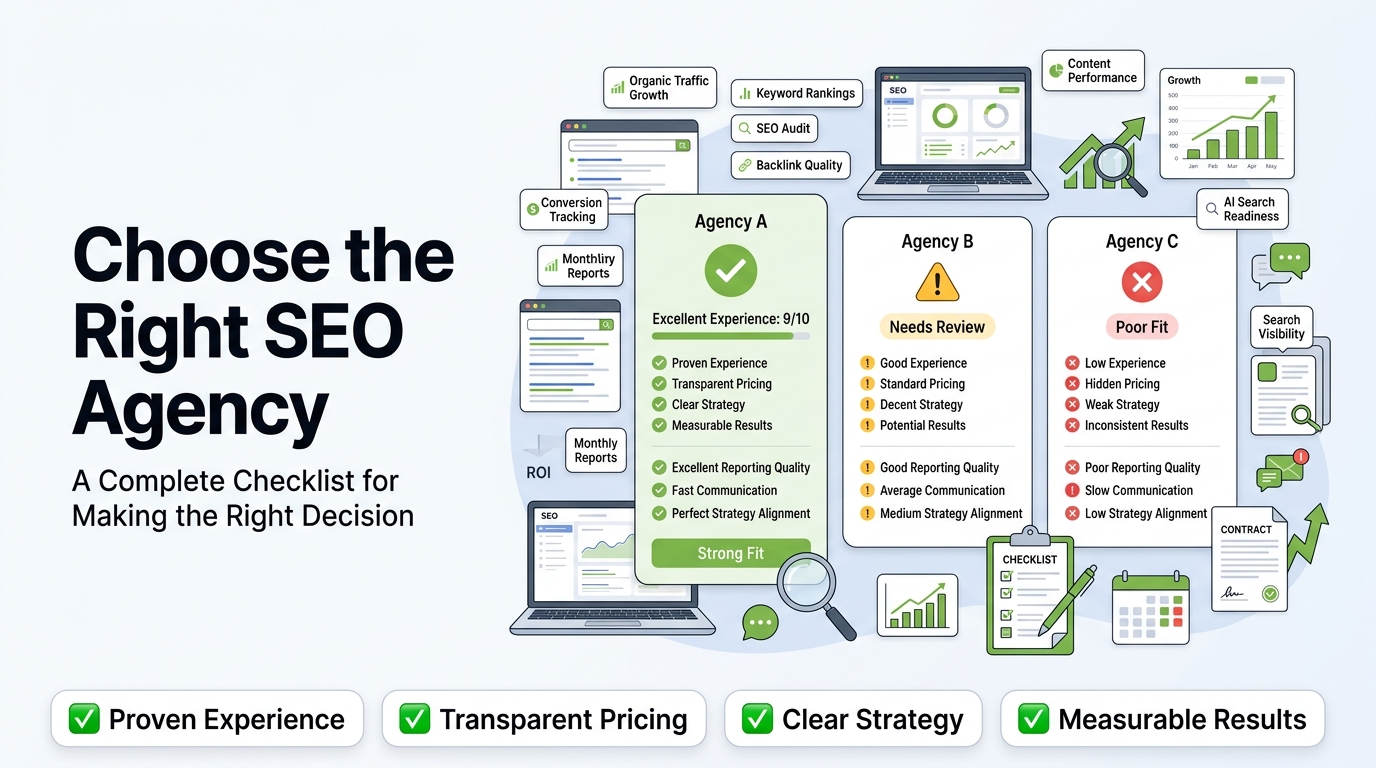
Agency A presents a polished deck with generic case studies from unrelated industries, quotes a single flat monthly price with no itemized breakdown, and promises significant ranking improvements within 30 days. When asked about their approach to Shopify-specific technical issues, the response is vague and generalized.
Agency B provides two recent case studies from comparable ecommerce clients, including specific before-and-after traffic data. Their pricing is broken down by technical audit, ongoing content, and link building, each scoped separately. When asked about Shopify-specific technical work, they describe exactly how they handle app-related script bloat and structured product data, and they're upfront that meaningful ranking movement typically takes three to six months, not thirty days.
Agency B isn't necessarily more expensive, and their pitch may even sound less flashy. But every answer reflects the kind of specific, verifiable substance this checklist is built to surface which is a far stronger predictor of actual results than confidence alone.
Questions to Ask in Your Discovery Call
A condensed list to bring directly into your evaluation conversations:
Can you show me a case study from a business genuinely similar to mine?
What does your technical SEO audit process actually include?
How do you approach [your specific platform Shopify, WordPress, etc.] differently from other platforms?
Who will actually be doing the work on my account?
How do you measure success, and how does that connect to my actual business metrics?
What's included at each pricing tier, specifically?
What are the contract terms, and what happens if I need to cancel?
What's a realistic timeline for meaningful results in my specific industry?
Final Checklist Before You Sign
[ ] Verified relevant case studies for your specific business type
[ ] Clear explanation of their technical SEO audit process
[ ] Platform-specific experience confirmed, if relevant (Shopify, WordPress, etc.)
[ ] Local SEO approach reviewed, if applicable, including multi-location handling
[ ] Content strategy and writing samples reviewed
[ ] Detailed, written scope of work and pricing breakdown obtained
[ ] Reporting approach tied to real business metrics, not just rankings
[ ] Contract terms reviewed, with reasonable cancellation flexibility
[ ] No major red flags present from the list above
How the Right Fit Changes Based on Your Company's Size
The right agency isn't a fixed answer it shifts meaningfully depending on your business's size and internal capacity.
Solo founders and very small businesses typically benefit most from an agency offering seo services for small businesses specifically scoped to a tight budget usually concentrated local SEO and a small, focused set of realistic keywords rather than a sprawling content campaign. Look for agencies comfortable being direct about what a smaller budget can and can't realistically achieve, rather than overpromising to close the deal.
Growing businesses with some internal marketing capacity often do well with a hybrid arrangement handling some execution internally (basic content publishing, review responses) while outsourcing technical audits, structured link building, and strategic guidance. In this scenario, evaluate an agency partly on how well they collaborate with an internal team, not just how independently they can execute alone.
Larger businesses with dedicated marketing departments may need less hand-holding on strategy and more on specialized execution deep technical work, a local seo marketing services program spanning many locations, or advanced content production at scale. Here, evaluate agencies more on their capacity to integrate with existing internal workflows and reporting systems than on basic strategic guidance they may not need.
Being honest with yourself about which category you fall into before you start evaluating agencies makes it considerably easier to filter out proposals that are mismatched to your actual situation, regardless of how polished they look on paper.
What Good Agency Communication Actually Looks Like
Beyond the specific checklist items above, pay attention to how an agency communicates during the sales and onboarding process itself it's often a reliable preview of what working together will actually feel like.
Clear, jargon-free explanations. An agency that can explain complex technical concepts in plain language, without hiding behind acronyms, is usually one that genuinely understands the material rather than reciting it.
Comfortable saying it depends. SEO outcomes genuinely vary by situation, and an agency willing to say so rather than offering the same confident promise to every prospect regardless of their specific circumstances is a stronger signal of honesty than universal confidence.
Willingness to say no. If a request you make is genuinely a bad idea an aggressive tactic carrying real risk, an unrealistic timeline a good agency will tell you directly rather than simply agreeing to keep the sale moving forward.
Responsiveness during evaluation. How quickly and thoroughly an agency answers your questions during the sales process is a reasonable proxy for how responsive they'll be once you're a paying, ongoing client rather than an active prospect.
Final Thoughts
Choosing the right SEO agency comes down to substituting verifiable specifics for confident generalities at every step of the evaluation real case studies instead of testimonials, a described technical process instead of a vague promise, itemized pricing instead of an opaque monthly number. The agencies worth hiring are rarely the ones with the smoothest pitch; they're the ones willing to answer every question on this checklist clearly, specifically, and without pressure to sign before you're genuinely ready.
Frequently Asked Questions
How long should I evaluate an SEO agency before signing a contract?
There's no fixed timeline, but rushing this decision under sales pressure is a mistake. Take the time to request and review case studies, ask detailed questions, and compare at least two or three options before committing.
Should I choose a specialized agency or a full-service one?
It depends on your needs. A specialized agency for a specific platform, industry, or local market often brings deeper expertise in that narrow area, while a full-service agency may be more efficient if you need SEO alongside other coordinated marketing services.
Is it a bad sign if an agency uses white label or reseller arrangements?
Not inherently, but transparency matters. Ask directly who performs the actual work, and evaluate the answer honestly rather than assuming reseller involvement automatically means lower quality.
How much should I expect to pay for a genuinely capable SEO agency?
Pricing varies enormously based on business size, industry competitiveness, and scope of work. Be more skeptical of pricing that seems dramatically below typical market rates than of pricing that seems appropriately scaled to real, described deliverables.
What's a reasonable timeline to expect results?
Most legitimate SEO work shows early movement within three to six months, with more substantial results building over six to twelve months. Any agency promising dramatically faster results for competitive terms deserves closer scrutiny.
Get a free audit and see exactly how this applies to your site.