AI search optimization is the practice of structuring, writing, and technically formatting content so that AI systems Google AI Overviews, Google AI Mode, ChatGPT, Gemini, Perplexity, and similar tools can accurately extract, summarize, and cite it as a source in generated answers. Unlike traditional SEO, which optimizes for a ranked list of blue links, AI search optimization optimizes for extractability: the likelihood that a single self-contained passage, table, or definition gets pulled directly into an AI-generated response. It sits at the intersection of two more specific disciplines Answer Engine Optimization (AEO), which targets direct-answer formats like featured snippets and voice search, and Generative Engine Optimization (GEO), which targets citations inside fully generative AI answers.
Most guides to AI search optimization read like a rebrand of a 2015 SEO checklist with AI pasted on top. Add more keywords, write longer posts, hope Google's crawler notices. That advice is not just outdated it actively hurts you in 2026, because AI Overviews, Google AI Mode, ChatGPT, Perplexity, and Gemini don't rank pages the way a traditional search engine does. They extract, synthesize, and cite fragments of your content, often without a click ever happening.
I've gone through Google's own Search Central documentation, OpenAI and Perplexity's public statements on how their retrieval systems work, and the citation-behavior research that Princeton, Georgia Tech, and the Search Engine Journal team have published on generative engines. What I found doesn't match the just add more keywords advice circulating everywhere else.
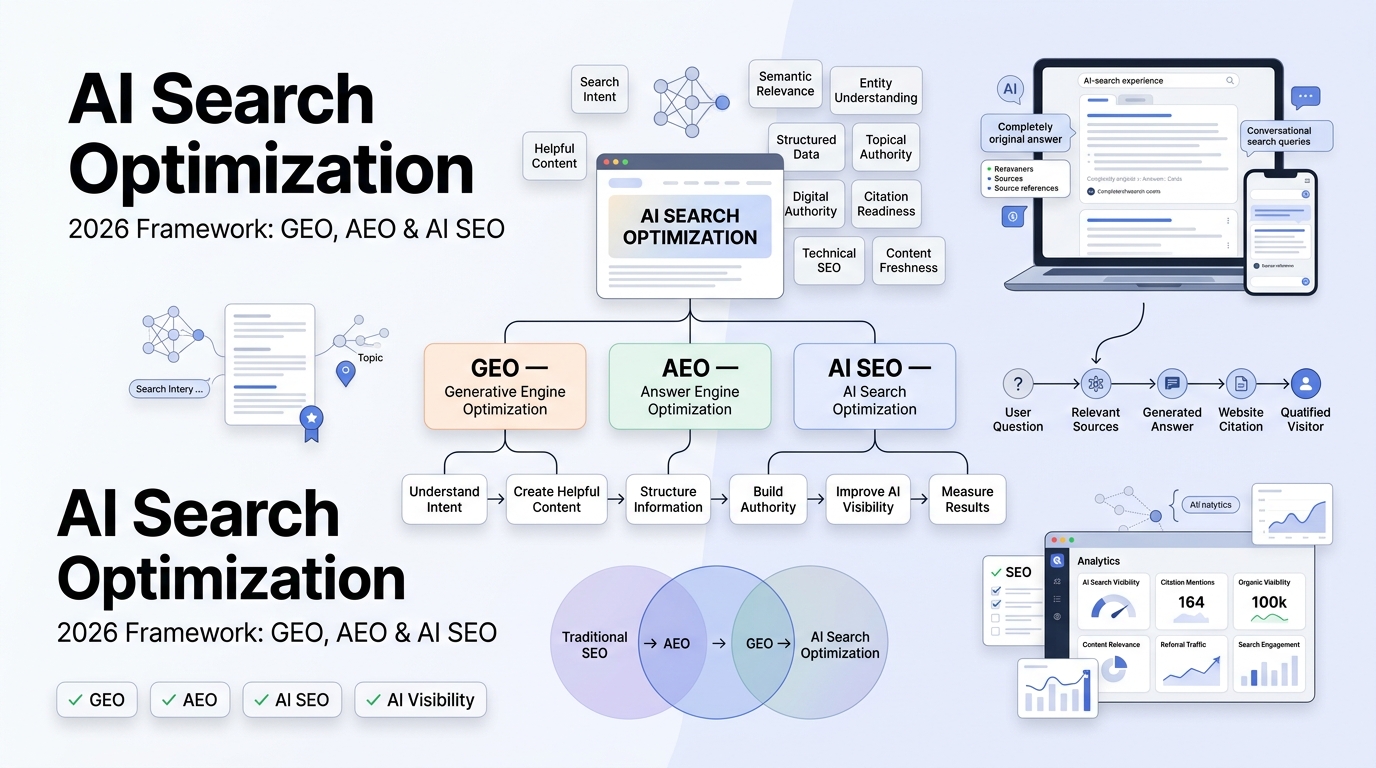
Three Ways Practitioners Define This Discipline
There isn't one universal definition yet, because the field is young and different organizations are approaching it from different angles.
Google's framing (via Search Central): Google has repeatedly stated that AI Overviews and AI Mode use the same core ranking systems as traditional Search, meaning there is no separate AI SEO algorithm to game the priority is still helpful, original, people-first content that satisfies search intent, with AI summarization layered on top of existing ranking signals.
The GEO research framing (Princeton/Georgia Tech GEO paper authors): This academic framing treats generative engine optimization as a measurable, testable discipline the researchers built a benchmark showing that specific content interventions (adding statistics, citing sources, using quotation-friendly structure) measurably increased a page's visibility inside generative AI answers, independent of its traditional search rank.
The industry/practitioner framing (SEO agencies and tools like Ahrefs, Semrush, and Profound): In practice, most SEO practitioners now describe AI search optimization as a hybrid discipline: keep the technical SEO and E-E-A-T fundamentals that already drive traditional rankings, but restructure content into self-contained, quotable blocks short-answer summaries, tables, and FAQs because that's the format generative engines lift most easily.
Each framing is useful for a different reason: Google's tells you the algorithm hasn't fundamentally forked, the academic framing tells you which structural levers actually move the needle, and the practitioner framing tells you how to operationalize both at once.
AEO vs. GEO: The One Distinction That Actually Matters
People use AEO and GEO almost interchangeably, but the structural difference explains nearly everything else people get confused about.
AEO (Answer Engine Optimization) targets discrete-answer surfaces: featured snippets, People Also Ask boxes, voice assistants, and short direct-answer widgets. The output is typically one fact, one definition, or one number, extracted from a single passage.
GEO (Generative Engine Optimization) targets fully generative, multi-source answers: an AI Overview, a ChatGPT response, or a Perplexity summary that synthesizes and cites several sources into one narrative answer. The output is a blended response, and your goal is to be one of the cited sources woven into that synthesis, not the sole answer.
Dimension | AEO (Answer Engine Optimization) | GEO (Generative Engine Optimization) |
Primary surfaces | Featured snippets, voice search, PAA boxes | AI Overviews, Google AI Mode, ChatGPT, Perplexity, Gemini |
Output format | One extracted fact/definition | Synthesized, multi-source narrative |
Content unit that wins | A single self-contained paragraph or list | Statistics, named sources, comparison tables, distinct framings |
Success metric | Snippet/answer-box placement | Citation frequency and brand mention rate inside AI answers |
Competing sources shown | Usually one | Often three to six sources woven together |
The practical takeaway: AEO content should be optimized so one paragraph works completely alone. GEO content should be optimized so multiple distinct, well-sourced sections each have an independent shot at being one of several sources cited in a synthesized answer.
What Makes Content Genuinely Citable
Across the Google documentation and the GEO benchmark research, four traits show up again and again as what separates content that gets cited from content that gets ignored.
Self-contained extractability. A passage that requires the surrounding paragraphs to make sense won't survive being lifted out of context, which is exactly what an AI system does when it quotes you.
Named, checkable attribution. Google's own guidance on E-E-A-T (Experience, Expertise, Authoritativeness, Trust) emphasizes that content backed by identifiable expertise and verifiable sourcing is treated as more trustworthy, and the GEO benchmark research found that adding cited statistics and quotations was one of the highest-impact interventions for generative visibility.
Structural clarity. Headers phrased as actual questions, markdown tables, and numbered lists are easier for a retrieval system to parse and excerpt cleanly than long unstructured prose blocks.
Freshness and specificity. Vague claims (many businesses, recent studies show) get deprioritized in favor of content carrying specific numbers, dates, and named sources, because generative systems are explicitly trying to reduce hallucination risk by grounding answers in verifiable specifics.
The Process: Turning a Page Into an AI-Citable Asset
Audit for extractability. Go through your existing top pages and identify which paragraphs could stand alone if quoted with zero surrounding context. If none can, that's your first fix.
Add a short-answer block near the top. Directly under your intro, add a clearly labeled 2-4 sentence answer to the page's core question, written to work as a standalone quote.
Convert comparisons into tables. Anywhere you're contrasting two things in prose, add a markdown comparison table alongside it; tables are disproportionately favored in AI Overview citations.
Attribute every statistic. Replace studies show with the actual named source, publication, and year wherever possible.
Build a real FAQ section. Write it in the language people actually search or speak, not keyword-stuffed phrasing, since voice and conversational AI queries increasingly mirror natural speech.
Monitor citations, not just rankings. Track brand mentions inside ChatGPT, Perplexity, and AI Overviews using tools built for this (Profound, Otterly, or manual prompt-testing) rather than relying solely on traditional rank trackers.
Repeat the audit quarterly. Generative engines re-crawl and re-synthesize frequently, so a page that was citable six months ago may have been displaced by fresher, better-sourced competitors.
This process connects naturally into deeper technical SEO work: crawlability, schema markup, and site speed since none of the above matters if the AI system's crawler can't access or parse the page in the first place.
The Data: What's Actually Happening in AI Search Right Now
Growth in AI-referred traffic has been substantial but from a small base: Adobe Analytics reported that traffic to U.S. retail sites from generative AI sources grew triple digits year-over-year during the 2025 holiday season, even though it still represented a small single-digit share of total site traffic. Similarly, BrightEdge and Similarweb data through 2025 and into 2026 has repeatedly shown AI-referred traffic as a fast-growing but still minority channel compared to traditional organic search.
The myth-busting section: The statistic that gets repeated constantly AI search is replacing Google is misleading. Google itself has stated that Search usage, including queries, has continued to grow overall since the rollout of AI Overviews, and third-party measurement firms have generally found that AI Overviews tend to sit on top of traditional results rather than eliminating clicks outright, though click-through rates on specific queries with an AI Overview present are measurably lower than on queries without one. The more accurate framing: AI search isn't replacing traditional search traffic wholesale it's compressing clicks on informational queries while traditional and AI search increasingly run in parallel, which is why brand visibility inside the AI-generated answer itself (a citation, not a click) is becoming a KPI in its own right.
When Does Something Stop Being AI Search Optimization?
This boundary trips people up because the term gets applied too broadly.
Clearly AI search optimization: Restructuring a comparison guide with tables, named sources, and a standalone answer block specifically so ChatGPT and AI Overviews can cite it accurately that's squarely GEO/AEO work.
Clearly not AI search optimization: Simply stuffing AI into a page title without changing structure, sourcing, or extractability is just old-style keyword optimization wearing a new label it doesn't change how citable the content actually is.
The borderline case: Technical SEO work like improving Core Web Vitals or fixing crawl errors sits in a gray zone it's foundational to being indexed and citable at all, but it's not itself an AI-specific tactic, since it improves both traditional rankings and AI visibility simultaneously.
conclusion
At its core, AI search optimization means writing for extraction and citation, not just for ranking that single shift in intent changes almost every structural decision you make on a page. If you're just starting, audit your highest-traffic pages for standalone extractability first; if you're further along, shift your measurement from rank position to citation frequency across AI Overviews, ChatGPT, and Gemini.
If you'd rather not run that audit yourself, this is exactly the kind of work a good agency should already be doing alongside your core SEO program. When people search for the best SEO company in USA, what they're really looking for is a team that treats AI search visibility as part of the same strategy as everything else not a separate add-on. Strong providers combine small business SEO services with full-scale SEO marketing services, offer white label SEO services for agencies that want to resell without building an in-house team, and run dedicated B2B SEO services for companies selling into other businesses. The best of them build long-term rankings through organic SEO services, back that up with platform-specific work like Shopify SEO services and WordPress SEO services, and extend it globally with international SEO services for multi-market brands. Because content is the foundation of AI citation and traditional ranking alike, look for a provider that pairs strategy with real SEO content writing services and SEO copywriting services, usually delivered as predictable monthly SEO services rather than one-off projects. In short, the right organic SEO services company one offering genuine SEO services for small businesses as well as enterprise-level programs is the one already building AI search visibility into everything they do, not treating it as an afterthought.
FAQ:
What is AI search optimization?
AI search optimization is structuring content so AI systems like Google AI Overviews, ChatGPT, and Gemini can accurately extract and cite it in generated answers, rather than optimizing purely for a ranked list of links.
Is GEO the same thing as SEO?
No GEO builds on top of SEO fundamentals (crawlability, authority, relevance) but adds specific structural requirements, like self-contained answer blocks and named sourcing, aimed at generative AI citation rather than link-ranking alone.
Does Google AI Mode use a different ranking algorithm than regular Search?
No, according to Google's own documentation, AI Mode and AI Overviews draw on the same underlying Search ranking systems, with a generative layer added to summarize and synthesize the retrieved results.
How do I know if ChatGPT or Perplexity is citing my site?
You can manually test relevant prompts in each tool and check the cited sources, or use AI-visibility tracking tools such as Profound or Otterly that monitor brand mentions across generative AI answers at scale.
Do FAQ sections actually help with AI citations?
Yes FAQs written in natural, self-contained language are one of the easiest content formats for AI systems to lift directly, because each answer already stands alone without needing surrounding context.
Will AI Overviews kill my organic traffic?
Not entirely; data through 2025 and 2026 shows AI Overviews reduce click-through rates on some informational queries while overall Search query volume has kept growing, so the more accurate concern is a shift in where visibility comes from, not a total loss of traffic.
What's the difference between AEO and traditional SEO?
Traditional SEO optimizes for ranking a full page in a list of results; AEO optimizes a specific passage or answer to be extracted and shown directly, often without the user clicking through at all.
Should small businesses care about AI search optimization yet?
Yes, especially in comparison and best of categories, since generative engines frequently cite smaller, well-sourced, specific sites over larger sites with vaguer, less-structured content on the same topic.
Get a free audit and see exactly how this applies to your site.