Every few months, a new AI tool launches promising to automate SEO entirely generate content, build strategy, fix technical issues, and produce rankings without needing a human specialist involved at all. It's a compelling pitch, especially for small businesses watching every marketing dollar closely. But the honest answer to whether AI can actually replace SEO experts is more nuanced than either the breathless AI hype or the reflexive AI will never replace real strategists defensiveness that often dominates this conversation.
This is a genuine, balanced look at what AI tools are actually good at in SEO today, where human expertise still clearly matters, and what the realistic relationship between the two looks like not the version either AI vendors or worried SEO professionals might prefer you to believe.
The Short Answer
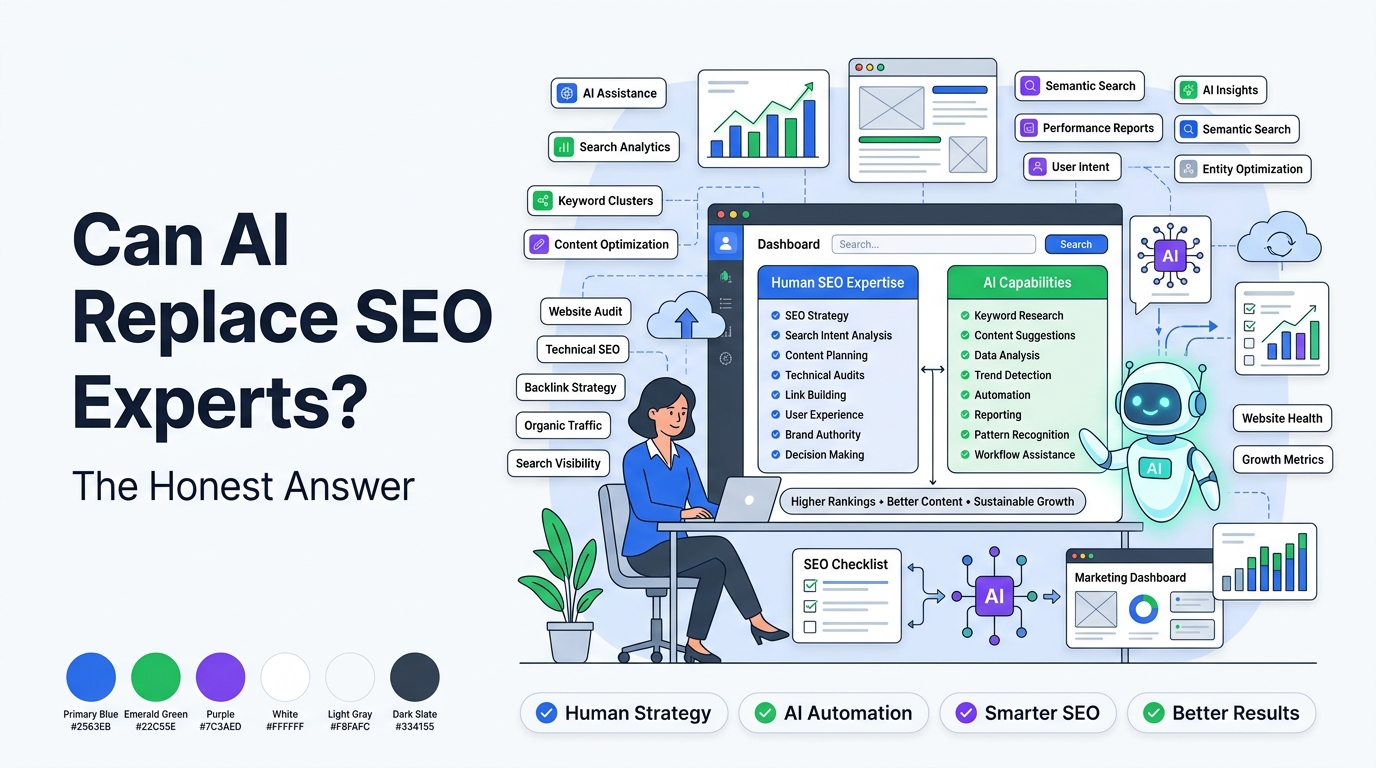
No, AI cannot fully replace experienced SEO experts today but it has genuinely automated large parts of the work SEO professionals used to do manually, and that shift is real, significant, and still accelerating. The more accurate framing isn't AI versus SEO experts it's how SEO expertise itself is changing shape around what AI now handles well.
What AI Is Genuinely Good At in SEO Today
It's worth being honest about this first, since dismissing AI's real capabilities doesn't serve anyone. Several parts of SEO work have been meaningfully transformed by AI tools.
Keyword research and clustering
AI-powered tools can process enormous keyword datasets, group related terms into topic clusters, and surface search intent patterns far faster than manual research ever could. What used to take a researcher days of spreadsheet work can now be substantially accelerated, though the strategic judgment about which clusters actually matter for a specific business still benefits from human context.
Content drafting and outlining
AI writing tools can produce solid first-draft content, generate outlines based on top-ranking competitors, and identify content gaps at scale. This has genuinely changed content production timelines, particularly for straightforward, informational content that doesn't require deep original insight or firsthand experience.
Technical audits at scale
AI-assisted crawling and auditing tools can flag broken links, duplicate content, missing meta tags, and site speed issues across thousands of pages far faster than manual review. Pattern detection across large sites is one of the areas where automated tools clearly outperform manual human review on speed alone.
Data analysis and reporting
Pulling insights out of large analytics datasets, spotting ranking fluctuations, and generating client-facing reports has become substantially faster with AI assistance, freeing up time that used to go into manual spreadsheet work.
Repetitive optimization tasks
Generating meta descriptions at scale, suggesting internal linking opportunities, or flagging thin content across a large site are exactly the kind of repetitive, pattern-based tasks AI tools handle efficiently and reliably.
Where Human SEO Expertise Still Clearly Matters
This is where the honest answer gets more interesting, because the gap isn't about AI being not smart enough yet it's about categories of judgment that depend on context AI tools simply don't have access to, or business risk that requires human accountability.
Understanding genuine business context
An AI tool doesn't know your specific competitive landscape, your sales team's actual objections from real customer conversations, your margins on different product lines, or which keywords would bring in traffic that never converts. A human strategist synthesizes this kind of business-specific context into a strategy in a way current AI tools can't independently do, because that information often doesn't exist anywhere for a model to learn from.
Judgment calls with real risk attached
Deciding whether to pursue an aggressive link-building campaign, how to handle a Google algorithm update that's tanked traffic overnight, or whether a particular technical change is worth the development resources it requires these are judgment calls with real financial and reputational consequences. AI tools can inform these decisions with data, but the accountability for getting them right still sits with a human who understands the specific stakes involved.
Genuine expertise and firsthand experience
Google's own guidance around content quality explicitly values firsthand experience and demonstrated expertise the kind of content a genuine practitioner writes based on things they've actually done, tested, or lived through. AI-generated content, by its nature, synthesizes existing information rather than contributing new, firsthand experience, which is precisely the kind of content quality signal that's become more valuable, not less, as AI-generated content has become more common across the web.
Relationship-driven work
Digital PR, genuine link building through real relationships, and negotiating placements with journalists and other site owners remain fundamentally human activities. AI can help identify opportunities and draft outreach, but the actual relationship-building that earns high-quality backlinks still depends on real trust built between people.
Adapting strategy to genuinely novel situations
AI tools are trained on patterns from existing data. When something genuinely new happens a fresh algorithm update with unclear effects, an unprecedented competitive move, a business pivot into an entirely new market human strategists can reason through unprecedented situations in ways that pattern-matching tools, by definition, handle less reliably.
Client and stakeholder communication
Explaining why SEO results take months to materialize, managing expectations after a difficult quarter, or translating technical findings into terms a non-technical business owner can act on requires the kind of nuanced, empathetic communication that remains a genuinely human skill.
The Real Shift: What SEO Expertise Looks Like Now
Rather than AI replacing SEO experts, what's actually happening is a redistribution of where human effort goes. The SEO professionals thriving right now aren't the ones refusing to use AI tools they're the ones who've shifted their time away from repetitive, mechanical tasks and toward the judgment-heavy work AI genuinely can't do well.
This looks like:
Less time on manual keyword list-building, more time on strategic prioritization of which keywords actually matter for revenue
Less time writing every first draft from scratch, more time editing, fact-checking, and injecting genuine expertise and firsthand experience into AI-assisted drafts
Less time manually auditing every page for technical issues, more time deciding which of the flagged issues are actually worth fixing given limited development resources
Less time on repetitive reporting, more time on the strategic conversation about what the data actually means for the business
This isn't a smaller job for skilled practitioners, it's often a more valuable one, since the work concentrated is precisely the work that's hardest to automate and therefore commands the most value.
Where Over-Reliance on AI Creates Real Risk
It's worth being direct about the failure modes businesses run into when they lean too heavily on AI without human oversight.
Generic, undifferentiated content
AI-generated content, produced without meaningful human input, tends to converge toward similar phrasing and structure across many different sites covering the same topic. This creates content that's technically competent but fails to differentiate a business from its competitors and increasingly, search engines and AI systems themselves appear to weigh genuine differentiation and firsthand expertise more heavily as a quality signal.
Missed nuance in technical decisions
An AI audit tool might flag a technical issue that's actually an intentional design decision, or miss a genuinely urgent problem buried among hundreds of lower-priority flags, because it lacks the contextual judgment to properly triage findings the way an experienced technical SEO professional would.
Strategic blind spots
AI tools are excellent at optimizing within an existing framework but less reliable at recognizing when the framework itself needs to change for instance, recognizing that a business's entire keyword strategy is misaligned with genuine buyer intent, something that often requires stepping back and questioning assumptions rather than optimizing within them.
Accountability gaps
When an AI-driven decision goes wrong a content strategy that tanks engagement, a technical change that breaks something critical someone still needs to own that outcome, diagnose what happened, and course-correct. AI tools don't carry accountability; the humans deploying them do.
A Practical Framework: What to Automate vs. What to Keep Human
A useful way to think about this for your own business or SEO practice:
Good candidates for AI automation:
Initial keyword research and clustering
First-draft content generation, especially for high-volume, straightforward content needs
Large-scale technical audits and pattern detection
Meta description generation at scale
Data aggregation and initial reporting
Better kept substantially human-led:
Overall strategic direction and prioritization
Content requiring genuine firsthand expertise or experience
High-stakes technical decisions with real business risk
Link building and digital PR relationship work
Client communication and expectation management
Interpreting what data actually means for business decisions, not just what the data shows
Most successful modern SEO work blends both AI accelerating the mechanical layers, humans owning the judgment layers.
What This Means If You're Hiring SEO Help
If you're evaluating an SEO provider, it's worth asking directly how they use AI in their process, since the honest answer reveals a lot about what you're actually paying for.
A provider dismissing AI entirely may be doing unnecessarily slow, expensive manual work for tasks AI genuinely handles well now you may be paying premium rates for work that's become commoditized.
A provider relying almost entirely on AI with minimal human oversight risks producing generic content and missing the strategic judgment that justifies hiring outside expertise in the first place.
A provider that's transparent about which parts of their process use AI, and why humans remain involved in the judgment-heavy parts, is generally the strongest signal of a genuinely thoughtful, current approach treating AI as a tool that changes how the work gets done, not as a replacement for the expertise behind it.
What This Means If You're an SEO Professional
For practitioners genuinely worried about AI's impact on the field, the more useful question isn't will I be replaced it's which parts of what I currently do are becoming commoditized, and am I building skill in the parts that aren't.
The specialists most at risk are those whose value was concentrated almost entirely in mechanical, repeatable tasks high-volume keyword research, formulaic content production, routine technical checks since these are precisely the tasks AI tools now handle at a fraction of the time cost. The specialists building genuine long-term value are investing in strategic thinking, real subject-matter expertise, client relationship management, and the judgment calls that come from years of pattern recognition across genuinely novel situations the things that remain stubbornly hard to automate, not because AI is incapable of ever approaching them, but because they depend on context, accountability, and trust that current tools simply don't have access to.
The Economics Behind This Shift
It's worth understanding why this transition is happening as fast as it is, because the economics explain a lot about where things are heading.
Mechanical SEO tasks the kind AI now handles well were always priced partly based on the time they consumed. A comprehensive technical audit of a large site used to take days of manual review; an AI-assisted version can flag the same categories of issues in a fraction of that time. Content production followed a similar pattern: a well-researched, well-outlined article used to represent hours of a writer's time before a single word of the final draft existed.
As those time costs collapse, so does the price businesses reasonably pay for that layer of work alone. This is genuinely disruptive for SEO providers whose business model depended heavily on billing for volume of mechanical output rather than depth of strategic judgment. It's also, in a sense, healthy for the industry it pushes pricing and positioning toward the parts of the work that are actually hard to replicate, rather than rewarding whoever could produce the most keyword research spreadsheets or blog drafts in a week.
Contentiris For businesses hiring SEO help, this economic shift is worth factoring into how you evaluate cost. A provider whose pricing still implicitly reflects the old time-cost of purely mechanical work, without a clear justification for what strategic value sits on top of it, may simply be behind the market adjustment that's already well underway among more current, competitive providers.
Real-World Patterns: Where This Plays Out in Practice
A few concrete patterns illustrate how this AI-and-human blend actually shows up in day-to-day SEO work.
A content team publishing a comparison article might use AI to generate an initial outline and first draft based on top-ranking competitor content, then have a genuine subject-matter expert review it, correct inaccuracies, add firsthand insight the AI couldn't have known, and reshape sections that read as generic. The final published piece is faster to produce than a fully manual process, but the parts readers and search engines respond to most the genuinely useful, specific insight still came from a human.
A technical SEO audit on a large ecommerce site might rely on automated crawling tools to flag thousands of potential issues across a huge product catalog, but a human specialist still needs to triage that list recognizing which flagged duplicate content issues are actually intentional product variant pages, which broken links represent genuinely lost revenue versus minor inconvenience, and which fixes are worth the engineering time required against everything else competing for that same development resource.
A local business owner using an AI SEO tool directly, without any human oversight, might get reasonably solid baseline recommendations but is unlikely to get the judgment call about whether an aggressive local link-building campaign carries reputational risk specific to their community, or whether their actual customer conversations reveal search intent the keyword tool's generic data doesn't capture.
In each case, AI isn't absent it's doing real, substantial work. But the outcome that actually performs well still depends on a human applying judgment somewhere in the process, usually at exactly the point where genuine business context or accountability matters most.
A Quick Self-Assessment: How Much Human Oversight Does Your SEO Actually Need?
If you're trying to decide how much to lean on AI tools directly versus bringing in human expertise, a few honest questions help calibrate the decision:
How competitive is your market? Low-competition niches often tolerate more AI-driven, less refined execution than genuinely crowded, high-stakes industries where every advantage matters.
How much does a wrong strategic call actually cost you? A small local business testing a new blog topic risks little if it underperforms. A larger company making a major technical change to a revenue-critical site carries real downside if that judgment call goes wrong.
Do you have anyone who can catch AI's mistakes? AI tools are confident even when wrong. If nobody on your team or with your provider has the expertise to catch an inaccurate claim, a poorly prioritized technical fix, or generic content that undersells your actual expertise, the risk of AI-driven mistakes compounds unnoticed.
Is your content meant to demonstrate real expertise? If your business depends on being seen as a genuine authority professional services, healthcare-adjacent fields, specialized technical products content lacking authentic, firsthand expertise tends to undermine exactly the trust you're trying to build, regardless of how technically competent the writing is.
The more these factors point toward higher stakes and genuine differentiation, the more human oversight is worth investing in, even while using AI to accelerate the mechanical layers underneath that oversight.
Final Thoughts
The honest answer to can AI replace SEO experts is that it already has, for a meaningful slice of the work and it hasn't, and likely won't anytime soon, for the parts that depend on genuine judgment, accountability, and expertise built from real experience. The businesses and professionals navigating this well aren't the ones picking a side in an AI-versus-humans framing they're the ones honestly assessing which parts of SEO work benefit from automation and which parts still need a person who actually understands the business, carries real accountability, and brings genuine expertise no model can fully substitute for yet.
Frequently Asked Questions
Will AI eventually be able to fully replace SEO experts?
It's genuinely uncertain how far AI capabilities will advance, but even optimistic projections suggest the accountability, business-context judgment, and genuine expertise components of SEO work will remain difficult to fully automate for the foreseeable future, even as more mechanical tasks continue to be automated.
Should small businesses just use AI tools instead of hiring an SEO expert?
For very small, simple needs, AI tools alone may be sufficient. As competitive complexity, technical requirements, or strategic stakes increase, the judgment and accountability a human expert provides becomes increasingly valuable relative to AI alone.
Is AI-generated content bad for SEO?
Not inherently the quality and genuine value of the content matters more than whether AI was involved in producing it. Content that's generic, inaccurate, or lacks genuine expertise performs poorly regardless of whether a human or AI wrote the first draft; the same is true of high-quality, well-edited content.
How can I tell if an SEO agency is over-relying on AI?
Ask specifically how they handle content review, strategic decision-making, and technical prioritization. Vague answers, or content that reads as generic and interchangeable with countless other sites on the same topic, are signs of over-reliance without sufficient human oversight.
What SEO skills are becoming more valuable, not less, because of AI?
Genuine subject-matter expertise, strategic judgment under uncertainty, relationship-based link building, and the ability to translate data into business decisions are all becoming more valuable, precisely because they're the parts of SEO work AI tools still handle least reliably.
Get a free audit and see exactly how this applies to your site.