Running an online store today means competing against millions of other product listings, marketplace giants with near-unlimited ad budgets, and search results increasingly dominated by shopping carousels and sponsored placements. In that environment, organic search might seem like an afterthought compared to paid ads but it's actually one of the few channels where a well-optimized store keeps generating revenue long after the initial investment, without paying per click for every single sale.
That's the real value of dedicated seo services for ecommerce: turning your product catalog, category structure, and content into an asset that search engines trust and reward, rather than a static digital storefront waiting for paid traffic to find it. This guide covers what ecommerce SEO actually involves, the platform-specific challenges that trip up most online stores, and how to build a strategy that increases both traffic and, more importantly, actual sales.
Why Ecommerce SEO Is Different From Standard SEO
A blog or a service-based business website has a relatively small number of important pages to optimize. An online store might have hundreds or thousands of product pages, each with its own competition, search intent, and conversion path and that scale changes everything about how SEO needs to be approached.
Ecommerce sites face challenges most other websites never encounter: faceted navigation generating thousands of near-duplicate filtered URLs, seasonal inventory that comes and goes, product descriptions that risk being flagged as duplicate content when pulled from manufacturer feeds, and the constant tension between showing enough products to convert browsers while keeping page load times fast enough to satisfy both users and search engines. A generic organic seo services approach built for a five-page brochure site simply doesn't account for any of this.
Platform-Specific Ecommerce SEO: Shopify vs. WordPress/WooCommerce
Where your store is built matters enormously for what SEO work actually needs to happen.
Shopify SEO
Shopify seo services need to work within the platform's specific constraints. Shopify handles a lot of the technical basics well out of the box clean code, decent default site speed, automatic sitemap generation but it also creates predictable problems: heavy app usage slowing down page load times, limited native control over certain URL structures, and duplicate content risk from collection pages generated by filtering and sorting options. A Shopify-focused SEO strategy typically involves auditing installed apps for performance impact, cleaning up collection URL structures, and making sure structured data for products (pricing, availability, reviews) is implemented correctly, since Shopify doesn't always handle this natively across every theme.
WordPress/WooCommerce SEO
Wordpress seo services for ecommerce stores built on WooCommerce face a different set of issues. WordPress offers far more flexibility and control, but that flexibility comes with risk poorly coded themes, conflicting plugins, and page builders that generate bloated code are common culprits behind slow load times. WooCommerce's default category and tag taxonomy can also spiral into duplicate or thin content if not managed carefully, since it's easy to end up with multiple URLs targeting nearly identical search intent. A solid WordPress ecommerce SEO strategy usually starts with a plugin and theme audit, followed by cleaning up taxonomy structure and confirming schema markup is correctly implemented for every product.
Neither platform is inherently better for SEO both can perform exceptionally well with the right technical foundation, and both can underperform badly if left unmanaged.
Product Page Optimization: Where Traffic Meets Revenue
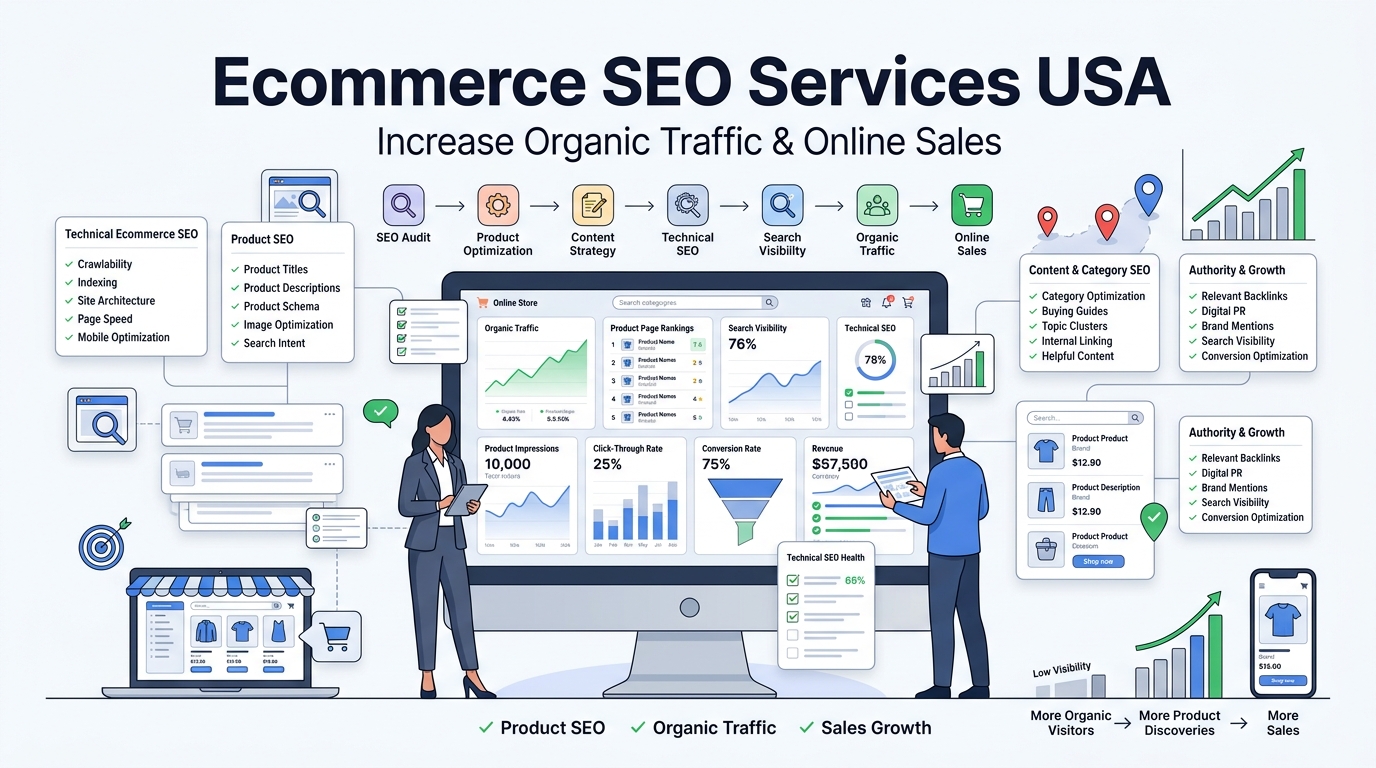
Product pages are the single most important asset in ecommerce SEO, since they're where organic traffic actually converts into sales. A few fundamentals separate high-performing product pages from ones that quietly underperform:
Unique, detailed descriptions. Manufacturer-supplied copy used verbatim across dozens of competing stores creates duplicate content issues and gives search engines no reason to favor your page over a competitor's. Original, detailed descriptions covering materials, sizing, use cases, and genuine selling points perform significantly better.
Structured data markup. Schema for price, availability, and review ratings allows product pages to display rich results directly in search listings star ratings and pricing shown right in the search results meaningfully improve click-through rates.
Optimized images. Compressed, properly named, and alt-tagged product images support both page speed and image search visibility, which is an often-overlooked traffic source for ecommerce.
Clear internal linking. Related products, customers also bought modules, and links from relevant blog content all help distribute authority across the catalog rather than concentrating it on just the homepage.
Genuine trust signals. Reviews, return policy clarity, and shipping information reduce bounce rate and support conversion once traffic actually lands on the page.
Category Page Strategy
Category pages often get less attention than product pages, but they're frequently what captures higher-volume, broader search terms running shoes ranks a category page, while Nike Air Zoom Pegasus 41 men's size 10 ranks a specific product. Strong category pages include a genuine intro paragraph explaining the category (not just a product grid), clear filtering that doesn't generate infinite duplicate URLs, and internal links guiding users toward best-sellers or featured products within that category.
Content Marketing for Ecommerce Stores
Product and category pages alone rarely capture top-of-funnel search demand searches like how to choose running shoes for flat feet or best gift ideas for new parents happen before someone has decided exactly what to buy. This is where dedicated seo content writing services and seo content services come in, producing buying guides, comparison articles, and gift guides that capture that earlier-stage search intent and funnel readers toward relevant product and category pages through internal linking.
Separately, seo copywriting services focus specifically on the conversion-oriented writing found directly on product and landing pages headlines, value propositions, and persuasive copy designed to turn a visitor who's already interested into an actual buyer. The strongest ecommerce content strategies use both together: content marketing to attract traffic, copywriting to convert it.
The Local Dimension of Ecommerce SEO
Not every online store is purely digital many ecommerce businesses also operate a physical showroom, warehouse pickup option, or brick-and-mortar location alongside their online store. For these hybrid businesses, local seo services become just as important as broader ecommerce optimization. A store offering local pickup, for example, benefits significantly from Google Business Profile optimization, local citation consistency, and location-specific landing pages the same fundamentals covered under local seo marketing services for any local business.
This applies across industries. A dental seo services client selling teeth-whitening or oral care products directly through an ecommerce store alongside their practice needs both ecommerce optimization for the product catalog and traditional local SEO for the practice itself two distinct strategies working together under one brand.
Businesses searching for local seo services near me or comparing best local seo services providers for their physical location should specifically confirm the agency also understands ecommerce fundamentals if online sales are part of the business model the two disciplines overlap but aren't identical, and a purely local-focused agency may not have deep ecommerce platform experience.
Scaling Ecommerce SEO Across Regions
Businesses shipping and marketing beyond their home state or internationally face additional complexity. Regional demand varies significantly: a store with warehouse operations or heavy customer concentration in local seo services florida or local seo services los angeles benefits from location-aware content and shipping-time messaging tailored to those regions, even without a physical retail presence there.
For stores expanding into international markets entirely, international seo services become essential hreflang implementation for multi-language or multi-currency versions of the site, localized keyword research (since search behavior and terminology vary by country even within the same language), and avoiding duplicate content penalties across regional site versions. Simply translating a US-based catalog word-for-word rarely performs as well as content genuinely adapted for how customers in each target market actually search and buy.
Ecommerce SEO for Small Businesses
Independent online stores and small ecommerce brands often can't compete head-on with large retailers across thousands of keywords, and they shouldn't try to. Seo services for small businesses in the ecommerce space typically prioritize a focused set of achievable keyword opportunities, a smaller but highly optimized product catalog, and content that builds a specific niche authority rather than attempting broad category dominance from day one. This focused approach often outperforms scattered efforts across too many keywords with too little content depth behind each one.
Building a Sustainable, Long-Term Strategy
Ecommerce inventory changes constantly new products launch, seasonal items rotate out, and pricing updates regularly. This makes ecommerce SEO fundamentally an ongoing discipline rather than a one-time project, which is why most stores work with providers offering monthly seo services rather than a single audit-and-walk-away engagement.
A genuine organic seo services company managing an ecommerce account on a monthly basis typically handles: monitoring for new duplicate content issues as filters and collections change, refreshing underperforming product descriptions, building fresh content around emerging search trends and seasonal demand, and continuously auditing technical health as the site itself evolves with new apps, themes, or plugin updates.
For Agencies: Reselling Ecommerce SEO
Web design agencies and marketing consultants managing ecommerce clients without deep in-house SEO expertise increasingly turn to seo reseller services and white label local seo services to fill that gap. This lets an agency offer full-service ecommerce SEO from technical audits to ongoing content and local optimization under their own brand, backed by specialists who handle the execution. A reliable local seo service company offering white-label ecommerce work should be comfortable with both major platforms (Shopify and WordPress/WooCommerce), provide fully brandable reporting, and communicate clearly enough that the reselling agency can confidently represent the work to their own clients.
Measuring What Actually Matters: Traffic Isn't the Goal, Sales Are
It's easy for ecommerce SEO reporting to focus heavily on traffic and keyword rankings while losing sight of the actual business goal revenue. When evaluating results from any local seo service or broader ecommerce SEO engagement, insist on metrics tied directly to sales performance:
Organic revenue, not just organic sessions traffic that doesn't convert isn't meaningfully valuable regardless of volume.
Conversion rate by landing page, identifying which product and category pages are turning visitors into buyers versus which ones are attracting traffic without converting it.
Average order value from organic traffic, since some content strategies attract higher-intent, higher-spending customers than others.
Product-level ranking movement for genuinely high-value search terms, not just easy, low-competition phrases that look good in a report but drive minimal revenue.
Return customer rate from organic channels, since strong content and product experience often drives repeat purchases beyond the first sale.
Why Nationwide Reach Still Needs Regional Nuance
Even ecommerce brands with no physical storefront often discover that demand isn't evenly distributed across the country. Shipping speed expectations, seasonal buying patterns, and even product preferences can vary meaningfully by region. A store optimizing broadly for local seo services usa visibility without accounting for these regional differences risks treating a genuinely national audience as one uniform group when, in practice, messaging around delivery times, regional promotions, or climate-specific product recommendations can meaningfully improve both rankings and conversion in specific markets. This doesn't mean building out local landing pages the way a service-area business would, but it does mean paying attention to where your actual customer concentration lies and adjusting content, shipping messaging, and even seasonal campaigns accordingly.
Keyword Research for Ecommerce: Beyond the Obvious Product Terms
Most ecommerce keyword strategies start and stop at direct product terms leather wallet, running shoes, coffee maker. These matter, but they're also the most competitive, highest cost-per-click terms in most industries, and organic ranking for the broadest versions of these phrases often takes considerable time and authority to achieve. A more effective approach layers in several tiers of keyword intent:
Transactional, product-specific terms highly specific searches like a particular model, size, or feature combination, where competition is lower and buying intent is highest.
Comparison and research terms searches like X vs Y or best [product] for [use case], which capture shoppers actively deciding between options rather than already knowing exactly what they want.
Problem-aware terms searches describing a need rather than a product, such as how to stop shoes from smelling rather than odor-eliminating insoles, which can be captured through blog and guide content that naturally links back to relevant products.
Brand and comparison-to-competitor terms searches including your brand name alongside a competitor's, which often convert exceptionally well since the searcher already has strong purchase intent and is doing final due diligence.
Building content and product optimization around this full range, rather than exclusively chasing the highest-volume product terms, tends to produce more consistent, compounding traffic growth especially for smaller stores that can't yet compete for the most contested head terms.
What to Look for in an Ecommerce SEO Provider
Given how much platform-specific and industry-specific nuance ecommerce SEO involves, evaluate potential providers carefully:
Direct experience with your specific platform (Shopify, WooCommerce, Magento, BigCommerce)
Real case studies showing revenue impact, not just traffic or ranking improvements
A clear process for handling product catalog changes without breaking existing SEO equity
Transparent local seo services pricing or ecommerce package pricing, broken down by deliverable rather than a vague flat monthly fee
Willingness to work alongside your existing content, design, or development team rather than requiring a full platform migration
If budget is limited, affordable local seo services or entry-level ecommerce packages can still deliver real value just confirm the scope realistically matches what's achievable within that budget, since a comprehensive thousand-product catalog audit genuinely requires more time than a smaller boutique store's catalog.
Common Ecommerce SEO Mistakes That Quietly Cap Growth
Even well-intentioned stores make recurring mistakes that limit organic performance long before anyone notices the pattern:
Copying manufacturer descriptions across every product. This is one of the most common and most damaging habits in ecommerce, creating duplicate content across potentially hundreds of pages and giving search engines no reason to favor your listing over a competitor's identical copy.
Letting faceted navigation run unchecked. Filter combinations (size, color, price range) can generate thousands of near-duplicate URLs if left unmanaged, diluting crawl budget and confusing which version of a category page should actually rank.
Discontinuing products without proper redirects. Deleting a product page outright instead of redirecting it to a relevant category or replacement product wastes any accumulated ranking value and creates a poor user experience for anyone who finds the old link.
Neglecting mobile experience. The majority of ecommerce traffic now happens on mobile devices, and slow, clunky mobile checkout flows directly suppress both rankings and conversion rates simultaneously.
Treating SEO and paid ads as separate strategies. The keyword and content insights from paid search performance often reveal genuinely valuable organic opportunities, and vice versa siloing the two teams wastes data that could inform both channels.
Avoiding these patterns from the start is significantly easier than untangling them after months of accumulated technical debt across a large catalog.
Final Thoughts
Ecommerce SEO isn't a single tactic it's the combination of clean technical foundations, genuinely useful product and category content, platform-specific know-how, and, for many stores, a local optimization layer working in parallel. The businesses that treat it as an ongoing discipline rather than a one-time project consistently outperform competitors relying purely on paid traffic, because organic visibility keeps compounding long after any single campaign ends. Get the platform fundamentals right, invest in content that actually helps buyers decide, and measure results against real revenue rather than vanity traffic numbers and organic search becomes one of the most reliable, cost-effective growth channels an online store can build.
None of this requires abandoning paid channels or existing marketing efforts organic search works best as one part of a broader growth strategy, not a replacement for everything else. But for stores that have leaned almost entirely on ads until now, even a modest, well-executed shift toward organic optimization tends to pay for itself many times over, simply because the traffic it earns keeps arriving long after the work that earned it is finished.
Frequently Asked Questions
How long does it take to see results from ecommerce SEO?
Most stores see meaningful movement within three to six months, though highly competitive categories or brand-new domains with no existing authority often take longer. Product and category page optimization tends to show results faster than broader content strategy, which builds momentum more gradually.
Should I prioritize product pages or category pages first?
Generally, category pages capture higher search volume and should be prioritized first for foundational optimization, while product pages benefit most from ongoing description improvements and structured data as time allows across the catalog.
Does ecommerce SEO work differently for B2B stores versus B2C?
Yes B2B ecommerce typically involves longer sales cycles, more detailed technical content, and search behavior focused on specifications and bulk purchasing rather than impulse or lifestyle-driven searches common in B2C, which changes both keyword targeting and content strategy significantly.
Is it worth optimizing for local search if I only sell online?
If you have zero physical location, warehouse pickup, or regional service differences, local SEO matters less than for a hybrid business but even purely online stores can benefit from location-aware content if shipping times or regional demand genuinely vary by area.
How is ecommerce SEO pricing typically structured?
Most providers price based on catalog size, platform complexity, and competitiveness of your product category, generally following a monthly retainer model similar to other monthly seo services, since ongoing inventory changes require continuous rather than one-time optimization work.
Get a free audit and see exactly how this applies to your site.