The Google August 2026 Spam Update is a global, all-languages ranking update that Google began rolling out on August 18, 2026, and finished on August 21, 2026 a total runtime of 2 days and 16 hours. It's the third confirmed spam update of 2026, following updates in March and June. Google did not announce any new spam policies alongside it, which means the update enforces existing Search Essentials spam policies (things like scaled content abuse, doorway pages, and cloaking) rather than introducing new rules to comply with.
Most coverage of a Google spam update follows the same lazy script: panic, a vague algorithm-changed headline, and a generic checklist copy-pasted from three years ago. That's not useful if your traffic just fell off a cliff and you need to know whether it's this update, a core update, or a technical bug on your own site.
I went through Google's Search Status Dashboard entries, Google Search Central's own posts on X, and reporting from Search Engine Journal, Search Engine Roundtable, and Search Engine Land to piece together exactly what the August 2026 Spam Update did, what it explicitly didn't touch, and how the recovery process actually works based on how Google's last two 2026 spam updates played out. By the end of this, you'll know the exact rollout window to check in Search Console, which spam policies are actually in play right now, and the one myth about new rules that keeps sending SEOs down the wrong recovery path.
How Different Sources Are Framing It
Google Search Central describes it plainly as a normal, global spam update with no companion blog post, directing site owners to its existing spam policies documentation for what's actually being enforced.
Search Engine Roundtable's Barry Schwartz reported specific exclusions straight from Google: this update does not target link spam and does not target the site reputation abuse policy, distinguishing it from some past spam updates that folded in backlink-manipulation signals.
Search Engine Journal framed the story around the Search Status Dashboard's own timestamps, treating the exact rollout duration (2 days, 16 hours) as the most concrete, verifiable data point available before Google's own communication catches up.
Coalition Technologies connected the update to the broader 2026 pattern, noting that Google's May 15 clarification extended spam-policy enforcement to attempts at manipulating AI Overviews and AI Mode responses meaning the update's scope may quietly reach further than the on-page spam behaviors older updates focused on.
Each framing is accurate; they're just answering different questions. Google's own statement tells you what happened. Schwartz's reporting tells you what didn't. SEJ's timeline tells you how long to wait before judging impact. Coalition's context tells you why the definition of spam keeps expanding.
Spam Update vs. Core Update: The One Distinction That Matters
People lump spam updates and core updates together because both can tank your traffic overnight. The distinction that actually explains almost everything else is directionality: a spam update can only hurt you, while a core update can help or hurt you.
If your rankings improved during a spam update rollout, that's not because the update rewarded you it's because a competitor violating a spam policy got demoted and you moved up by default. A core update, by contrast, is a broad re-evaluation of relevance and quality that can genuinely lift a site that improved its content.
Spam Update (e.g., August 2026) | Core Update | |
Can it raise your rankings? | No only indirectly, via a competitor's demotion | Yes, directly |
Search Console manual action shown? | No fully algorithmic | No also algorithmic |
Typical rollout length | Hours to a few days | Days to weeks |
What triggers it | Specific spam policy violations (doorways, cloaking, scaled content, etc.) | Broad relevance/quality signal re-weighting |
Recovery path | Remove or fix the violating pages/behavior | Improve overall content quality and satisfaction signals |
Recovery timeline | Can take months; not tied to the next core update | Often requires waiting for the next core update to re-assess |
What Makes This a Spam Update and Not Something Else
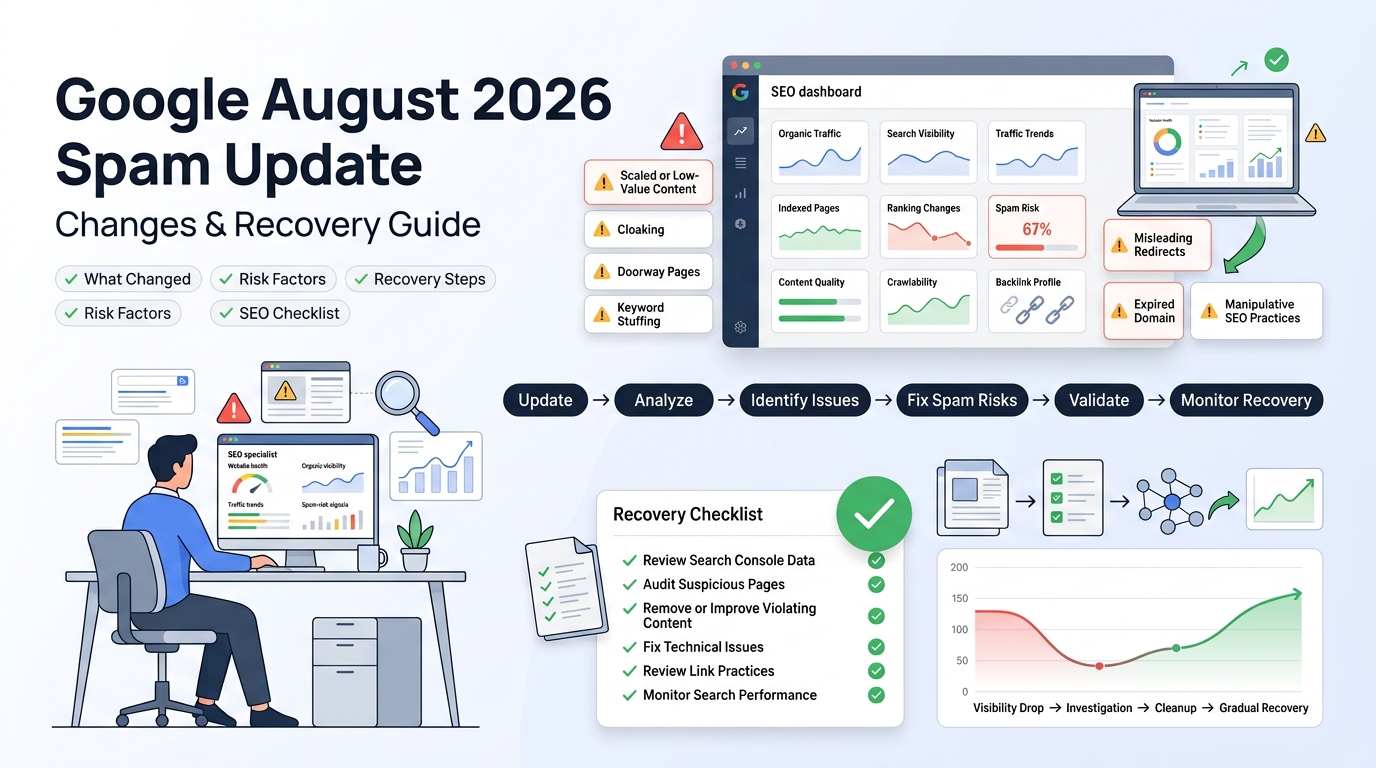
1. Policy-specific enforcement. Spam updates target a defined list of behaviors from Google's spam policies cloaking, sneaky redirects, doorway abuse, expired domain abuse, hidden text, keyword stuffing, and scaled content abuse. A site that's simply thin or mediocre, but not violating one of these named policies, isn't who this update is aimed at.
2. Purely punitive, never additive. As covered above, a spam update has no mechanism to boost a compliant site beyond the natural effect of a spammy competitor dropping out of the results.
3. No new rules announced. Google explicitly did not publish new spam policy types alongside the August 2026 rollout, according to Google Search Central's own release note. That matters because it means the compliance bar for this update is identical to the one that's existed since Google's spam policies were last revised there's no new checklist to chase.
4. Independent of the core ranking systems. Spam enforcement runs on separate infrastructure from the core relevance systems, which is why spam updates and core updates can and sometimes do overlap in the same month without being the same event.
How to Actually Check and Recover From It
Confirm your traffic drop overlaps the exact window. The rollout ran from August 18 to August 21, 2026. Pull your Search Console Performance > Clicks report and check whether your decline is concentrated in that window specifically, rather than starting earlier or continuing to worsen well after.
Rule out overlapping causes. Check whether a core update, a Search Console coverage issue, or a site migration coincided with the same dates. Spam updates get blamed for drops they didn't cause more often than people realize.
Audit against the named spam policies, not general quality. Go policy by policy: Do you have pages built around near-duplicate keyword variants (doorway abuse)? Content scraped or lightly reworded from other sources or AI output at volume (scaled content abuse)? Any cloaking or sneaky redirect behavior left over from an old tracking setup?
Check user-generated sections separately. Forums, comment sections, and guest posts are common blind spots spam injected into UGC areas can drag down an otherwise clean site's rankings.
Fix or remove the offending pages, don't just tweak them. Policy violations usually need removal, noindexing, or a substantial rework not a light edit.
Skip the reconsideration request unless you have a manual action. This is algorithmic; there's no manual penalty message to appeal in Search Console. Fixing the issue and waiting for reprocessing is the actual path.
Give it real time. Recovery from a spam update can take months and, per how these updates have historically behaved, isn't dependent on the next core update running first.
The Data: Rollout Speeds and the Myth Worth Correcting
Here's how 2026's three spam updates compare by confirmed Search Status Dashboard runtime:
March 2026 Spam Update: 19 hours, 30 minutes the fastest confirmed spam update rollout in the dashboard's history.
June 2026 Spam Update: 2 days, 1 hour.
August 2026 Spam Update: 2 days, 16 hours.
For comparison, the prior year's August 2025 Spam Update took considerably longer to fully complete, running from late August into a September 22 completion.
Myth-busting: A common assumption is that any named spam update comes bundled with new rules to learn. That wasn't the case here Google explicitly did not publish new spam policies with the August 2026 rollout, and its spam policies documentation hadn't been updated since the prior December. The better mental model: think of most spam updates as re-enforcement events against an existing rulebook, not rule-expansion events. The May 15, 2026 clarification that spam policies also cover attempts to manipulate AI Overviews and AI Mode responses is the actual rule change worth knowing, and it predates this rollout by three months.
When a Ranking Drop Stops Being This Spam Update
Not every traffic drop during this window is actually caused by it. Three rough categories help separate signal from noise:
Clearly this update: A site with dozens of near-identical, lightly-reworded pages targeting keyword variants of the same core topic (classic doorway/scaled-content territory) sees a sharp, sustained drop starting exactly August 18–21, with no core update or technical issue overlapping.
Clearly not this update: A site sees a gradual decline starting in late July, well before the rollout window, or the drop coincides with a Search Console indexing error that points to a technical issue or an unrelated core update, not this spam enforcement pass.
The borderline case: A site using AI tools to draft content, but with real editorial review, original data, and added analysis on top, sits in genuinely ambiguous territory. Google's scaled-content policy is about the purpose and originality of the content, not the tool used to produce a first draft which is exactly why did I get hit for using AI is the wrong question. Did I publish unoriginal content at scale for ranking purposes is the right one.
conclusion
The August 2026 Spam Update is a fast, global, algorithmic enforcement pass against Google's existing spam policies not a new rulebook, and not something with the power to boost a clean site's rankings. If you saw a drop in that exact window, audit against the named policies (scaled content, doorways, cloaking, UGC abuse) before assuming the worst, and give a genuine fix real time to take effect rather than chasing a quick reconsideration request that doesn't apply to algorithmic actions in the first place.
FAQ
When did the Google August 2026 Spam Update start and end?
It started rolling out on August 18, 2026, and finished on August 21, 2026, a total runtime of 2 days and 16 hours according to Google's Search Status Dashboard.
Is the August 2026 update the same as a core update?
No. Spam updates only lower rankings for policy-violating sites, while core updates can raise or lower rankings based on a broader relevance and quality re-evaluation.
Does the August 2026 Spam Update target backlinks?
No. Reporting citing Google directly states this update does not target link spam or the site reputation abuse policy, unlike some past updates that did fold in link-based signals.
Will I get a manual action notice if I'm affected?
No. Spam updates are fully algorithmic there is no manual action message in Search Console, even if your site is impacted.
Were there new spam policies introduced with this update?
No. Google did not announce new spam policy types alongside the August 2026 rollout, meaning existing policies like scaled content abuse and doorway abuse remain the standard to check your site against.
How long does recovery from a spam update usually take?
Recovery is typically measured in months, and it is not tied to the timing of the next core update fixing the underlying violation is what matters, not waiting for a specific future rollout.
Does using AI to write content automatically violate the scaled content policy?
No. Google's scaled-content policy is about producing unoriginal content at volume primarily to manipulate rankings, regardless of whether it's created manually, with AI, or through a combination the production method itself isn't the violation.
How can I check if my site was actually affected?
Compare your Search Console Performance > Clicks report against the exact August 18–21, 2026 window, and rule out any overlapping core update or technical/indexing issue before concluding the spam update is the cause.
Get a free audit and see exactly how this applies to your site.