AI digital marketing is the use of artificial intelligence, machine learning, generative AI, predictive analytics, and automation to improve marketing decisions and activities.
In 2026, AI helps marketers analyze customer behavior, create and optimize content, personalize campaigns, automate repetitive tasks, improve SEO, manage advertising, and identify potential leads.
The biggest change is simple: marketing is becoming more data-driven, automated, and personalized, while human expertise remains essential for strategy, creativity, and quality control.
Digital marketing in 2026 is no longer simply about creating more content, running more ads, or posting more frequently on social media. The real shift is happening behind the scenes.
Artificial intelligence is changing how marketers research audiences, create content, optimize campaigns, analyze data, personalize customer experiences, and make decisions.
Using AI does not automatically make a marketing strategy better. Publishing hundreds of AI-generated articles without expertise, context, or quality control can create the exact opposite result. The businesses getting the most value from AI digital marketing are using artificial intelligence to improve human decision-making, automate repetitive work, and deliver more relevant experiences.
What Is AI Digital Marketing?
AI digital marketing refers to the use of artificial intelligence technologies to support or automate marketing activities.
These technologies can include:
Generative AI
Machine learning
Natural language processing
Predictive analytics
AI agents
Marketing automation
AI algorithms
Large language models
Customer data analysis
Instead of manually analyzing thousands of customer interactions, an AI system can process large amounts of data and identify patterns much faster.
For example, AI can help a marketer:
Find keyword opportunities
Analyze search intent
Create content outlines
Personalize email campaigns
Segment audiences
Predict customer behavior
Optimize advertising campaigns
Identify potential leads
Analyze campaign performance
Automate repetitive marketing tasks
However, AI is a tool, not a complete marketing strategy.
A poor strategy with AI can simply produce poor results faster.
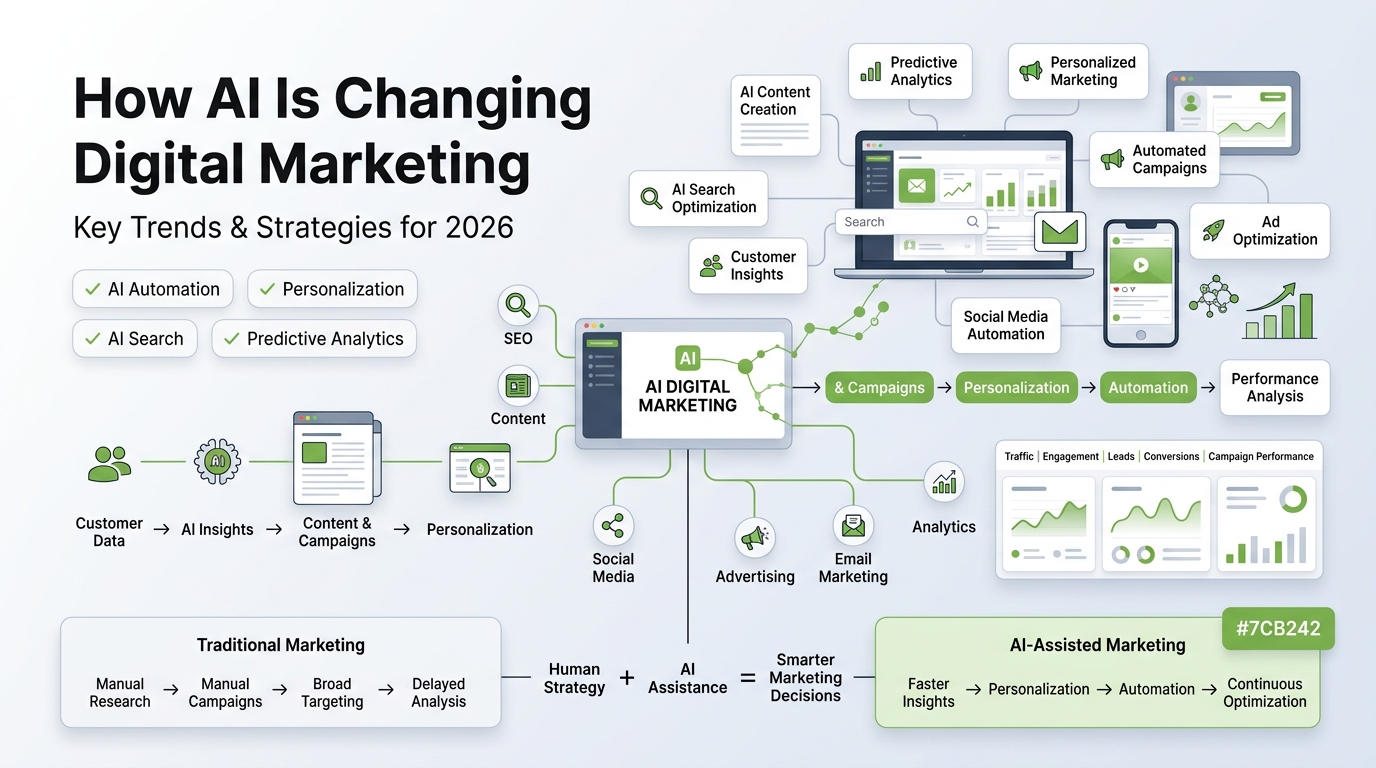
AI Digital Marketing vs Traditional Digital Marketing
Traditional digital marketing relies heavily on manual research, campaign management, reporting, and content production.
AI-powered digital marketing adds automation and intelligence to those processes.
Area | Traditional Marketing | AI Digital Marketing |
Data analysis | Mostly manual | Automated pattern analysis |
Content creation | Human-led | AI-assisted and human-reviewed |
Personalization | Broad audience segments | More dynamic personalization |
SEO research | Manual keyword analysis | AI-assisted topic and intent analysis |
Advertising | Manual optimization | Automated bidding and optimization |
Email marketing | Standard segments | AI-driven personalization |
Reporting | Manual reports | Automated insights and analysis |
Customer support | Human teams | AI chat and automated assistance |
Lead generation | Manual qualification | Predictive lead scoring |
The most important difference is not simply speed.
It is the ability to process information and identify patterns at a scale that would be difficult to manage manually.
10 Ways AI Is Changing Digital Marketing in 2026
1. AI Is Transforming SEO and Search Optimization
SEO is changing rapidly because search itself is changing.
Traditional SEO focused heavily on ranking web pages in search results. Modern SEO increasingly considers multiple discovery environments, including traditional search engines and AI-powered search experiences.
This has increased interest in:
AI SEO
AI search
Google AI Overviews
Answer Engine Optimization
AEO
Generative Engine Optimization
GEO
Semantic search
Search intent
Entity optimization
The goal is no longer just to place a keyword on a page.
A strong piece of content should clearly explain:
What the topic is.
Why it matters.
How it works.
What the user should do next.
AI can help marketers analyze search intent, identify related topics, organize keyword clusters, and find content gaps.
But AI-generated content should still be reviewed carefully.
The strongest SEO strategy combines AI efficiency with human experience and subject knowledge.
2. AI Content Marketing Is Becoming More Strategic
AI content creation has changed the speed at which marketers can research and produce content.
AI can assist with:
Topic research
Keyword clustering
Content outlines
First drafts
Content summaries
Headline ideas
Meta descriptions
Content optimization
Internal linking suggestions
Content updates
However, speed is not the same as value.
If ten websites publish nearly identical AI-generated content, none of them provides a strong reason for readers or search systems to prefer one over another.
That is why information gain is becoming increasingly important.
Your content should add something useful that competing pages do not provide.
This could include:
Original examples
First-hand experience
Proprietary research
Expert opinions
Detailed comparisons
Updated data
Case studies
Practical frameworks
AI should help you produce better content, not simply more content.
3. AI Is Improving Content Personalization
One of the biggest benefits of AI in digital marketing is personalization.
Traditional campaigns often divide customers into broad groups.
For example:
New customers
Returning customers
Small businesses
Enterprise customers
AI can potentially analyze more behavioral signals and help marketers create more relevant audience segments.
This can support:
Personalized product recommendations
Customized emails
Dynamic website content
Personalized offers
Content recommendations
Customer journey optimization
For example, an education website could show different scholarship content to visitors interested in:
UK scholarships
USA scholarships
Master's programs
PhD opportunities
Fully funded scholarships
Instead of showing every visitor the same content, AI systems can help marketers organize more relevant experiences.
4. AI Email Marketing Is Becoming Smarter
Email remains an important digital marketing channel, but generic campaigns often struggle to attract attention.
AI email marketing can help with:
Subject line ideas
Audience segmentation
Send-time optimization
Content personalization
Product recommendations
Lead nurturing
Automated workflows
Imagine two customers.
One recently visited your SEO services page.
Another downloaded a technical SEO guide.
Sending both people exactly the same email may not be the best approach.
AI-powered segmentation can help marketers create campaigns based on behavior and interests.
The important word here is relevance.
Better personalization should improve the customer experience rather than make communication feel intrusive.
5. AI Social Media Marketing Is Reducing Manual Work
Managing multiple social platforms can be time-consuming.
AI social media tools can help marketers:
Generate post ideas
Repurpose long-form content
Create captions
Analyze audience engagement
Monitor conversations
Identify content patterns
Schedule posts
Generate creative variations
This can make social media automation more efficient.
However, fully automated social media accounts often have a recognizable problem.
They can sound repetitive.
A strong AI social media marketing strategy should use AI for efficiency while keeping human judgment for:
Brand voice
Humor
Cultural context
Sensitive topics
Community engagement
Final approval
People generally do not want to build relationships with a content machine.
They want useful information and genuine interaction.
6. AI Advertising Is Changing PPC Campaign Management
AI has become deeply connected to modern digital advertising.
AI advertising and AI PPC can support:
Automated bidding
Audience targeting
Ad optimization
Conversion prediction
Creative testing
Budget allocation
Performance analysis
Instead of manually adjusting every campaign variable, marketers can use automation to process performance signals more quickly.
This does not mean marketers should simply activate automation and walk away.
Human oversight is still necessary to monitor:
Budget allocation
Conversion quality
Brand safety
Targeting accuracy
Creative messaging
Business goals
Automation works best when marketers clearly define what success actually means.
A campaign optimized only for cheap clicks may produce very different results from a campaign optimized for qualified leads or revenue.
7. AI Is Improving Lead Generation
AI lead generation can help businesses identify patterns that may indicate customer interest.
AI systems can assist with:
Lead scoring
Audience segmentation
Customer behavior analysis
Predictive analytics
Sales prioritization
Automated follow-up
For example, a business may receive hundreds of inquiries every month.
Not every inquiry has the same likelihood of becoming a customer.
AI-assisted systems can help sales and marketing teams prioritize leads based on relevant signals.
This can reduce wasted time and improve the efficiency of lead nurturing.
However, predictive systems depend on the quality of the underlying data.
Bad or incomplete data can lead to poor recommendations.
8. AI Marketing Analytics Is Making Data Easier to Understand
Digital marketers often have access to huge amounts of data.
The challenge is not always collecting more data.
The challenge is understanding what matters.
AI marketing analytics can help identify:
Traffic trends
Conversion patterns
Customer behavior
Campaign anomalies
Audience segments
Potential opportunities
Instead of manually reviewing dozens of reports, marketers can use AI to surface patterns and questions worth investigating.
But marketers should avoid blindly accepting every AI-generated insight.
Always ask:
What data supports this recommendation?
AI can identify a pattern.
Human marketers still need to understand the business context.
9. AI Agents Are Changing Marketing Workflows
AI agents represent a growing area of AI automation.
An AI agent can potentially perform a sequence of tasks rather than simply generating one answer.
For example, a marketing workflow could involve:
Researching a topic.
Collecting keyword ideas.
Organizing keywords by search intent.
Creating a content brief.
Preparing a draft.
Identifying internal linking opportunities.
Creating a publishing checklist.
Human review should remain part of this process.
The opportunity is not necessarily to remove people from marketing.
The opportunity is to reduce repetitive tasks so marketers can spend more time on:
Strategy
Creativity
Customer understanding
Analysis
Brand development
10. AI Is Changing Customer Expectations
As personalization and AI-powered experiences become more common, customer expectations also change.
Users increasingly expect:
Faster answers
More relevant recommendations
Personalized experiences
Better search results
Immediate assistance
This creates both an opportunity and a challenge.
Businesses need to use AI without making customer interactions feel artificial.
The best experience is often one where technology quietly improves the process without becoming the entire experience.
AI SEO, AEO and GEO: The New Search Landscape
Search optimization is expanding beyond traditional ranking strategies.
What Is AI SEO?
AI SEO involves using artificial intelligence to support search optimization activities such as keyword research, content analysis, technical audits, and search intent analysis.
AI can improve efficiency, but it does not replace fundamental SEO principles.
You still need:
Helpful content
Clear site architecture
Crawlable pages
Strong internal linking
Relevant external signals
Good user experience
Accurate information
What Is AEO?
Answer Engine Optimization (AEO) focuses on structuring content so search engines and answer systems can easily identify direct answers to user questions.
For example:
Question: What is AI digital marketing?
Direct answer: AI digital marketing is the use of artificial intelligence to automate, analyze, personalize, and improve digital marketing activities.
That answer is clear, concise, and understandable without additional context.
This format can help make content easier to extract and understand.
What Is GEO?
Generative Engine Optimization (GEO) focuses on improving how content is understood and potentially referenced by AI-powered search and generative systems.
A GEO-friendly article should include:
Clear definitions
Specific facts
Strong topic structure
Named entities
Original insights
Reliable sources
Direct answers
Relevant examples
The underlying principle is straightforward:
If an AI system cannot clearly understand what your content says, it will struggle to use that content accurately.
How to Build an AI Digital Marketing Strategy
Here is a practical framework.
Step 1: Identify the Right Marketing Problems
Do not start with the question:
"What AI tool should we use?"
Start with:
"What marketing problem are we trying to solve?"
Examples:
Content production takes too long.
Customer segmentation is weak.
PPC optimization requires too much manual work.
SEO research is inefficient.
Reporting takes too much time.
Once you identify the problem, evaluate whether AI can genuinely help.
Step 2: Choose the Right AI Marketing Tools
Different tools are designed for different tasks.
Your AI marketing stack might include tools for:
Content research
SEO
Analytics
Email marketing
Social media
Advertising
Automation
Customer support
Avoid adding tools simply because they are popular.
Every tool should have a clear purpose.
Step 3: Keep Humans in the Review Process
AI can make mistakes.
It can misunderstand context, produce inaccurate information, or create generic content.
Create a review process for:
Facts
Statistics
Brand messaging
Legal claims
Financial claims
Customer communications
Published content
The more important the decision, the more important human oversight becomes.
Step 4: Build a Quality-Control System
Before publishing AI-assisted content, check:
Is the information accurate?
Does the article answer the search intent?
Does it add something original?
Are the examples relevant?
Does it sound like the brand?
Are important claims verified?
This prevents the common problem of publishing content that is technically readable but practically useless.
Step 5: Measure Business Results
Do not measure AI success only by the number of articles or social posts created.
Track meaningful metrics such as:
Organic traffic
Search visibility
Qualified leads
Conversion rate
Revenue
Customer retention
Time saved
Content performance
The goal is not maximum automation.
The goal is better marketing outcomes.
AI Digital Marketing Tools vs Human Marketers
AI and human marketers should not be viewed as direct competitors.
They have different strengths.
Task | AI Strength | Human Strength |
Data processing | Excellent | Limited scale |
Repetitive tasks | Excellent | Time-consuming |
Content drafts | Fast | Better strategic judgment |
Brand strategy | Limited context | Strong contextual understanding |
Creativity | Pattern-based assistance | Original perspective |
Customer empathy | Simulated understanding | Genuine human judgment |
Business decisions | Data-supported | Context and accountability |
Quality control | Can flag patterns | Can evaluate meaning and accuracy |
The best model is usually AI-assisted marketing, not completely automated marketing.
AI handles scale and repetitive work.
Humans provide strategy, experience, judgment, and accountability.
The Biggest Risks of AI in Digital Marketing
AI has major benefits, but marketers should also understand the risks.
Generic Content
AI can produce content that sounds polished but says very little.
The solution is to add original experience, examples, research, and useful analysis.
Inaccurate Information
AI-generated content can contain errors.
Important claims should always be verified before publication.
Brand Voice Problems
Overusing AI can make every article, email, and social post sound similar.
Human editing helps maintain a recognizable brand voice.
Privacy and Data Risks
Customer data should be handled carefully.
Businesses need to understand what information they are sharing with AI tools and whether those tools meet relevant privacy and security requirements.
Over-Automation
Not every customer interaction should be automated.
Complex questions, complaints, and sensitive situations may require human support.
Best Practices for AI-Powered Digital Marketing in 2026
Follow these principles:
Use AI to solve real problems.
Keep humans responsible for important decisions.
Verify facts before publishing.
Prioritize original value over content volume.
Protect customer data.
Measure business outcomes, not just output.
Test AI recommendations instead of blindly trusting them.
Build AI workflows around your actual customers.
Maintain a consistent brand voice.
Continuously review your AI marketing strategy.
Best SEO Company in USA for On-Page SEO Services
Contentiris If you are looking for the best SEO company in USA, choosing a provider with a strong on-page optimization process is essential. Professional on page SEO services should go beyond adding keywords to a page. A reliable on page SEO service can include keyword and search intent research, content optimization, title and meta tag improvements, heading structure, internal linking, image optimization, schema where appropriate, and technical page-level improvements. Businesses looking for expert on-page SEO services or advanced on page SEO services should choose an SEO partner that focuses on sustainable search visibility, useful content, and measurable business goals rather than promising instant rankings.
Final Thoughts
AI digital marketing is changing how businesses research, create, optimize, personalize, and measure marketing, but the most effective strategies still combine AI capabilities with human expertise.
The marketers who benefit most from AI in 2026 will not necessarily be the ones using the most tools. They will be the ones using the right technology to solve real problems, improve customer experiences, and make better decisions.
If your business wants to improve its search visibility, the next step is to review your existing website, content, technical SEO, and on-page optimization to identify where AI-assisted workflows and expert SEO can create measurable improvements.
Frequently Asked Questions
What is AI digital marketing?
AI digital marketing is the use of artificial intelligence to improve marketing activities such as content creation, audience analysis, SEO, advertising, automation, personalization, and campaign reporting.
How is AI changing digital marketing?
AI is changing digital marketing by automating repetitive tasks, improving data analysis, supporting personalized customer experiences, assisting with content creation, and helping marketers optimize campaigns.
Can AI replace digital marketers?
AI can automate specific marketing tasks, but it does not fully replace human strategy, creativity, business understanding, and accountability. The strongest approach is usually AI-assisted marketing.
How can AI help with SEO?
AI SEO can support keyword research, search intent analysis, content optimization, technical audits, competitor analysis, and internal linking. Human review is still necessary for strategy and quality control.
What is AI marketing automation?
AI marketing automation uses artificial intelligence to automate and optimize marketing activities such as email campaigns, lead nurturing, audience segmentation, reporting, and customer interactions.
What is the difference between AI SEO and AEO?
AI SEO focuses on using artificial intelligence to improve SEO processes. AEO, or Answer Engine Optimization, focuses on structuring content so it can provide clear and direct answers to search queries.
What is GEO in digital marketing?
GEO, or Generative Engine Optimization, focuses on making content clear, structured, specific, and useful for AI-powered search and generative systems that analyze and present information.
What is the biggest risk of using AI for marketing?
One major risk is publishing inaccurate, generic, or low-value content without human review. AI should support quality and efficiency, not replace verification and strategic thinking.
Get a free audit and see exactly how this applies to your site.