
User experience (UX) affects SEO both directly and indirectly. Google directly measures a narrow set of UX signals Core Web Vitals (loading speed, interactivity, and visual stability) and mobile usability as confirmed page experience ranking factors.
Everything else, including bounce rate, dwell time, and click-through rate (CTR), works indirectly: poor UX drives these behavioral signals down, and Google's systems interpret that pattern as a sign your content doesn't satisfy the search intent behind the query, which suppresses rankings over time even without a single UX penalty ever being applied.
How Different Sources Frame the UX-SEO Relationship
There isn't one universal definition of UX for SEO; different authorities frame it around different mechanics.
Google's official framing (Page Experience signals): Google has confirmed that Core Web Vitals and mobile-friendliness are part of its page experience ranking signal, sitting alongside, not above, relevance, content quality, and authority. Google treats these signals as a tie-breaker rather than a dominant factor: when two pages are otherwise comparable, the one with a better page experience score is more likely to edge ahead.
Contentsquare's behavioral framing: Digital experience analytics firm Contentsquare frames UX-SEO through Core Web Vitals Explained click-through rate, dwell time, and bounce rate while pointing out plainly that Google has never officially confirmed these as direct ranking inputs. Their position is that these metrics matter because they expose why a page underperforms, not because Google scores them explicitly.
Search Engine Journal / Nightwatch's intent-matching framing: This framing centers on pogo-sticking and dwell time as proxies for search-intent alignment. A page in the top 10 results averages roughly 3 minutes and 10 seconds of dwell time, a benchmark that reflects satisfied intent rather than a technical checkbox.
The DOJ antitrust disclosures' framing: Internal Google research surfaced during recent U.S. antitrust litigation confirmed that click and engagement data feed into Google's quality assessments in ways the company had previously downplayed publicly, lending real weight to what SEOs had long suspected about behavioral signals.
Each framing describes the same phenomenon from a different vantage point: Google's is mechanical, Contentsquare's is diagnostic, and the intent-matching view is psychological. Understanding all three keeps you from over-indexing on any single metric.
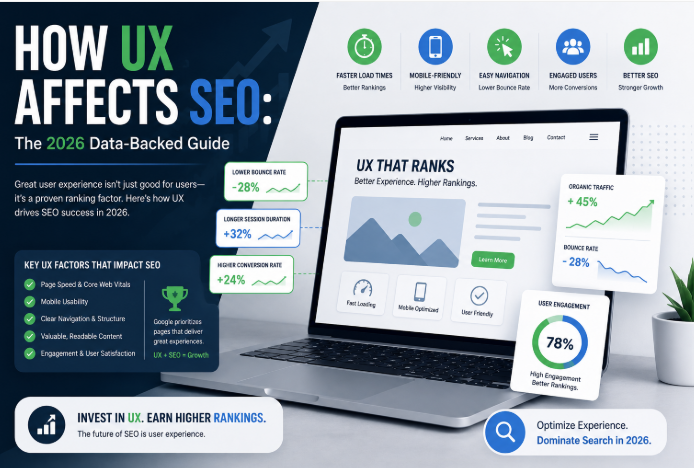
Direct Ranking Signals vs. Indirect Behavioral Signals
The single distinction that explains almost every confusing claim you've read about UX and SEO is this: some UX metrics are ranking factors Google measures itself, and others are behavioral side-effects Google's systems merely observe. Confusing the two is why so much SEO advice sounds contradictory.
Core Web Vitals are measured directly, using real Chrome user data (via the Chrome User Experience Report), and Google has explicitly confirmed their role in ranking. Bounce rate, dwell time, and CTR are not measured or scored the same way; Google has stated it does not use raw bounce rate as a ranking signal, but they still shape outcomes indirectly by revealing whether your content matches intent.
Signal | Type | Confirmed by Google? | How it affects rankings |
Core Web Vitals (LCP, INP, CLS) | Direct ranking signal | Yes | Acts as a tie-breaker between pages of similar content quality; measured via real-user CrUX data |
Mobile usability | Direct ranking signal | Yes | Part of the page experience signal since Google's mobile-first indexing shift |
Bounce rate | Indirect/behavioral | No (explicitly denied as a direct factor) | High bounce combined with pogo-sticking suggests intent mismatch, which affects future visibility |
Dwell time | Indirect/behavioral | No official confirmation | Longer dwell correlates with top-10 rankings, but correlation isn't causation |
Click-through rate (CTR) | Indirect/behavioral, complicated by position bias | Partially internal research suggests click data feeds quality systems | Sustained low CTR at a given position can suggest weak titles/meta descriptions, not just weak content |
In plain terms: fix Core Web Vitals and mobile usability because Google says so. Fix everything else: navigation, content clarity, page speed perception, and intent match because it changes what real users do, and what real users do eventually shows up in the metrics Google does trust.
This is also why two sites with nearly identical technical setups can perform very differently in search. One might pass every Core Web Vitals threshold and still lose rankings because its content buries the answer under three paragraphs of throat-clearing, while a competitor's page, slightly slower, technically speaking, wins because it satisfies intent within the first screen. Direct signals set the floor; indirect signals decide who wins once that floor is met. Agencies running B2B SEO services USA for longer sales-cycle content see this constantly: a whitepaper-style page can pass every technical audit and still underperform a shorter, better-structured competitor simply because dwell time and pogo-sticking tell a different story than the crawler does.
What Makes UX SEO-Relevant 4 Core Criteria
Not every UX improvement moves the needle for SEO. Four factors do the heavy lifting.
1. Loading Performance (Largest Contentful Paint). LCP measures how long it takes the largest visible element usually a hero image or headline block to render. Google's documentation defines a good LCP as occurring within 2.5 seconds of real user data, not a single lab test.
2. Interactivity (Interaction to Next Paint). INP officially replaced First Input Delay as Google's responsiveness metric in March 2024. It measures how quickly your page responds across an entire visit, not just on the first click meaning janky forms, laggy dropdowns, and delayed button responses further down a page can still hurt your score.
3. Visual Stability (Cumulative Layout Shift). CLS tracks how much content jumps around as a page loads. According to a widely cited analysis from a March 2026 core-update review, pages ranking in position one showed roughly a 10% higher Core Web Vitals pass rate than pages sitting in position nine evidence that stability compounds with other quality signals rather than acting alone.
4. Intent Match (Content Structure and Navigation). Even a technically flawless page fails on UX if the content doesn't answer what the searcher actually needed. This is where information architecture, clear headers, and logical internal linking matter as much as page speed.
These four factors interact rather than operating in isolation. A page can post a perfect LCP score and still frustrate users if a late-loading cookie banner triggers layout shift the moment they start reading, dragging CLS back into needs improvement territory. Similarly, a fast, stable page with confusing navigation can technically pass every Core Web Vitals threshold while still producing the pogo-sticking pattern that signals poor intent match. Treating these four criteria as a checklist to clear once, rather than a system to monitor continuously, is one of the most common reasons UX regressions creep back into a site after a redesign or CMS migration which is exactly why teams running organic SEO services USA build recurring technical checks into their retainers instead of one-off audits.
The UX-to-SEO Improvement Process
If you're auditing a site for UX-driven ranking issues, work through this sequence rather than jumping straight to a redesign.
Run a Core Web Vitals audit. Pull real-user data from Google Search Console and PageSpeed Insights (which draws on CrUX) rather than relying on a single lab test lab and field data frequently disagree.
Fix the worst-performing template first. Most sites have one or two templates (product pages, blog posts, category pages) responsible for the majority of poor scores. Fixing that template fixes the site.
Audit mobile usability separately. Tap targets, font sizing, and viewport configuration are evaluated independently of desktop performance under mobile-first indexing.
Restructure content around search intent. Add a short, direct answer near the top of the page, break up long blocks of text, and make sure headers double as questions users would actually type.
Monitor CTR and dwell time as diagnostics, not targets. Use Search Console to track CTR by query and page. A high CTR paired with a high bounce rate signals a title/content mismatch your meta description is over-promising what the page delivers.
Re-crawl and re-test. Core Web Vitals scores update on a rolling basis using real-user data, so improvements typically take a few weeks to fully reflect in reporting.
This is exactly the workflow our team runs inside Contentiris's monthly SEO services, since UX regressions tend to creep back in after every content or design update.
A few practical notes make this process work in the real world instead of just on paper. First, template-level fixes almost always beat page-level fixes for return on effort correcting the LCP issue on a shared product template can lift Core Web Vitals scores across thousands of pages in a single deployment, which is a big part of why our WordPress SEO services engagements start with theme and plugin audits rather than individual post edits. Second, mobile and desktop should be tested and reported separately, since Google's mobile-first indexing means your mobile experience is effectively the version of your site being evaluated. Third, don't treat mobile usability as done after one pass; new content blocks, embedded widgets, and third-party scripts (chat widgets, review plugins, ad units) are the most common causes of usability regressions creeping back in month after month. Finally, when you're managing UX-SEO across multiple regions or language versions, hreflang and localized page speed testing both matter a fast U.S.-hosted site can still feel slow to visitors in other markets, which is a routine finding in the international SEO services work we do for multi-region clients.
UX and SEO: The Data
Vague claims don't help you prioritize. Here's what's actually documented:
Google confirmed page experience including Core Web Vitals as a ranking factor when it rolled the signal into search in June 2021, and it remains part of the algorithm in 2026.
To get the full ranking benefit, 75% of a site's real-world visits need to meet the Good threshold across all three Core Web Vitals metrics, based on CrUX data, per Google's own guidance.
Pages ranking in position one show roughly a 10% higher Core Web Vitals pass rate than pages in position nine, according to a 2026 analysis of the March core update.
Studies on load-time abandonment show that over 50% of users bounce after just a three-second delay, and separate research from HubSpot found that a one-second delay in load time can reduce conversions by up to 7%.
Backlinko's 2025 CTR benchmark data shows the #1 organic result averages a 27.6% CTR, while the top 3 results capture roughly 54.4% of all clicks meaning weak UX that costs you even one position can cost you outsized traffic.
Pages in the top 10 results average a dwell time of roughly 3 minutes and 10 seconds, according to Search Engine Journal's benchmarking.
Myth-Busting: Bounce Rate Is a Direct Google Ranking Factor
This is one of the most repeated claims in SEO content, and it's not accurate. Google has not confirmed bounce rate as a direct ranking input, and treating it as a universal red flag misreads what the metric means. A visitor who lands on a page, gets a complete answer in ten seconds, and leaves satisfied still counts as a bounce but that's a UX success, not a failure. The metric that actually matters is bounce rate combined with pogo-sticking (immediately returning to the search results to click a different listing). That combination is a genuine signal of intent mismatch. Isolated bounce rate, without that return-to-SERP behavior, tells you almost nothing on its own.
When Does UX Stop Counting as an SEO Factor?
Not every UX decision has an SEO consequence, and knowing where the line sits saves you from optimizing the wrong things.
Clearly an SEO factor: A Shopify product page with a 6-second Largest Contentful Paint, layout shift caused by late-loading ad units, and a broken mobile checkout flow. This directly depresses Core Web Vitals scores and mobile usability both confirmed ranking signals and it's exactly the kind of issue our Shopify SEO services are built to catch before it costs a client rankings.
Clearly not an SEO factor: The specific shade of a Buy Now button or the exact animation style of a hover menu. These affect conversion rate and brand feel, but they have no documented connection to Google's ranking systems, direct or indirect, as long as they don't harm load speed or accessibility.
The borderline case: A logged-in SaaS dashboard's internal UX onboarding flow, in-app navigation, dashboard layout. This matters enormously for retention and product-led growth, but almost none of it is crawlable or evaluated by Google at all, since it sits behind a login wall. The line isn't does this affect the user it's does this affect a page Google can crawl, render, and measure.
The Bottom Line
UX affects SEO through two channels at once: a small set of directly measured page experience signals (Core Web Vitals and mobile usability), and a larger set of behavioral signals (CTR, dwell time, bounce-and-return patterns) that indirectly shape how Google's systems judge whether your content satisfies intent.
If you're not sure where your site is actually losing ground technical page experience, content-intent mismatch, or both that diagnosis is the first thing to get right before spending a budget on redesigns. That's the exact gap Contentiris closes for clients, whether that means organic SEO services, technical audits under our SEO marketing services, or a full white label SEO services partnership for agencies who need the analysis without the headcount.
Ready to find out which UX signals are actually costing you rankings? Get a free UX-SEO audit from Contentiris and see exactly where your site stands before you spend another dollar guessing.
Contentiris offers a full range of SEO support, including small business SEO services SEO services for small businesses B2B SEO services WordPress SEO services international SEO services SEO content writing services and SEO copywriting services alongside our organic SEO services company work and monthly SEO services retainers for teams that want ongoing UX and technical monitoring.
Frequently Asked Questions
Does Google use bounce rate as a ranking factor?
No. Google has stated it does not use raw bounce rate as a direct ranking signal. What matters more is pogo-sticking when users bounce back to the search results and click a different listing, which suggests intent mismatch.
Is Core Web Vitals still important for SEO in 2026?
Yes. Core Web Vitals remain a confirmed part of Google's page experience signal in 2026, functioning as a tie-breaker between pages with comparable content quality rather than a standalone ranking booster.
Does click-through rate (CTR) directly affect Google rankings?
Not definitively. Google has said CTR is complicated to use as a direct signal because of position bias (top results get more clicks regardless of quality), but internal research surfaced through recent litigation suggests click data does feed into Google's broader quality assessments.
What replaced First Input Delay (FID) as a Core Web Vital?
Interaction to Next Paint (INP) officially replaced FID as the third Core Web Vital in March 2024, measuring responsiveness across an entire page visit rather than just the first interaction.
How fast should my Largest Contentful Paint (LCP) be?
Google defines a good LCP as 2.5 seconds or less, measured using real user data from the Chrome User Experience Report rather than a single lab test.
Can good UX help a page outrank a competitor with more backlinks?
It's unlikely on its own. Content relevance and authority remain the dominant ranking factors; UX signals function mainly as tie-breakers when competing pages are otherwise similar in quality.
Should I hire someone specifically for UX-focused SEO, or is that part of general SEO copywriting?
It's usually part of a broader engagement rather than a standalone service. Technical UX fixes (Core Web Vitals, mobile usability) typically fall under SEO marketing services, while intent-matching and on-page structure fall under SEO content writing services most agencies, including Contentiris, handle both together since they reinforce each other.
Does mobile usability count separately from page speed?
Yes. Mobile usability tap target sizing, viewport configuration, responsive layout is evaluated as its own component of the page experience signal, distinct from Core Web Vitals scores.
Is dwell time the same thing as session duration?
Not exactly. Dwell time specifically measures how long a user stays on a page before returning to the search results, while session duration measures total time across an entire site visit, including multiple pages.
Get a free audit and see exactly how this applies to your site.