Getting cited inside an AI-generated answer is quickly becoming one of the most valuable and least understood forms of visibility a business can earn. Unlike a traditional ranking, a citation inside Google's AI Overview or a ChatGPT response puts your brand directly in front of someone at the exact moment they're deciding what to do next, sometimes even when they never click through to your site at all.
The problem is that most businesses are still optimizing purely for traditional rankings and hoping AI citations follow automatically. Sometimes they do. Often, they don't because citation depends on a distinct combination of technical accessibility, content clarity, and trust signals that traditional SEO alone doesn't fully guarantee.
This guide breaks down exactly how citation works in both Google AI Overviews and ChatGPT, and the concrete steps that actually improve your odds of being the source these systems choose to name.
Why AI Citations Matter More Than You Might Think
A citation inside an AI-generated answer isn't just a nice-to-have vanity metric. It carries real, distinct value:
Zero-click brand exposure. Even when a user doesn't click through, seeing your brand named as a trusted source builds recognition and credibility they carry into future decisions.
Implicit third-party endorsement. Being cited by an AI system reads, subconsciously, as a form of validation similar to how a Wikipedia citation or a mention in a respected publication builds trust.
Downstream branded search. Businesses frequently see an uptick in direct, branded search traffic after being cited repeatedly for a topic, as users remember the name even without clicking in the moment.
Competitive scarcity. AI systems typically cite a small handful of sources per answer, not ten. Winning that limited real estate carries outsized weight compared to being one of many results on a traditional search page.
How Citation Actually Works: Google AI Overviews vs. ChatGPT
These two systems pull information in meaningfully different ways, and understanding that difference changes how you should approach each one.
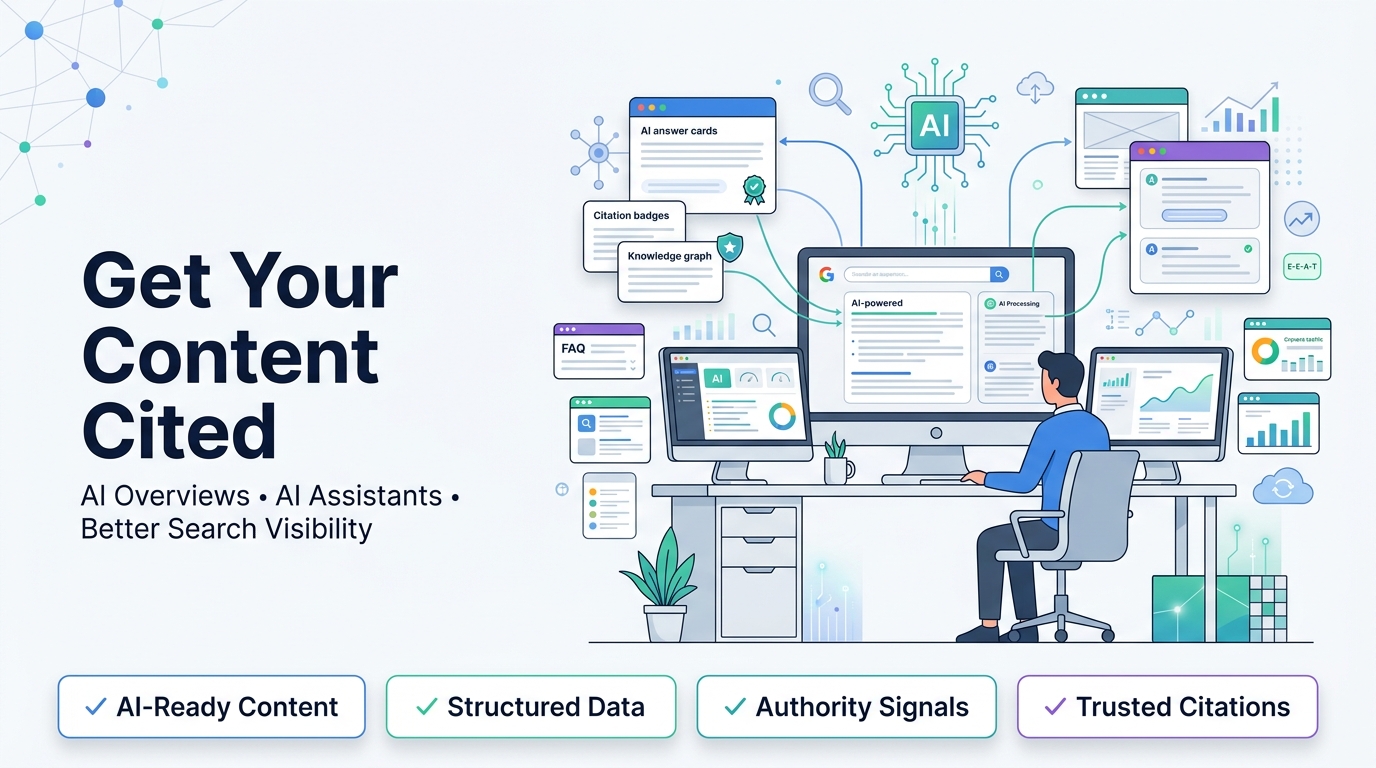
How Google AI Overviews select sources
AI Overviews are built on top of Google's existing search index and ranking systems. In practice, this means:
Pages already ranking reasonably well organically for a query are far more likely to be pulled into an AI Overview, since the system draws heavily from Google's existing understanding of relevance and authority for that query.
The content selected tends to mirror what already performs well in featured snippets direct, clearly structured answers near the top of a well-organized page.
Multiple sources are often cited within a single AI Overview, meaning you're not necessarily competing for one single spot the way you might for a featured snippet.
How ChatGPT selects and cites sources
ChatGPT's citation behavior depends on which mode is active. Its underlying training data reflects a broad snapshot of publicly available web content up to a point in time, without live citations. But when ChatGPT uses live web browsing which is increasingly the default for time-sensitive or specific queries it behaves more like a real-time research assistant, retrieving current pages, evaluating them, and citing specific sources directly in its response.
For live-browsing citations specifically, a few things matter more than raw historical authority:
Current crawlability, since the system is fetching pages in real time rather than relying solely on older training data
Clear, well-structured answers that are easy to extract accurately in the moment
Source credibility signals that are quickly verifiable, since the system doesn't have unlimited time to evaluate a page's full history and reputation
The Technical SEO Foundation Citation Depends On
Before any content or structural tactic can help, your site needs to be technically accessible to both traditional crawlers and AI systems in the first place. This is where a proper technical SEO service matters more than many businesses realize when they're focused purely on content strategy.
Crawlability and indexing
If a page can't be crawled and indexed cleanly, it doesn't matter how well-written the content is it simply won't be part of the pool either system draws from. This includes proper robots.txt configuration, clean XML sitemaps, and no accidental noindex tags blocking important pages.
Site speed and Core Web Vitals
Slow-loading pages create friction for both traditional crawlers and AI systems retrieving content in real time. A technical seo audit service should flag any pages with poor load times or layout instability that could be quietly working against citation eligibility.
Structured data implementation
Schema markup Article, FAQPage, Product, Organization, and Review schema depending on the page gives search engines and AI systems unambiguous, machine-readable context. It isn't a guaranteed citation trigger on its own, but it removes a layer of ambiguity that otherwise works against clear extraction.
Mobile usability and clean HTML
Both systems need to parse your page's actual content cleanly. Bloated, poorly structured HTML, intrusive pop-ups, or content locked behind JavaScript rendering that crawlers struggle with can all quietly reduce your odds of clean extraction.
This is exactly the kind of groundwork a proper technical seo audit uncovers and it's worth treating as a prerequisite step before investing heavily in new content aimed at AI citation specifically. Businesses evaluating outside help for this stage typically look for technical seo auditing services or a technical seo audit service company that can produce a clear, prioritized list of fixes rather than a generic report.
Step-by-Step: How to Get Cited in Google AI Overviews
1. Rank well organically first
Since AI Overviews draw heavily from existing search rankings, strong traditional SEO remains the single highest-leverage starting point. There's no reliable shortcut around this.
2. Answer the query directly near the top of the page
Structure your content so the core answer to the target question appears within the first sentence or two of the relevant section, rather than after several paragraphs of introduction.
3. Use clear, extractable formatting
Numbered lists, bullet points, definition-style openings, and short paragraphs all make it easier for Google's systems to lift a clean, accurate excerpt from your page.
4. Cover the full scope of the question
Thin content that only partially answers a query is less likely to be selected than content that thoroughly addresses the question and its natural follow-ups within the same page.
5. Maintain accuracy and freshness
For time-sensitive topics pricing, statistics, product availability keep the content updated. AI Overviews appear to favor current, verifiably accurate information, particularly for queries where facts change.
6. Monitor which queries trigger AI Overviews for your topics
Track your target keywords specifically for AI Overview appearances, and note whether your content is being cited. This tells you where to prioritize further optimization rather than guessing.
Step-by-Step: How to Get Cited in ChatGPT
1. Make sure your content is genuinely crawlable in real time
Since live browsing citations depend on ChatGPT retrieving current pages, the same technical fundamentals crawlability, speed, clean HTML apply here just as much as they do for Google.
2. Write in a natural, conversational register
Content that mirrors how people actually phrase questions in conversation tends to align more closely with how ChatGPT queries are typically framed, compared to content written purely around short keyword phrases.
3. Build topical depth across multiple pages
A single article rarely establishes enough authority on its own. A cluster of well-organized, interlinked content around a subject signals the kind of depth that supports confident citation.
4. Include clear, quotable statements
Content with specific, well-phrased statements a clear definition, a direct comparison, a concrete statistic gives the system something precise to quote or summarize accurately, rather than something it has to paraphrase loosely.
5. Earn genuine external validation
Backlinks and mentions from other credible sources appear to reinforce how confidently AI systems treat a given source as trustworthy enough to cite directly.
6. Keep author and organizational credibility visible
Clear author bylines, credentials, and organizational transparency (an About page, verifiable contact information) support the same trust signals that influence traditional SEO authority and likely factor into AI citation confidence as well.
Content Formats That Consistently Earn Citations
Certain content structures show up disproportionately often in both AI Overviews and ChatGPT citations:
Definition-style openings clearly stating X is... within the first sentence of a section
Comparison tables structured, side-by-side comparisons that are easy to extract and summarize accurately
Numbered step-by-step guides processes broken into clear, sequential steps
FAQ sections direct question-and-answer pairs that function as self-contained extractable units
Original data or statistics content citing specific, sourced figures tends to be treated as more authoritative than purely opinion-based content
Industry-Specific Approaches to AI Citation
Different industries face different citation dynamics worth accounting for.
Ecommerce
Product comparison queries increasingly get synthesized directly by AI systems. Ecommerce seo services and platform-specific work like a shopify technical seo audit service should specifically address structured Product and Review schema, since comparison-style AI answers draw heavily on this kind of structured product data.
Small businesses and local services
Small business seo services aimed at AI citation should prioritize clear, specific answers to the exact questions local customers ask pricing, process, and comparison questions since these tend to be exactly the kind of specific query both AI Overviews and ChatGPT handle well.
B2B
Longer, research-driven buying journeys increasingly involve ChatGPT for vendor comparison. B2B seo services should account for citation-worthy comparison and evaluation content built around genuine buyer questions, not just product feature lists.
Regulated and specialized industries
Fields like insurance and healthcare face an added trust bar, since AI systems appear to weigh source credibility especially heavily for topics with real financial or health consequences. Insurance technical seo services in particular should prioritize clear author credentials, accurate regulatory information, and technical accessibility, since both accuracy and technical crawlability compound in importance here.
Dental and other local professional services
Dental seo services benefit from the same local-AEO principles that apply broadly to service businesses: consistent business information, clear answers to common patient questions, and a technically sound, fast-loading site that doesn't create friction for either traditional crawlers or AI retrieval.
International businesses
International seo services need to account for the fact that AI citation behavior varies across languages, regions, and even individual platforms a page optimized for citation in one market won't necessarily transfer cleanly to another without real localization work, both linguistically and in terms of locally credible sourcing.
Choosing the Right Support: SEO and Technical Audit Services
Given how much of AI citation depends on technical accessibility, it's worth understanding how to evaluate outside help specifically for this layer of work.
A proper technical seo service engagement should start with a full seo technical audit service covering crawlability, indexing, site speed, structured data, and mobile usability the foundation everything else depends on. When comparing technical seo audit services providers, look for a clear, prioritized list of issues tied to specific pages, not just a generic scorecard.
For platform-specific sites, a dedicated shopify technical seo audit service expert should understand Shopify's particular constraints around URL structure, app-related script bloat, and theme-level rendering issues that generic audits sometimes miss. The same logic applies to wordpress seo services, where plugin conflicts and page-builder bloat are common, platform-specific technical issues worth flagging separately.
Beyond the technical layer, seo content writing services and seo copywriting services become central to citation success, since content clarity and structure not backlinks alone most directly determine whether AI systems extract and cite your content accurately. A provider offering organic seo services or positioned as a broader seo marketing services partner should be able to explain specifically how their content process accounts for direct-answer structure, not just keyword targeting.
If you're an agency looking to add this capability for your own clients, white label seo services covering both the technical audit side and the content structuring side let you offer a combined AEO-aware strategy without building every piece of expertise internally from scratch.
Common Mistakes That Hurt Citation Chances
Publishing content without checking technical accessibility first. Excellent writing on a page blocked by a crawl error or buried under slow-loading scripts never gets the chance to be evaluated at all.
Burying the answer under unnecessary preamble. Long introductions before the actual point delay or prevent clean extraction.
Treating schema markup as optional. Skipping structured data removes a layer of clarity that costs little to implement and offers a real, if unconfirmed, benefit.
Letting facts go stale. Outdated statistics or pricing that contradicts more current information elsewhere undermines the trust signals citation depends on.
Chasing citation at the expense of accuracy. Content engineered to sound authoritative without being genuinely correct risks real reputational damage once inaccuracies get repeated and amplified by AI systems.
How to Track Whether Your Citation Efforts Are Working
Search for your target queries directly in Google and ChatGPT periodically to see whether and how your content is being cited.
Monitor branded search volume for upticks that may correlate with increased AI-driven exposure.
Track referral traffic patterns from AI platforms where available, even though this remains a less mature area of analytics than traditional referral tracking.
Revisit your technical audit regularly, since crawlability and site health can degrade over time as new pages, plugins, or content get added without oversight.
A Practical Example: Turning a Weak Page Into a Citation-Ready One
It helps to see this as a concrete before-and-after rather than an abstract list of tips. Imagine a dental practice with an existing blog post titled Everything About Root Canals, written as a long, narrative-style article with no headers for the first several paragraphs, no schema markup, and a page load time of over five seconds due to unoptimized images.
The technical layer first. A technical seo audit service flags the slow load time, missing image compression, and an absent FAQPage schema opportunity, given the content already answers several common patient questions buried in the text. These get fixed: images compressed, unnecessary scripts trimmed, and Article plus FAQPage schema added.
Then the content structure. The page gets reorganized around the actual questions patients ask How painful is a root canal?, How long does recovery take?, How much does a root canal cost? each with a direct, one-to-two-sentence answer at the top of its section, followed by supporting detail. A comparison table contrasting root canal treatment with tooth extraction is added, since that's a genuinely common decision point patients search for.
The result is a page that's now fast, clearly structured, and directly answers exactly the kind of specific, high-intent questions both Google AI Overviews and ChatGPT are well-suited to extract and cite without the underlying expertise or content quality having fundamentally changed. What changed was accessibility and clarity, which is precisely where most citation opportunity is lost or won.
Building Citation Tracking Into Your Regular SEO Workflow
Citation monitoring shouldn't be a one-time check it works best folded into whatever reporting cadence you already use for traditional SEO.
Set a recurring schedule monthly is reasonable for most businesses to manually search your top target queries in both Google and ChatGPT and note whether your content appears, and how it's being represented.
Keep a simple log of which queries triggered citations, which didn't, and any patterns in content format between the two, so you can spot what's actually working rather than guessing.
Loop findings back into your technical audit cycle. If a previously-cited page stops appearing, check for technical regressions first a broken schema tag, a slower load time introduced by a new plugin, or an accidental noindex before assuming the content itself is the problem.
Treat this as an ongoing layer of your existing SEO process, not a separate initiative competing for attention, since the two are far more connected than they might initially appear.
Final Thoughts
Earning a citation inside Google AI Overviews or ChatGPT isn't a matter of one clever trick it's the natural outcome of a technically sound website, content that answers questions clearly and completely, and credible, consistent sourcing across the web. Start with the technical foundation, since no amount of great content overcomes a page these systems can't properly access in the first place, then build content genuinely structured to be understood and trusted by a person or a machine, either way.
Frequently Asked Questions
Does ranking #1 in Google guarantee an AI Overview citation?
No, but it significantly improves your odds, since AI Overviews draw heavily from already well-ranking content. Strong organic performance is a strong predictor, not a guarantee.
Can a brand-new website get cited in ChatGPT or AI Overviews?
It's harder, since both systems favor established trust signals, but not impossible a technically sound site with clear, accurate, well-structured content on a genuinely under-served topic can earn citation faster than a broad, competitive topic would allow.
How important is a technical SEO audit for AI citation specifically?
Very important if a page isn't cleanly crawlable and fast-loading, none of the content-level optimization matters, since the system may never retrieve or index it properly in the first place.
Do I need different content for Google AI Overviews versus ChatGPT?
Not fundamentally different, but conversational, naturally-phrased content tends to perform slightly better for ChatGPT queries, while tightly structured, snippet-style formatting tends to favor AI Overview inclusion. Well-built content usually satisfies both.
Is there a way to guarantee an AI citation?
No platform guarantees citation, and any provider promising a guarantee should be treated with skepticism. The realistic goal is meaningfully improving your odds through technical soundness, content clarity, and credible sourcing not securing a fixed outcome.
Get a free audit and see exactly how this applies to your site.