Traffic from search engines is one of the few marketing channels that keeps working long after the initial effort is spent. A well-optimized blog post or product page can keep bringing in visitors for years, without the ongoing spend that paid advertising demands. But "doing SEO" and actually growing organic traffic in a measurable way are two very different things and the gap between them usually comes down to a handful of fundamentals that get overlooked.
This guide walks through the practical steps that move the needle on organic traffic, from technical foundations to content strategy, link building, and knowing when it makes sense to bring in outside help. Whether you're managing SEO yourself or evaluating an seo service to handle it for you, understanding what actually drives traffic growth will help you make better decisions either way.
What Counts as SEO Traffic, and Why It Matters
SEO traffic refers to visitors who arrive at your website through unpaid, organic search results as opposed to paid ads, social media referrals, or direct visits. It's driven by how well your pages match what people are searching for, and how much search engines trust your site to deliver a good answer.
Organic traffic tends to compound over time in a way paid traffic doesn't. A page that ranks well can continue attracting visitors for months or years with little additional investment, while paid traffic stops the moment the budget does. That compounding effect is exactly why organic seo services remain one of the most requested offerings among businesses trying to build sustainable, long-term visibility rather than relying on a channel that requires continuous spend.
Start With a Technical SEO Foundation
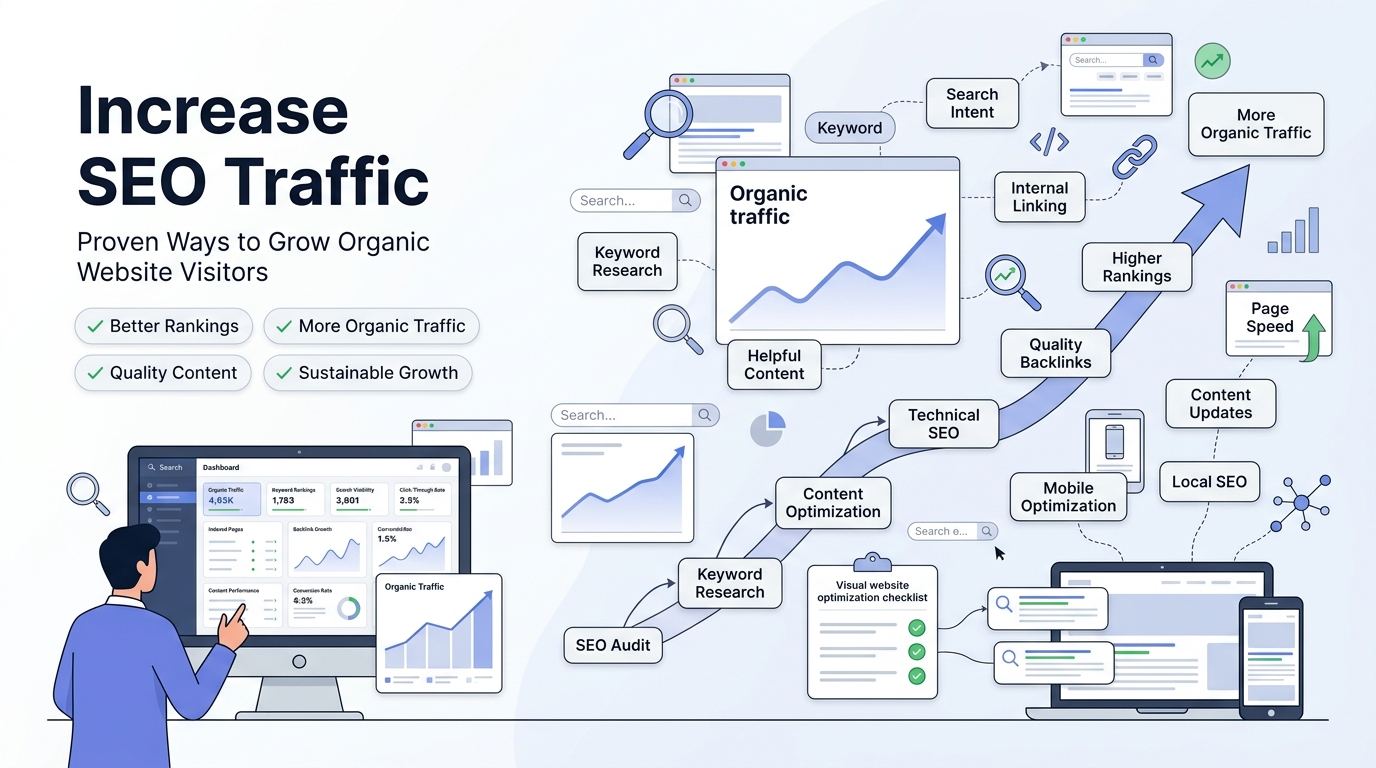
Before content or link building can have much impact, your website needs to be technically sound enough for search engines to crawl, index, and understand it properly. Skipping this step is one of the most common reasons traffic growth stalls despite significant content investment.
Site speed. Slow-loading pages hurt both rankings and user experience visitors are far more likely to leave a page that takes several seconds to load, and that behavior signals poor quality to search engines. Compressing images, minimizing unnecessary scripts, and using a reliable hosting provider all contribute to faster load times.
Mobile-friendliness. Since the majority of searches now happen on mobile devices, and search engines primarily index the mobile version of a site, a responsive design isn't optional it's foundational.
Crawlability and indexing. Make sure your XML sitemap is up to date, your robots.txt file isn't accidentally blocking important pages, and there are no broken internal links preventing search engines from discovering your content.
Site structure. A logical, shallow site structure where important pages are just a click or two from the homepage helps both search engines and visitors navigate your site more efficiently.
Secure, accessible URLs. HTTPS is now a baseline expectation, and clean, descriptive URLs (rather than long strings of parameters) tend to perform better and are easier for both users and search engines to understand.
Build Your Strategy Around Real Keyword Research
Guessing at what your audience searches for is one of the fastest ways to waste content effort. Proper keyword research grounds your strategy in actual search demand.
Start by identifying a mix of:
High-volume, competitive terms that define your core offering
Long-tail keywords with lower competition but clearer intent these often convert better and are easier to rank for, especially for newer sites
Question-based queries that reflect how people naturally phrase searches, which are increasingly important as search engines prioritize direct, conversational answers
Understanding search intent behind each keyword matters just as much as search volume. A keyword like "seo services near me" reflects someone ready to hire, while a broader term like "how does SEO work" reflects someone still researching and each deserves a different type of content built around it.
On-Page SEO: Getting the Fundamentals Right
Once you know what to target, on-page optimization ensures each page clearly communicates its relevance to both search engines and visitors.
Title tags and meta descriptions should include your primary keyword naturally while still reading like something a person would actually want to click.
Header structure (H1, H2, H3) should organize content logically, making it easier for both readers and search engines to understand the page's structure.
Internal linking connects related pages together, helping distribute authority throughout your site and helping visitors (and search engines) discover more of your content.
Image optimization, including descriptive file names and alt text, contributes to both accessibility and image search visibility.
Semantic, topic-rich content that naturally includes related terms and concepts rather than repeating a single exact-match keyword tends to rank for a wider range of relevant searches and reads more naturally to actual visitors.
Content Is Still the Engine Behind Organic Growth
Even with strong technical foundations, traffic growth depends heavily on consistently publishing content that actually answers what your audience is searching for. This is where many businesses either invest in seo content writing services or build an internal content process, since quality and consistency both matter enormously.
Depth over length for its own sake. Comprehensive content that genuinely covers a topic tends to outperform thin content padded to hit a word count. That said, longer, well-organized guides often naturally rank for more related keywords simply because they cover more ground.
Update existing content regularly. Refreshing older posts with new information, updated statistics, and improved structure is often more efficient than only publishing new content, since existing pages may already have some authority built up.
Balance informational and commercial content. A healthy content strategy includes educational blog posts that build authority and trust, alongside more commercially focused pages designed to convert visitors who are further along in their decision process. This is the distinction between seo content services focused on top-of-funnel education, and seo copywriting services aimed specifically at persuading a reader to take action once they've arrived.
Write for people first. Search engines have gotten significantly better at recognizing content written primarily to manipulate rankings rather than genuinely help readers. Clear, well-researched, useful content consistently outperforms keyword-stuffed pages over the long run.
Link Building: Earning Authority, Not Just Volume
Backlinks remain one of the strongest signals search engines use to judge a site's credibility. However, the quality and relevance of links matter far more than sheer quantity.
Earn links through genuinely useful content original research, data-driven guides, and tools tend to attract natural links more effectively than generic posts.
Build relationships through outreach, connecting with other sites in your industry for guest posts, mentions, or collaborative content.
Fix broken links on other sites by suggesting your own relevant content as a replacement a low-friction way to earn placements.
Avoid manipulative tactics, such as buying links in bulk from low-quality networks, which can lead to penalties that undo months of legitimate progress.
Local SEO: Capturing Nearby Search Intent
Contentiris For businesses serving a specific geographic area, local search behavior deserves dedicated attention. When someone searches for seo services near me, or searches for any local business "near me," they're typically ready to take action soon making local visibility a high-value opportunity.
Key elements of local SEO include:
Google Business Profile optimization, including accurate business information, categories, and regularly updated photos
Consistent citations across directories, with matching name, address, and phone number details
Localized content, including location-specific landing pages for businesses serving multiple areas
Review management, since review volume and recency both influence local search visibility
This matters across virtually every industry a dental seo services strategy, for example, depends heavily on local visibility, since most patients search for providers within a specific, limited radius of their home or workplace.
SEO for Different Business Models
Traffic growth strategies aren't one-size-fits-all the right approach depends heavily on your business model and platform.
E-commerce SEO. Online stores face unique challenges: product pages need unique descriptions rather than manufacturer copy, category pages need to balance broad and specific keyword targeting, and site speed becomes especially critical given typically large product catalogs. Businesses running online stores often turn to ecommerce seo services or platform-specific expertise, such as shopify seo services for stores built on Shopify, which address platform-specific technical considerations around app-based site speed, collection structure, and product schema markup.
Content management platform considerations. Sites built on WordPress have their own set of technical factors plugin management, page speed optimization, and proper schema implementation which is why wordpress seo services specifically addressing these platform quirks can meaningfully speed up traffic growth compared to generic, platform-agnostic advice.
B2B SEO. Business-to-business companies typically deal with longer sales cycles and multiple decision-makers researching a purchase over weeks or months. B2b seo services USA tend to prioritize content built around comparison, research-stage questions, and case studies rather than immediate transactional keywords, reflecting how B2B buyers actually search and evaluate options.
International SEO. Businesses expanding into new markets or serving multiple countries need to think beyond simple translation. International seo services typically involve proper hreflang implementation, localized keyword research (since search behavior varies by country and language), and content genuinely adapted for cultural context rather than directly translated.
Should You Manage SEO In-House or Hire Help?
Growing organic traffic takes consistent effort across multiple disciplines technical fixes, content production, and link building all require ongoing attention rather than a one-time push. For many businesses, this raises a practical question: handle it internally, or bring in outside expertise?
Signs you might benefit from outside help:
You don't have the internal bandwidth to consistently publish content or monitor technical issues
Your traffic has plateaued despite reasonably consistent effort
You're a small business without a dedicated marketing hire, and small business seo services can fill that gap more affordably than a full-time employee
You need specialized expertise for a specific platform or channel, such as ecommerce seo services for a growing online store
Types of SEO support available:
Full-service seo marketing services covering strategy, technical audits, content, and link building together
Monthly seo services structured as ongoing retainers, which suit businesses looking for continuous, incremental improvement rather than a one-time project
Affordable seo services aimed at smaller budgets, often focused on a narrower scope like local SEO or content alone
White label seo services, typically used by agencies and consultants who want to offer SEO to their own clients without building an internal team
Seo reseller services, a closely related model where agencies purchase SEO work to resell under their own brand
If you're specifically comparing seo services for small businesses, look for providers who scope their pricing and service level to match a smaller budget and simpler website, rather than applying enterprise-level pricing to a five-page business site.
How to Choose the Right SEO Partner
Not all providers deliver the same value, and a structured evaluation process helps avoid a costly mismatch.
Ask for case studies or examples relevant to your industry or business size, rather than generic before-and-after screenshots.
Clarify what's included in reporting. A reputable organic seo services company should be able to show ranking movement, traffic trends, and completed work in clear, understandable terms not just vague promises.
Understand the timeline. SEO is a compounding process; be cautious of any provider guaranteeing specific rankings within an unrealistically short window.
Confirm ethical practices, particularly around link building, since manipulative tactics can put your entire site at risk of a penalty.
Match the service to your actual needs. A local service business likely needs different expertise than an e-commerce store or a B2B software company make sure the provider's strengths align with your specific situation.
Measuring Whether Your SEO Efforts Are Working
Tracking the right metrics helps you understand whether your traffic growth strategy is actually working, rather than relying on guesswork.
Organic traffic trends over time, viewed monthly or quarterly rather than reacting to daily fluctuations
Keyword rankings for a defined, prioritized list of target terms
Click-through rate from search results, which reflects how compelling your titles and meta descriptions are
Conversion rate from organic traffic, since traffic alone doesn't matter if it isn't turning into leads, sign-ups, or sales
Backlink growth, tracking both the number and relevance of new referring domains over time
Most meaningful SEO progress takes several months to show up clearly, since search engines need time to crawl, index, and evaluate new or updated content against competing pages.
Common Mistakes That Slow Down Traffic Growth
Focusing only on rankings, not traffic or conversions. Ranking for a keyword with little search volume or poor intent match doesn't translate to meaningful business results.
Publishing inconsistently. A burst of content followed by months of silence tends to underperform a steady, sustainable publishing cadence.
Neglecting technical issues. Even excellent content can underperform on a site with slow load times or crawl errors.
Chasing every algorithm update. Constantly rewriting strategy around every reported update usually creates more instability than following consistent, fundamentals-first best practices.
Ignoring existing content. Many sites see meaningful traffic gains simply by updating and improving pages that already rank on page two or three, rather than only focusing on brand-new content.
Building a Repeatable Traffic-Growth Workflow
One of the biggest differences between businesses that see steady organic growth and those that stall out after an initial push is whether they treat SEO as a repeatable system rather than a series of one-off projects. A simple, sustainable workflow tends to outperform sporadic bursts of effort, even when the total time invested is similar.
Set a realistic publishing cadence. Rather than committing to an ambitious schedule that fizzles out after a month, choose a pace you can maintain consistently even one well-researched, thorough piece of content per week compounds meaningfully over a year.
Audit performance quarterly. Every few months, review which pages are gaining traffic, which have stalled, and which have actually declined. This helps prioritize where to focus: updating an underperforming page that already has some authority is often faster than starting from zero with new content.
Keep a running list of content and technical opportunities. Rather than deciding what to work on reactively, maintain a simple backlog of keyword opportunities, pages that need technical fixes, and outdated content that needs refreshing. This makes planning far more efficient than starting from scratch each month.
Loop in feedback from actual conversions. Traffic is only valuable if some portion of it converts into leads, sign-ups, or sales. Reviewing which pages drive the most conversions not just the most visits helps direct future content and optimization efforts toward what actually supports business goals.
Revisit your keyword strategy periodically. Search behavior shifts over time, new competitors enter the picture, and previously untapped long-tail opportunities emerge. Revisiting keyword research every six to twelve months keeps a content strategy aligned with how people are actually searching today, rather than how they searched when the plan was first built.
This kind of structured, ongoing approach is exactly why many businesses eventually move from ad hoc efforts toward a more formal engagement whether that's hiring an internal specialist or working with an organic seo services company that can maintain this cadence consistently, month after month, without the effort quietly dropping off during busy periods.
Final Thoughts
Growing SEO traffic isn't about chasing a single trick or algorithm hack it's the result of consistent, fundamentals-first work across technical health, content quality, and earned authority. Start by making sure your site is technically sound and easy to crawl, build content around real search intent rather than guesswork, and earn links through genuine value rather than shortcuts. Whether you handle this in-house or bring in an experienced seo service to help, the businesses that see the strongest long-term traffic growth are almost always the ones that treat SEO as an ongoing process rather than a one-time project.
Frequently Asked Questions
How long does it take to see results from SEO?
Most businesses start seeing meaningful movement within three to six months, though highly competitive industries or newer websites may take longer. Early technical and on-page improvements often show impact sooner than content or link-building efforts.
Is it better to hire an SEO service or handle it in-house?
It depends on available time, expertise, and budget. Businesses with limited internal resources often find that affordable seo services or monthly seo services provide better ROI than attempting to build every skill set internally.
What's the difference between organic and paid traffic?
Organic traffic comes from unpaid search results and tends to build compounding value over time, while paid traffic (through ads) stops as soon as spending stops. Most sustainable long-term strategies rely primarily on organic growth, sometimes supplemented by paid campaigns.
Do I need different SEO strategies for different platforms?
Yes, to some extent. While core SEO principles apply everywhere, platform-specific factors such as those addressed by shopify seo services or wordpress seo services can meaningfully affect technical performance and should be accounted for.
How much should I budget for SEO services?
Pricing varies widely based on scope, competition, and business size. Small businesses often start with a narrower, more affordable scope and expand their investment as they see measurable traffic and conversion growth.
Can I combine in-house efforts with outside SEO services?
Absolutely, and many businesses do. A common approach is handling day-to-day content publishing internally while relying on specialized seo marketing services for technical audits, link building, or platform-specific work that requires deeper expertise. This hybrid model often makes efficient use of both internal knowledge of the business and external SEO specialization.
Get a free audit and see exactly how this applies to your site.