Search has changed more in the last two years than in the previous decade combined. SEO in 2026 no longer means competing for ten blue links on a results page a growing share of queries now surface an AI-generated summary before any traditional listing appears at all, and an entirely separate conversational experience, Google AI Mode, is reshaping how people search altogether. For businesses and content creators, the practical question has shifted from "how do I rank #1 to something more fundamental: how do you get cited inside an AI-generated answer in the first place?
This guide breaks down exactly what's actually changed, how Google AI Overviews SEO and Google AI Mode SEO differ from traditional optimization, and the concrete strategies that are working right now to improve visibility inside both surfaces. Consider this your working playbook for AI SEO heading into the rest of the year.
How AI Is Changing SEO in 2026
The shift underway isn't a minor algorithm tweak it's a structural change in how search engines retrieve and present information. Traditional SEO ranked whole pages against a query using keywords, backlinks, and user signals, then returned a ranked list for the searcher to click through. AI-driven search works differently: instead of returning links, systems like Google AI Overviews and AI Mode synthesize an answer by pulling relevant passages from multiple sources and presenting a single, conversational response, with citations to the sources used.
This changes the actual unit of competition. You're no longer just competing for a ranking position you're competing to be one of the handful of sources an AI system chooses to cite when constructing its answer. And critically, being cited doesn't require ranking #1. Research into AI Overview citation patterns has repeatedly shown that a substantial share of cited sources come from well outside the traditional top five organic positions, since the systems selecting citations weigh passage-level relevance, trust signals, and topical depth rather than overall page rank alone.
This is exactly why how AI is changing SEO in 2026 has become one of the most searched questions in the industry practitioners who spent years optimizing purely for ranking position are discovering that ranking well doesn't automatically translate into AI visibility, and the two now require distinct, if overlapping, strategies.
Google AI Overviews vs. Google AI Mode: What's the Difference?
Before diving into tactics, it's worth being clear on what each surface actually is, since they behave differently and reward slightly different signals.
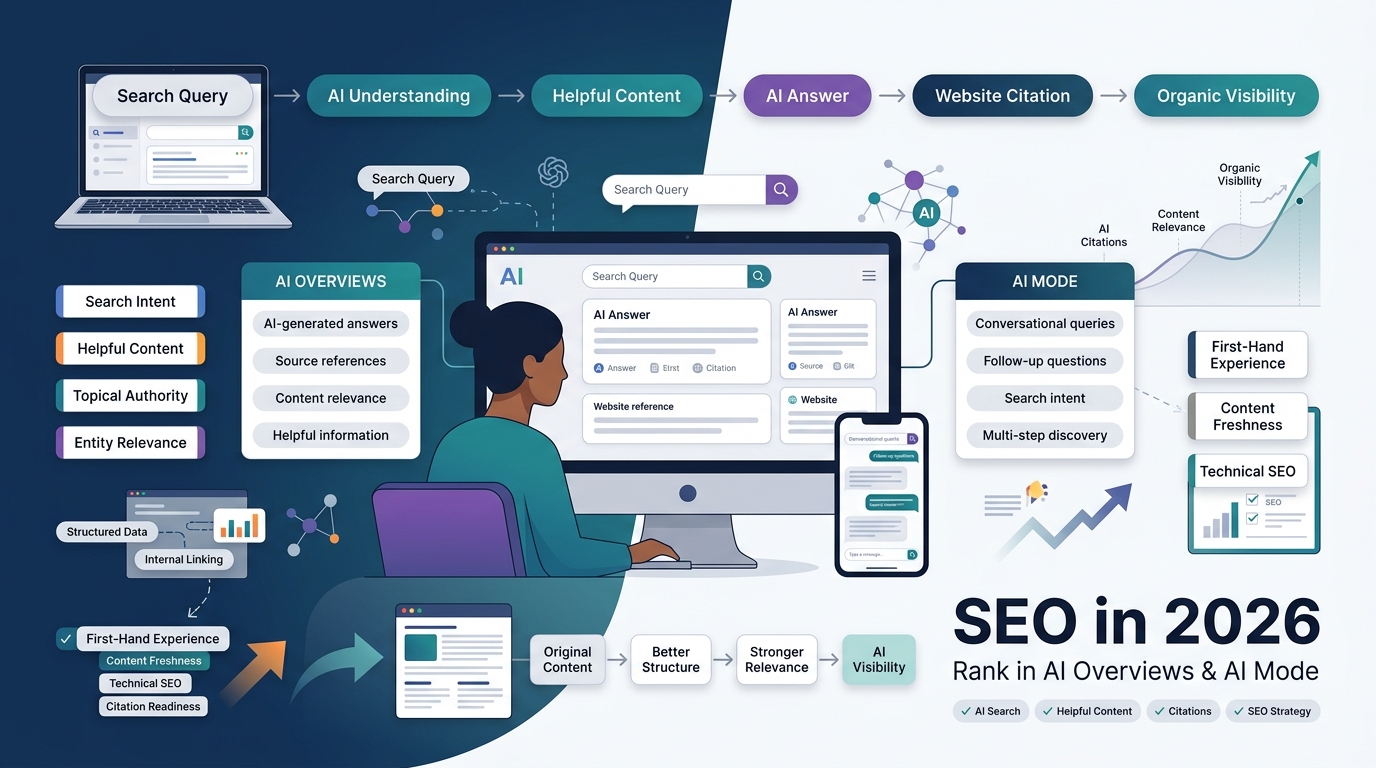
Google AI Overviews appear directly within standard search results an AI-generated summary box sitting above or alongside traditional organic listings, answering the query directly while citing the sources it drew from. Users can still see and click through to traditional results below the overview, making it an additive layer on top of classic search rather than a full replacement.
Google AI Mode is a more fully conversational search experience, built to handle complex, multi-part queries through a chat-like interface rather than a static results page. Rather than returning a single static answer, AI Mode can break a query into multiple sub-questions behind the scenes, gather information across several sources for each, and synthesize a more comprehensive response closer to a research assistant than a search engine in the traditional sense.
The overlap between what gets cited in each surface is smaller than most people assume. Sources appearing in AI Mode citations frequently differ from those appearing in standard AI Overview citations for the same topic, which means a strategy built purely around SEO for AI Overviews won't automatically translate into strong AI Mode optimization both need deliberate attention.
Google AI Overviews Ranking Factors
Understanding what actually drives citation selection is the foundation of any real strategy here. Based on current research and observed patterns, several factors consistently correlate with which sources get cited inside AI Overviews.
Topical Authority and Comprehensiveness
AI systems favor sources that cover a topic thoroughly rather than addressing it in a single shallow paragraph. A page that answers not just the primary question but the natural follow-up questions a reader would have is far more likely to be pulled from than one narrowly focused on a single keyword phrase.
E-E-A-T Signals
Experience, Expertise, Authoritativeness, and Trustworthiness have become effectively non-negotiable rather than a nice-to-have. Author credentials, first-hand experience, original data, and transparent sourcing all feed into how much an AI system trusts a given page enough to cite it directly in a generated answer.
Structured, Extractable Formatting
Content that's easy for a machine to parse clear headings, concise direct-answer paragraphs, bullet points, tables, and well-organized sections gets extracted and cited more reliably than dense, unstructured prose. AI systems need to isolate a specific, accurate passage quickly, and formatting that makes that easy meaningfully improves citation odds.
Structured Data and Schema Markup
Schema markup helps AI systems understand exactly what a page is about, what type of content it contains, and how its pieces relate to each other. While not a magic bullet on its own, structured data consistently correlates with improved discoverability for AI-driven retrieval systems.
Content Freshness
AI systems weigh recency meaningfully when selecting sources, particularly for topics where information changes over time. A page last meaningfully updated years ago competes at a real disadvantage against a recently refreshed article covering the same ground with current data and examples.
Technical Crawlability
None of the above matters if AI crawlers can't actually access your content. Robots.txt misconfigurations, aggressive bot-blocking (including default settings on some CDN and security services), and slow-loading pages can silently remove a site from consideration entirely, regardless of content quality.
Google AI Mode Ranking Factors
AI Mode shares foundational overlap with AI Overview ranking factors but adds its own layer of emphasis, largely because of how it processes more complex, multi-part queries.
Entity coherence matters more here AI Mode evaluates how clearly a site establishes itself as an authoritative entity around a specific topic area, not just whether an individual page answers a specific question well.
Answer extractability is weighted heavily, since AI Mode frequently breaks a single user query into multiple sub-questions behind the scenes, retrieving and synthesizing information for each before combining them into a final response. Content structured to directly and cleanly answer discrete sub-questions performs better than content that requires significant synthesis to extract a usable answer.
Semantic topical mapping how thoroughly a site or content cluster covers not just the primary topic but its closely related subtopics appears to carry more weight in AI Mode than in standard AI Overviews, rewarding sites that build genuine topic clusters rather than isolated, disconnected articles.
Multi-modal content is increasingly relevant as well. Sources that combine well-structured text with supporting images, video, or data visualizations tend to perform better than text-only pages, reflecting how these systems increasingly draw from and reference varied content formats when constructing richer answers.
Together, these represent the current best understanding of Google AI Mode ranking factors and given how quickly this space continues to evolve, treating this as a fixed checklist rather than a living, evolving discipline would be a mistake.
What Is Generative Engine Optimization (GEO)?
Generative engine optimization (GEO) has emerged as the umbrella term for the practice of structuring content specifically to be retrieved, synthesized, and cited by AI-generated answers across Google AI Overviews and AI Mode, as well as external systems like ChatGPT, Perplexity, Gemini, and Claude. Where traditional SEO optimizes for ranking position in a list of links, GEO optimizes for something different entirely: citation frequency and inclusion inside a generated response.
The relationship between the two disciplines isn't competitive it's additive. Strong technical SEO, clean site architecture, and quality backlinks continue to matter as a foundation, but GEO adds specific requirements traditional SEO alone doesn't address: structuring content for extractability, building genuine topical depth around entity clusters, and prioritizing content freshness and original insight over simply matching keyword intent. Businesses treating GEO as a replacement for SEO, rather than a parallel layer built on top of it, tend to underperform both disciplines simultaneously.
How to Rank in Google AI Overviews: A Practical Framework
Turning the ranking factors above into an actual action plan to optimize for Google AI Overviews comes down to a few concrete steps.
1. Lead with the direct answer. The opening section of any page targeting AI Overview visibility should answer the core query clearly and completely within the first few sentences, rather than building up to it through a lengthy introduction. AI systems retrieving passages favor content that front-loads the answer rather than burying it.
2. Build genuine topical depth. Cover the natural follow-up questions a reader would have alongside the primary query, rather than stopping once the surface-level question is answered. This is the single biggest lever for improving how content gets evaluated for comprehensiveness.
3. Add structured data throughout. Implement relevant schema markup Article, FAQPage, HowTo, or Product schema depending on content type consistently across your site, not just on a handful of flagship pages.
4. Strengthen E-E-A-T signals visibly. Add real author bios with genuine credentials, cite credible external sources to support claims, and include first-hand data, case studies, or original insight wherever possible rather than purely synthesizing existing published information.
5. Keep cornerstone content current. Set a recurring schedule to revisit and refresh your most important pages with updated data, new examples, and a visible "last updated" date, since freshness is weighted meaningfully in citation selection.
6. Confirm technical accessibility. Audit robots.txt and bot-management settings specifically for AI crawler access many sites unintentionally block AI bots through default security configurations without realizing it.
Following this framework consistently and treating the goal as learning to genuinely rank in AI Overviews rather than chasing a single tactic is what separates sites that reliably show up in AI-generated answers from those left wondering why their strong traditional rankings aren't translating into AI visibility.
SEO Strategies for Google AI Overviews: A Quick Reference
Pulling the framework above into a condensed set of SEO strategies for Google AI Overviews you can act on this week:
Audit your top 20 commercial and informational pages for direct-answer clarity in the opening paragraph
Add or expand FAQ sections addressing genuine follow-up questions readers have
Implement or refresh schema markup across your highest-traffic templates
Set a recurring quarterly review cycle for your cornerstone content
Confirm AI crawler access isn't being silently blocked by security or CDN defaults
Small, consistent execution against this list tends to outperform sporadic, large one-off content overhauls citation selection rewards sustained topical authority more than a single burst of optimized content.
AI Search Ranking Factors 2026: What's Likely to Matter Next
Looking ahead, several emerging signals appear likely to carry increasing weight among AI search ranking factors 2026 and beyond, based on current trajectory: deeper emphasis on multi-modal content combining text with data visualizations and video, growing weight on cross-platform entity presence (being recognized consistently across your own site, business listings, and third-party mentions), and continued tightening of E-E-A-T requirements across content categories that previously received less scrutiny. None of these represent a dramatic departure from current best practices they're a continuation of the same trajectory already underway, which is exactly why building strong foundations now pays compounding dividends rather than requiring a reactive scramble later.
How to Rank in Google AI Mode
Because AI Mode handles more complex, multi-part queries through sub-question retrieval, the optimization approach needs an additional layer beyond standard AI Overview tactics.
Build topic clusters, not isolated articles. Organize related content into clearly interlinked clusters a hub page covering a broad topic, linked to detailed subpages addressing specific subtopics so AI Mode's sub-question retrieval process finds multiple relevant, interconnected sources from your site rather than a single disconnected page.
Structure content around discrete, answerable sub-questions. Break longer content into clearly labeled sections that each directly answer a specific question, since AI Mode frequently retrieves and synthesizes multiple narrow answers rather than a single broad passage.
Reinforce entity clarity sitewide. Make sure your site consistently and clearly establishes what entity (brand, expert, organization) it represents across About pages, author bios, and structured data this feeds directly into the entity coherence signals AI Mode weighs heavily.
Diversify content formats. Where relevant, support text content with data tables, comparison charts, or original visuals, since multi-modal sources increasingly have an edge in surfacing within AI Mode's more comprehensive, synthesized responses.
How to Optimize Content for AI Overviews at the Page Level
Beyond sitewide strategy, individual page-level choices meaningfully affect citation odds:
Use clear, descriptive headings that function almost like standalone questions and answers
Keep paragraphs concise and scannable rather than dense blocks of text
Include comparison tables or bullet-point breakdowns wherever they genuinely clarify information
Use natural language variation around your core topic rather than repeating one exact keyword phrase mechanically this improves how AI systems build a semantic understanding of your content's relevance
Explicitly connect related concepts within the text, helping AI systems understand relationships between ideas rather than leaving connections implicit
Measuring AI Search Visibility: New Metrics That Matter
Traditional rank tracking alone no longer tells the full story. Improving AI search visibility requires monitoring a different, complementary set of metrics:
Citation share how often your content is cited across a representative set of queries relevant to your business, tracked through emerging AI-visibility monitoring tools
Query-type performance in Search Console segmenting informational versus transactional versus branded queries separately, since AI Overview impact tends to concentrate heavily on informational, how-to, and explainer-style searches
Referral traffic patterns watching for new, highly specific, conversational-style referral queries that indicate traffic originating from an AI-generated citation rather than a standard organic listing
Impressions without click growth a page maintaining or growing impressions while clicks decline can indicate strong AI Overview visibility with users getting their answer without needing to click through, which isn't necessarily a bad outcome if brand visibility and trust are being reinforced
Businesses that continue tracking only traditional ranking position risk missing this entire second layer of visibility developing in parallel and potentially misdiagnosing genuine AI Overview cannibalization as a ranking drop requiring an entirely different fix.
Best SEO Practices for AI Search: Bringing It All Together
Pulling every thread above into a coherent set of AI search optimization strategies, a few principles apply across the board regardless of which specific surface you're targeting:
Foundational SEO still matters. Clean technical architecture, solid site speed, and quality backlinks remain the baseline everything else builds on AI-driven search adds requirements, it doesn't remove existing ones.
Depth beats breadth. Comprehensive, genuinely useful coverage of fewer topics consistently outperforms thin coverage spread across many keywords.
Original insight is a genuine differentiator. Synthesized, generic content increasingly struggles to earn citations when AI systems have countless similar sources to choose from original data, case studies, and first-hand expertise stand out.
Structure for machines and humans simultaneously. The formatting choices that improve AI extractability clear headings, direct answers, logical organization also improve human readability, making this a genuinely low-risk investment.
Treat this as ongoing, not a one-time project. AI ranking factors and citation patterns continue evolving rapidly; a strategy built once and left untouched will lose ground within months, not years.
Common Mistakes Undermining AI Search Rankings
A handful of recurring missteps quietly suppress visibility even for otherwise strong content:
Blocking AI crawlers unintentionally, often through default CDN or security settings that weren't configured with AI bot access specifically in mind
Treating GEO and SEO as separate, competing strategies rather than complementary layers built on the same technical and content foundation
Publishing thin, single-angle content that answers only the literal query without addressing the natural follow-up questions a reader or an AI system fanning out sub-queries would have
Letting cornerstone content go stale, assuming a strong page written years ago will continue performing without periodic refreshes
Chasing exact-match keyword density instead of natural semantic variation, which actually weakens the quality of the topical signals AI systems rely on
How to Appear in AI Search Results: A Quick-Start Checklist
If you're looking for a condensed answer to how to appear in AI search results across Google's surfaces and external AI platforms alike, these are the non-negotiables to get right first:
Confirm AI crawlers can actually access your site (check robots.txt and any CDN-level bot blocking)
Answer the core query directly within the first few sentences of any page
Add relevant schema markup sitewide, not just on a handful of pages
Build real topical depth around your core subject areas rather than isolated one-off articles
Keep your most important content visibly current with regular updates
Get these five right before investing heavily in more advanced tactics they form the baseline that determines whether an AI system can even consider citing you in the first place.
How to Improve AI Search Visibility Over Time
Optimize for Google AI Overviews and AI Mode is not a set-it-and-forget-it project improving visibility is a compounding process that plays out over months, not days. A practical way to think about how to improve AI search visibility on an ongoing basis:
Audit citation performance quarterly against your top commercial and informational queries, noting where competitors are being cited and you aren't
Expand topical coverage incrementally, closing gaps in your content clusters rather than only publishing net-new, disconnected articles
Continue strengthening E-E-A-T signals over time add more original research, more credentialed contributors, more first-hand case studies
Revisit technical accessibility periodically, since crawler access settings and bot-management defaults can change without notice as platforms update their infrastructure
Treated this way, improving visibility becomes a durable, compounding advantage rather than a single campaign with a defined end date.
Search Engine Optimization for AI: Why the Foundations Still Apply
It's worth restating plainly: search engine optimization for AI surfaces is not a wholesale replacement for the discipline that came before it it's an extension of the same underlying principles applied to a new retrieval mechanism. AI-powered search optimization still depends on clean site architecture, genuine expertise, and technical health; what's changed is the presentation layer AI systems build on top of that foundation, and the specific structural choices that make content easier for those systems to extract and cite. Businesses that abandon core SEO practices in favor of chasing AI-specific tactics alone tend to underperform both the two need to be built together, not treated as separate tracks.
Final Thoughts
SEO in 2026 isn't a rejection of everything that came before it's an expansion of it. The fundamentals that always mattered (technical health, genuine expertise, comprehensive content) remain the foundation, but the target has broadened from ranking position alone to citation inside AI-generated answers across Google AI Overviews, AI Mode, and beyond. Businesses treating this shift as a passing trend rather than a structural change in how information gets discovered are already losing ground to competitors building deliberately around it. Start with the fundamentals, layer in the AI-specific structural and content practices covered here, and treat the whole effort as an ongoing discipline rather than a one-time project because the systems deciding what gets cited are only going to keep evolving from here.
Frequently Asked Questions
Do I need to rank #1 organically to appear in Google AI Overviews?
No. Citation selection weighs passage relevance, trust signals, and content comprehensiveness alongside not solely based on traditional ranking position, meaning pages outside the top few organic results regularly earn citations.
Is generative engine optimization replacing traditional SEO?
No GEO builds on traditional SEO fundamentals rather than replacing them. Sites with weak technical foundations or thin content still struggle in AI search, regardless of how well they apply GEO-specific tactics on top.
How is Google AI Mode different from AI Overviews in terms of what to optimize for?
AI Mode handles more complex, multi-part queries through sub-question retrieval, rewarding genuine topic clusters and entity clarity more heavily, while standard AI Overviews lean more on direct-answer clarity and page-level comprehensiveness for a single query.
How often should I update content to maintain AI search visibility?
There's no fixed universal timeline, but revisiting cornerstone content at least every few months updating data, examples, and the visible "last updated" date helps maintain the freshness signal AI systems weigh when selecting sources.
Can small businesses realistically compete for AI Overview citations against larger brands?
Yes. Citation selection favors content quality, structural clarity, and topical depth over sheer brand size or backlink volume alone, meaning a smaller site with genuinely comprehensive, well-structured content on a specific topic can outperform a larger competitor's thinner coverage of the same subject.
Get a free audit and see exactly how this applies to your site.