Local SEO is the practice of optimizing a business's online presence its Google Business Profile, website, citations, and reviews so it ranks higher in location-based search results, including Google's Local Pack (the map with three business listings), Google Maps, and local organic results. For 2026, Whitespark's ranking factor survey of 47 local search experts finds that Primary GBP Category, proximity of the business address to the searcher, and keywords in the Google Business Profile title are the top three local pack ranking signals, ahead of any traditional SEO factor like backlinks or domain authority.
Most Local SEO Advice Is Still Fighting the Last War
Type local SEO tips into Google and you'll get the same recycled checklist from 2019: build 50 citations, stuff your Google Business Profile description with keywords, and hope for the best. I went through the actual primary research instead of Whitespark's 2026 Local Search Ranking Factors report, which surveys 47 named local search experts on 187 individual ranking signals, and BrightLocal's 2026 Local Consumer Review Survey of 1,002 US consumers and the picture has shifted more than most guides admit.
By the end of this guide, you'll know the four signal groups that actually move the needle in Google's Local Pack for 2026, the one number that determines whether a fully optimized Google Business Profile is worth the effort, and why the most-repeated near me search statistic online is functionally unverifiable. Here's where it gets interesting.
How Different Sources Define Local SEO Success
Whitespark, which has run the industry's benchmark ranking factors survey since taking it over from David Mihm in 2017, frames local SEO as a competition across eight distinct signal groups Google Business Profile signals, on-page signals, review signals, link signals, behavioral signals, citation signals, personalization signals, and (newly added for 2026) social signals and asks 47 named experts to score 187 individual factors within them.
BrightLocal, through its annual Local Consumer Review Survey, frames local SEO success from the buyer's side rather than the algorithm's: its 2026 edition of 1,002 US consumers found that 97% of consumers read reviews before choosing a local business, and reviews now function less as a ranking input and more as the final layer of trust a consumer checks before converting.
Google itself, through its Business Profile help documentation, frames local ranking around three stated factors relevance, distance, and prominence a simpler public framework that underlies the far more granular signals the Whitespark survey attempts to reverse-engineer.
Each framing is useful for a different purpose: Whitespark's for prioritizing your work, BrightLocal's for understanding buyer psychology, and Google's for a plain-language gut check on why a competitor might be outranking you.
Local SEO vs. Traditional SEO: The Real Difference
The surface-level difference people cite is local SEO targets a geographic area. That's true but incomplete it doesn't explain why the tactics diverge so sharply.
The real structural distinction is that local SEO ranks a place, not just a page. Traditional organic SEO is a contest between web pages, decided almost entirely by content relevance and link authority. Local SEO is a three-way contest between a Google Business Profile, a physical or service-area location, and a website, decided by an algorithm that has to reconcile a searcher's real-world position with a business's real-world position before it even considers page content. That's why a perfectly optimized website with zero Google Business Profile presence will rarely appear in the Local Pack, no matter how strong its backlink profile is.
Distinction | Traditional Organic SEO | Local SEO |
What's being ranked | A web page | A business location (via GBP + website) |
Top ranking signal (2026) | Backlink quality/authority | Primary GBP Category |
Role of physical distance | None | Direct ranking factor (proximity to searcher) |
Primary profile to optimize | None website only | Google Business Profile |
Review signals | Minimal direct impact | Directly scored ranking factor group |
Duplicate/competing listings | Rare issue | Major issue (multiple GBPs, citation NAP conflicts) |
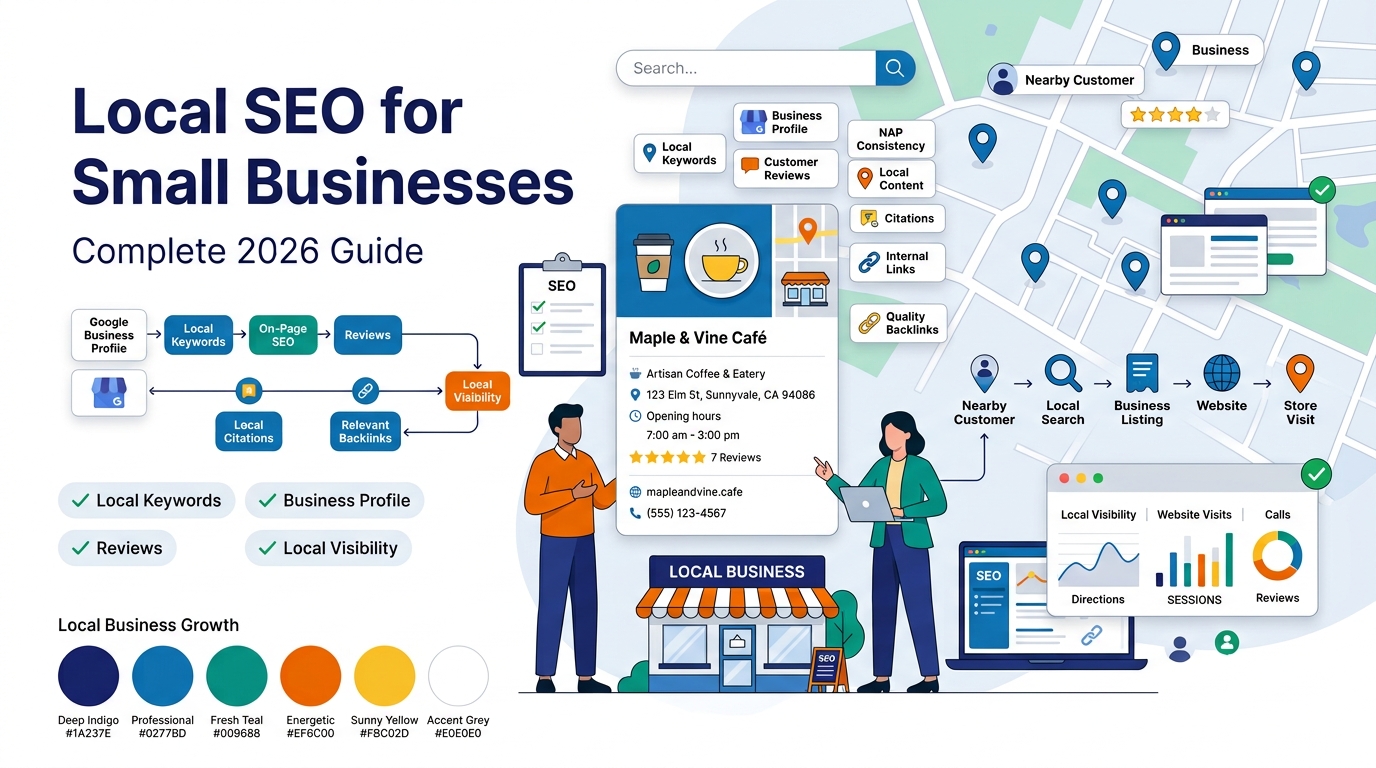
What Makes It Local SEO: 4 Core Pillars
1. Google Business Profile optimization. This is the single highest-weighted group of ranking signals. Within it, the top individual factors for 2026 are Primary GBP Category, keywords in the GBP business title, and additional GBP categories all outranking review count or website authority in Whitespark's local pack rankings.
2. Citations and NAP consistency. A citation is any online mention of your business's Name, Address, and Phone number (NAP), whether or not it links back to your site. Whitespark's 2026 data shows citation signals declining slightly for traditional local pack rankings, but notes that three of the top five factors for AI Search visibility are citation-related meaning citations are shifting from a Google-ranking tactic to an AI-recommendation tactic.
3. Review signals. Quantity of native Google reviews with text ranks #9 among all local pack factors, and review recency ranks #11 both outranking most website-based signals entirely. On the consumer side, BrightLocal's 2026 survey found that 97% of US consumers read reviews before choosing a local business, and that figure climbs to 41% who say they always read reviews when browsing, up sharply from 29% the year before.
4. On-page local content. Having a dedicated page for each individual service is the single most important factor for local organic rankings (the results below the map), and geographic keyword relevance using real neighborhood and city names naturally in your content ranks second.
How to Build a Local SEO Strategy: The Process
Claim and verify your Google Business Profile. Nothing else on this list works until this is done. Choose your primary category with precision it's the single highest-weighted ranking factor in the entire 2026 survey.
Audit and fix your NAP consistency across citations. Search your business name plus your city and check that every existing directory listing (Google, Bing Maps, Apple Maps, Yelp, industry-specific directories) shows an identical name, address, and phone number.
Build dedicated landing pages for each service you offer. A plumbing company shouldn't have one services page it should have separate pages for drain cleaning, water heater repair, and pipe replacement, each targeting its own service-plus-location keyword combination.
Set up a systematic review-generation process. Don't rely on customers to remember to leave a review; use a direct Google review link sent immediately after service, since review recency and sustained influx (rather than sudden bursts) both carry real ranking weight.
Fill out every available Google Business Profile field. Hours, attributes, services, products, and Q&A sections all carry measurable ranking weight individually, and an incomplete profile forfeits all of it.
Respond to reviews and keep your GBP active. Owner responses, fresh photos, and Google Posts all feed into the behavioral and engagement signals that increased in weight for 2026.
Track your rankings across multiple locations, not just your office address. A single keyword can rank very differently a mile away, so use grid-based rank tracking to see your real visibility across your service area.
If you serve multiple locations, this same process compounds see our companion guide on multi-location and franchise local SEO for how citation and profile management change at scale.
Data & Statistics Worth Knowing for 2026
Google Business Profile signals form the single largest group of local pack ranking factors, ahead of on-page, citation, review, link, and behavioral signals combined, according to analysis of Whitespark's 2026 survey data.
Whitespark's 2026 survey confirms that review signals and behavioral signals both increased in importance compared to the prior edition, while on-page and link signals both declined slightly, a shift the report's author attributes partly to the newly added social signals category taking share from the others.
BrightLocal's 2026 survey found that the share of consumers discovering local businesses through Google dropped from 83% to 71% year over year, while the share using AI tools like ChatGPT and Google's AI Mode for business recommendations jumped from 6% to 45% in the same period.
Within that AI shift, BrightLocal found ChatGPT specifically was used by 31% of consumers for business recommendations, and Google's AI Mode by 23%.
Myth-busting: the near me search growth statistic is unreliable. Nearly every local SEO article in 2026 cites a dramatic growth figure for near me searches but the number varies wildly depending on which site you land on, ranging from 150% to 400%, 500%, and even 900% growth, each attributed vaguely to Google or Google Trends with no traceable original report. This is a textbook example of a recycled zombie stat a number that gets copied from one SEO blog to the next until its origin is untraceable. The more durable, source-verified takeaway isn't a specific growth percentage; it's that Google now infers local intent even when a searcher never types near me at all, triggering local results automatically based on device location. Optimizing for the literal phrase near me matters far less than optimizing for the underlying local intent behind ordinary searches.
When Does Local SEO Stop Being Local?
Clearly local SEO: a single-location dentist's office optimizing its Google Business Profile, building city-specific service pages, and generating reviews from patients in its own metro area every tactic here is anchored to one real, verifiable address competing on proximity and relevance for nearby searchers.
Clearly not local SEO: a pure e-commerce brand with no physical storefront and no service-area limitation, competing nationally on product-page SEO and backlinks proximity to the searcher is irrelevant to its ranking, so none of the Google Business Profile or citation tactics above apply.
The borderline case: a service-area business (SAB), like a mobile pet groomer or a home appliance repair company, that has no public-facing storefront but still competes in the Local Pack. SABs are eligible for a Google Business Profile but must hide their address, and Whitespark's 2026 data flags Address Is Showing on GBP (Not SAB) as the #7 most important local pack ranking factor meaning an SAB is structurally excluded from one of the highest-weighted signals in local search, even while competing directly against businesses that do show an address.
conclusion
Local SEO in 2026 is still fundamentally about matching a real business to a real searcher's location, but the signals Google weighs to do that have shifted toward your Google Business Profile category, your review recency, and increasingly the same citation data that now feeds AI recommendation tools. If you're starting from zero, skip the recycled 50 citations checklists and start with the one action that outranks everything else in the current data: claim your Google Business Profile and get the primary category exactly right before you touch anything else.
FAQs
What's the difference between local SEO and a Google Business Profile?
A Google Business Profile (GBP) is one component a free business listing that appears on Google Maps and in the Local Pack while local SEO is the broader practice that includes GBP optimization plus citations, reviews, and location-specific website content.
How long does local SEO take to show results?
There's no universally fixed timeline, but ranking factors like sustained review influx, content freshness, and citation consistency are explicitly weighted around consistency over time rather than bursts, meaning local SEO tends to compound gradually rather than produce results from a single one-time fix.
Do I need a physical address to rank in local search?
No service-area businesses without a public address can still create a Google Business Profile and compete in local results, though Whitespark's 2026 data shows that showing a real address is one of the highest-weighted ranking factors, so SABs are competing with a structural disadvantage on that specific signal.
Are local citations still worth building in 2026?
Yes, but their role has shifted: Whitespark's 2026 data shows citation signals have declined slightly for traditional Google ranking, while three of the top five factors for AI search visibility are citation-related, meaning citations now matter more for getting recommended by AI tools like ChatGPT than for classic Google Maps rankings.
Does the number of Google reviews matter more than the star rating?
Both matter, but they measure different things the quantity of native Google reviews with text is a top-10 local pack ranking factor, while high numerical Google ratings rank just above it at #6, so a business needs both volume and a strong average rating rather than optimizing for just one.
Is local SEO different for a service-area business versus a storefront business?
Yes storefront businesses can display their address and compete fully on proximity-based ranking factors, while service-area businesses must hide their address per Google's guidelines, which excludes them from that specific high-weighted signal even as they remain eligible for most other local pack factors.
How do I optimize for AI tools like ChatGPT recommending my business, not just Google?
Focus on citation completeness and consistency across prominent directories in your industry, since BrightLocal's 2026 data shows 45% of consumers now use AI tools for local business discovery, and Whitespark's data confirms citations are among the top factors driving AI search visibility specifically.
What's the single highest-priority local SEO task for a small business just getting started?
Claim your Google Business Profile and select the correct primary category, since it's the #1-ranked factor in Whitespark's 2026 local pack survey outranking review count, backlinks, and website content entirely.
Get a free audit and see exactly how this applies to your site.