Optimizing a Google Business Profile for AI-powered local search means making your listing structured and complete enough that Google's AI Overviews, AI Mode, and Local Pack systems can pull accurate details about your business directly into an AI-generated answer not just rank you in a list of blue links.
That means complete categories, detailed services, a strong review volume, Q&A activity, and consistent business information across the web. Google itself says local rankings come down to three factors: relevance, distance, and prominence. AI-powered search results are built on top of that same foundation they just surface it differently.
Most Google Business Profile optimization guides still read like it's 2019. Fill out your hours. Add photos. Get reviews.
That advice isn't wrong. But it skips the biggest shift in local search since the Local Pack itself: AI is now generating the answer directly, and it's pulling from your profile to do it.
By the end of this guide, you'll know exactly which GBP elements AI-powered search actually reads, the step-by-step process to optimize your profile for it, real 2026 data on how much this now matters, and when it makes more sense to bring in professional local SEO services instead of doing it yourself. Let's get into it.
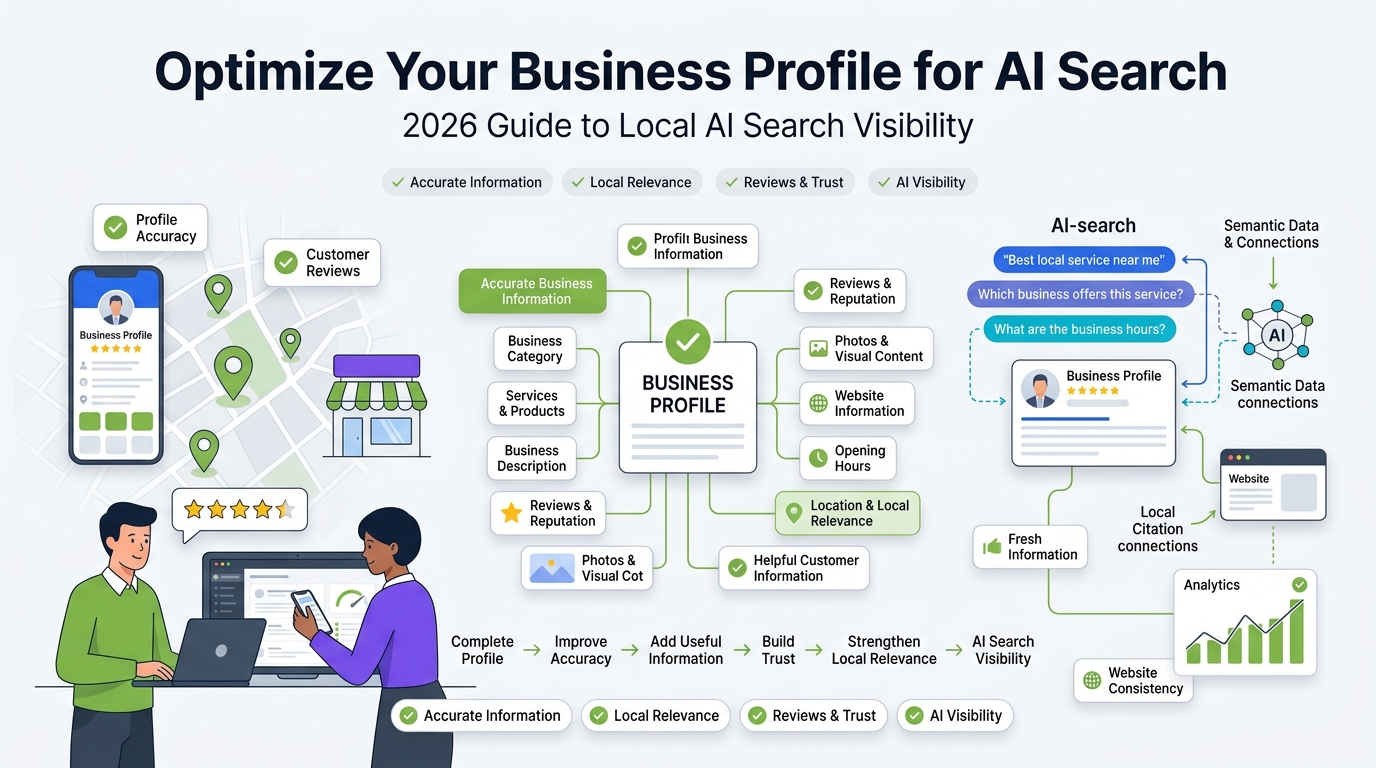
Three Ways to Understand Local Ranking
There's no single accepted model for how local search decides who shows up. Three framings matter here, and each explains a different piece.
Google's Own Framework (Business Profile Help Documentation). Google states directly that local results are based primarily on relevance, distance, and prominence. Relevance is how well your listing matches what someone searched for. Distance is how close you are to the searcher. Prominence is how well-known your business is, based on reviews, links, and citations. These three factors existed before AI Overviews, and they still feed the systems that generate them.
The AI Search / GEO Framing. Industry researchers tracking AI Overviews describe a related but distinct pattern: AI-generated answers pull structured, verifiable facts from a small number of trusted sources rather than summarizing an entire page. For a local business, your Google Business Profile is often the single most structured, verifiable source Google has about you which is why an incomplete profile increasingly means being left out of the AI answer entirely, even if you'd technically still rank.
The Local SEO Services / Agency Framing. Agencies that manage GBP at scale describe this shift in practical terms: profiles are no longer set it and forget it listings. They require ongoing management posts, review responses, Q&A monitoring, photo updates which is exactly why demand for dedicated local SEO marketing services has grown alongside AI Overviews, especially among multi-location businesses that don't have time to manage this in-house.
Put together: Google tells you what it evaluates, AI search behavior tells you what gets surfaced, and the agency framing tells you what ongoing maintenance actually looks like in practice.
DIY GBP Optimization vs. Hiring Local SEO Services
The real comparison most business owners need isn't SEO vs. no SEO. It's whether to optimize the profile yourself or hire a local SEO service to do it for you.
DIY optimization costs nothing but your own time. You have full control, but you're also responsible for staying current as Google adds new profile features, categories, and AI-related changes.
Professional local SEO services cost money, but they bring dedicated tools, geo-grid rank tracking, and review-management systems that are hard to replicate manually especially if you're managing more than one location.
The structural distinction: DIY works well for a single, simple listing with time to spare. A local SEO service company earns its cost once you're managing multiple locations, competing in a dense market, or don't have bandwidth for ongoing weekly maintenance.
Factor | DIY Optimization | Local SEO Services |
Cost | Free (your time only) | Varies from affordable local SEO services for single locations to higher-tier retainers for multi-location brands |
Time required | Several hours upfront, then weekly upkeep | Minimal handled on your behalf |
Best for | Single-location, low-competition businesses | Multi-location brands, competitive markets, agencies needing white label local SEO services to resell |
Tooling | Free GBP dashboard only | Geo-grid rank tracking, review automation, listing sync |
Typical local SEO services pricing | $0 | Roughly 300–2,000+/month depending on scope and location count |
Geographic reach | Wherever you operate | Available as local SEO services USA-wide, or city-specific e.g. local SEO services Florida or local SEO services Los Angeles |
What Makes a Profile AI-Search Ready: Four Core Criteria
1. Category and Service Precision. Google explicitly recommends choosing the most specific applicable category rather than a broad one, since this directly feeds the relevance factor. A landscaping business listed simply as Contractor is harder for Google's systems to match to a specific query than one listed as Landscaper with itemized services.
2. Structured Completeness. Hours, attributes, services, products, and a detailed business description all give Google's systems verifiable facts to extract. An AI Overview needs a fact it can state confidently an incomplete profile simply gives it nothing to pull from.
3. Review Volume and Recency (Prominence). Google's own guidance ties prominence directly to review count and rating. Businesses ranking in the Local Pack see roughly 126% more traffic and 93% more customer actions than those ranked 4–10, according to 2026 local search data and review activity is one of the few prominence signals a business can actively influence.
4. Consistency Across the Web (NAP). Your business name, address, and phone number (NAP) need to match exactly across your website, directories, and profile. Inconsistent NAP data undermines the trust signals both traditional ranking and AI extraction rely on.
The 7-Step Process to Optimize Your GBP for AI Search
1. Claim and fully verify your listing. Only about 35% of small businesses currently have a claimed Google Business Profile, according to 2026 local search research this alone puts unclaimed competitors at an immediate disadvantage.
2. Choose the most specific primary category available. Add secondary categories only where they're genuinely accurate, not to cast a wider net.
3. Fill out every structured field. Hours, service areas, attributes, products, and a full business description leave nothing blank that Google offers a field for.
4. Add a detailed, keyword-natural business description. Describe what you actually do and where, in plain language, without stuffing it with repeated phrases.
5. Build a steady review pipeline. Ask every customer, respond to every review, and don't let volume go stagnant recency matters as much as total count.
6. Post and answer Q&A consistently. Both signal an active, maintained profile, which AI systems tend to treat as more trustworthy than a dormant one.
7. Monitor how you appear in AI Overviews and the Local Pack over 4–8 weeks. Local ranking changes tend to show up faster than organic web rankings, but AI Overview inclusion specifically can take longer to stabilize as Google recrawls and reprocesses your profile.
Data & Statistics: What 2026 Local Search Actually Looks Like
According to 2026 local search research, 40.16% of local business queries now trigger a Google AI Overview, meaning a large share of local searches are being answered directly on the results page rather than through a traditional list of links.
The same research found that 42% of local searchers click a result within the Google Map Pack, making it the single most valuable piece of local search real estate and one built almost entirely from Google Business Profile data.
Separately, research tracking AI Overviews found that when AI Overviews and featured snippets appear together, they can occupy roughly 67.1% of the screen on desktop and 75.7% on mobile meaning even a well-ranked page can go largely unseen if it isn't the source the AI answer pulls from.
Myth-busting: Verifying my listing is enough. This is one of the most common misconceptions in local SEO. Verification only confirms ownership it does nothing for relevance, distance, or prominence. 2026 local search data shows only about 40% of small businesses even have a dedicated website, and a large share of claimed profiles remain incomplete, meaning verification alone leaves most of the ranking opportunity untouched.
When Does a Business Actually Qualify for AI-Powered Local Visibility?
Not every optimized profile gets surfaced, and not every gap disqualifies you the line isn't always obvious.
Clearly qualifies: A fully verified, category-precise profile with consistent NAP data, a steady stream of recent reviews, and active Q&A. This is the profile type AI Overviews and the Local Pack are built to surface confidently.
Clearly doesn't qualify: A profile with a mismatched address, no reviews in over a year, and a generic or incorrect category. Google's own guidance treats these as basic relevance and prominence failures no amount of AI-search awareness fixes a listing that fails the fundamentals.
Borderline case: A service-area business (no public storefront) with a strong review count but an inconsistent service-area radius set in GBP. This can rank inconsistently appearing for some nearby searches but not others until the service area and address settings are fully aligned with how the business actually operates.
conclusion
Optimizing your Google Business Profile for AI-powered local search comes down to the same three factors Google has always used relevance, distance, and prominence applied with more precision and more consistency than your competitors.
If you're managing this yourself, start with categories and structured fields before chasing reviews; an AI system can't extract facts your profile never gave it. If you'd rather hand this off, local SEO services whether a single local seo service for one location or white label local SEO services for an agency managing many can implement and maintain all of this on your behalf, whether you need coverage across the USA, in Florida, in Los Angeles, or anywhere in between.
FAQ
Do I need a website if I already have a Google Business Profile?
Yes a website still strengthens prominence and gives Google more verifiable content to cross-reference against your profile, even though the profile itself can rank independently in the Local Pack.
How much do local SEO services typically cost?
Local SEO services pricing commonly ranges from roughly $300/month for a single location to $2,000+/month for multi-location or highly competitive markets, depending on scope.
Are affordable local SEO services actually effective, or only premium ones?
Affordable local SEO services can be effective for single-location businesses with straightforward needs the value gap widens mainly for multi-location brands or highly competitive markets that need dedicated tooling.
What is white label local SEO services, and who uses it?
White label local SEO services let marketing agencies resell local SEO work under their own brand while a specialized provider handles the actual GBP and listing management behind the scenes.
Do I need a local SEO service company, or can I do this myself?
A single, simple listing is usually manageable on your own a local SEO service company becomes worth it once you're managing multiple locations or a competitive market without spare time for weekly upkeep.
Does AI Overview inclusion replace ranking in the Local Pack?
No they're related but separate. A business can still appear in the Local Pack without being cited in an AI Overview, and vice versa, though a complete, prominent profile improves the odds for both.
How do local SEO services near me differ from a national provider?
Providers offering local SEO services near me often bring familiarity with local competitors and directories, while national or local SEO services USA-wide providers typically offer more standardized tooling and pricing.
Do reviews really affect AI Overview visibility?
Yes review volume and recency feed directly into the prominence factor, which is one of the signals Google's local systems (and the AI features built on top of them) draw from.
Get a free audit and see exactly how this applies to your site.