Search engines are no longer limited to showing ten blue links. Google now uses AI-powered experiences such as AI Overviews and AI Mode to answer complex questions and connect users with supporting websites. Bing is also integrating AI-generated answers through Copilot and other experiences. ChatGPT can search the web and cite relevant websites directly.
This creates a new SEO question:
What happens when users get their answer before they click a traditional search result?
That is where AI visibility becomes important.
The future of SEO isn't about abandoning Google rankings. It's about expanding the definition of visibility.
You need to be discoverable, understandable, trustworthy, and useful to both search engines and AI systems.
Let's get into it.
The future of SEO is moving from a narrow focus on traditional search rankings toward broader search and AI visibility. Websites still need strong technical SEO, crawlability, indexing, useful content, and authority. However, they also need content that AI-powered search systems can understand, retrieve, summarize, and potentially cite. Google explicitly states that its existing SEO fundamentals remain relevant for AI Overviews and AI Mode.
In simple terms:
SEO gets your website into the search ecosystem. AI visibility helps your website become part of the answers users receive.
How Is SEO Changing in 2026?
The biggest change isn't that Google suddenly stopped ranking websites.
It hasn't.
Google's own documentation says AI features are rooted in its existing Search systems. Pages still need to be crawlable, indexable, and eligible for normal Search before they can appear as supporting links in AI Overviews or AI Mode.
The difference is how users interact with information.
Traditional search often looks like this:
Query → Search results → Website → Answer
AI-powered search can look more like this:
Question → Multiple searches → AI synthesis → Sources → Website
Google says AI Overviews and AI Mode can use a technique called query fan-out, where related searches are performed across different subtopics and data sources to develop a response.
That changes the optimization target.
Instead of creating one page for one keyword, marketers increasingly need to build content that covers a topic comprehensively and answers related questions naturally.
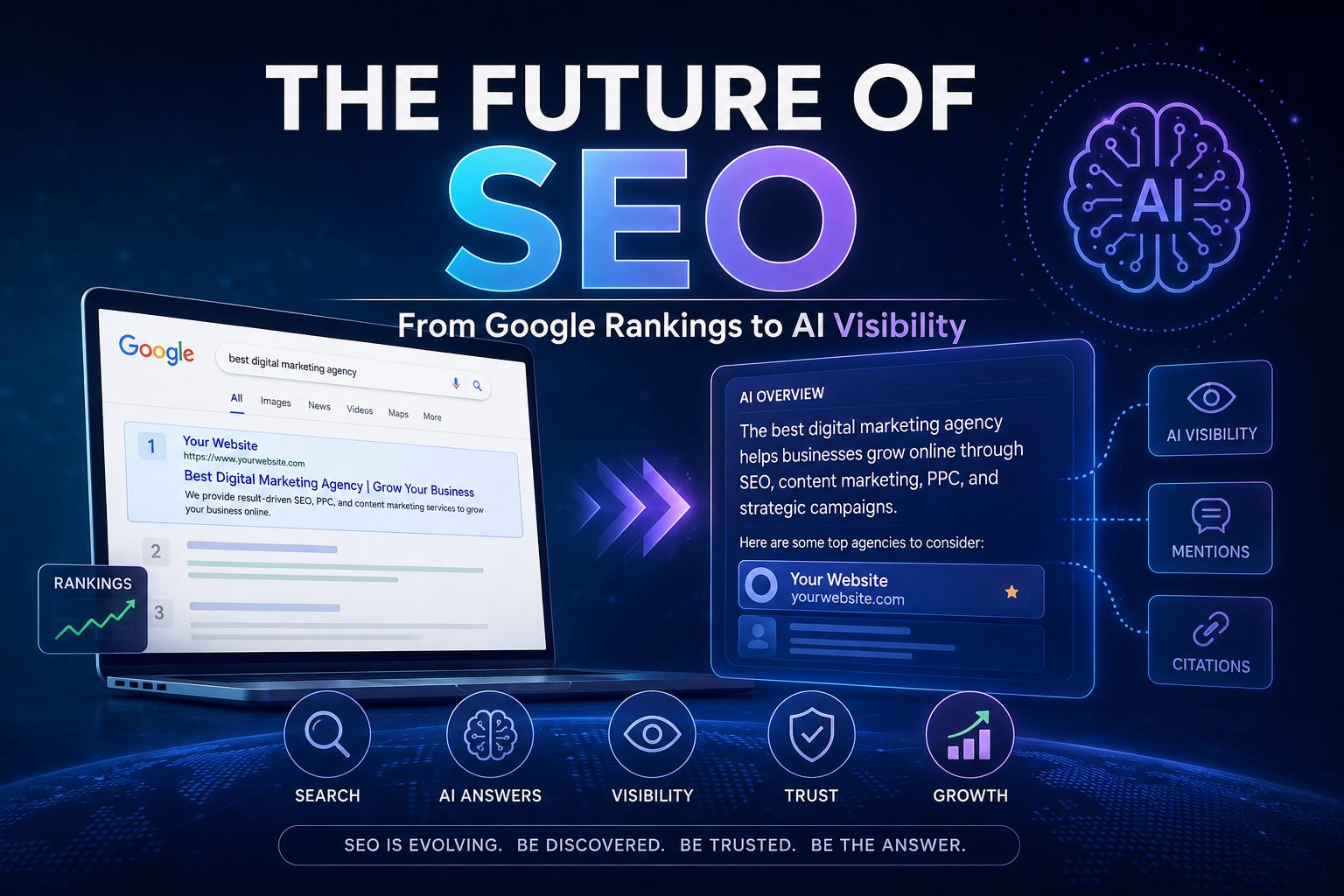
Google Rankings vs AI Visibility: What's the Difference?
Traditional SEO focuses heavily on where a page appears in search results.
AI visibility focuses on whether your information is retrieved, referenced, cited, or represented within AI-generated answers.
The two overlap, but they are not identical.
Traditional SEO | AI Visibility |
Focuses on rankings | Focuses on inclusion in AI answers |
Keyword-driven | Intent and topic-driven |
Measures clicks and rankings | Measures citations, mentions, visibility and traffic |
SERPs are the primary surface | AI search is another major surface |
Optimizes pages | Optimizes information ecosystems |
Links remain important | Evidence, clarity, entities and authority matter strongly |
The important point is that AI visibility does not replace SEO.
Google explicitly says there are no special technical requirements or special schema needed to appear in AI Overviews or AI Mode. Existing SEO fundamentals remain important.
So don't throw away your SEO strategy.
Expand it.
Why Traditional Keyword Rankings Are No Longer Enough
Imagine you rank #1 for:
best CRM software for small businesses
That's valuable.
But what if a user asks an AI search system:
I'm running a 10-person B2B company. Which CRM should I choose if I need automation, simple reporting, and a low monthly cost?”
That isn't one clean keyword.
It's a conversational problem.
The AI system may break the question into multiple subtopics.
It might evaluate:
CRM pricing
automation features
small-business usability
reporting
integrations
customer reviews
implementation difficulty
industry relevance
Google's AI search systems can use multiple related searches to develop answers, while Bing describes AI grounding as relying on its search infrastructure to connect AI responses with relevant web content.
This means your content needs to answer real problems, not simply repeat exact-match keywords.
What Makes Content Visible to AI Search?
1. Clear, Direct Answers
AI systems need information they can understand.
That doesn't mean writing robotic content.
It means making important answers obvious.
Instead of writing five paragraphs before answering a question, provide a concise answer first.
For example:
What is technical SEO?
Technical SEO is the process of improving a website's crawlability, indexing, architecture, performance, and technical accessibility so search engines can discover and understand its pages.
Then explain the details.
This structure helps humans skim the page and makes individual sections easier to understand.
2. Strong Topical Coverage
One isolated article rarely establishes strong authority around a competitive subject.
Consider a website targeting ecommerce SEO.
A strong topical ecosystem could include:
Ecommerce keyword research
Technical SEO for ecommerce
Product page optimization
Category page SEO
Internal linking
Ecommerce schema
Faceted navigation
Product reviews
Link building
Conversion optimization
Ecommerce SEO audits
Each article answers a different search intent.
Together, they establish a stronger topical footprint.
This is especially important as AI systems retrieve information across multiple related queries.
3. Original Information
This may become one of the biggest competitive advantages in AI search.
Generic information is easy to reproduce.
Original information isn't.
Google's current guidance emphasizes creating valuable, unique, non-commodity content rather than simply producing another version of information already available online.
That could mean:
Original research
First-hand testing
Expert commentary
Proprietary data
Customer examples
Original surveys
Case studies
Screenshots
Experiments
Unique comparisons
Think about it this way.
If 500 websites say the same thing, your version isn't particularly valuable.
If you provide information that 500 websites don't have, you create something worth referencing.
Does E-E-A-T Matter for AI Visibility?
Yes, trust remains important.
AI systems need reliable information.
That makes expertise, experience, authority, and trust valuable signals for content creators and publishers.
However, don't treat E-E-A-T as a magic ranking score.
Instead, demonstrate credibility through the content itself.
Show who wrote it.
Explain their experience.
Cite reliable sources.
Use evidence.
Update outdated information.
Disclose first-hand testing.
For example, instead of saying:
This software is the best.”
Say:
We tested the platform across five workflows and found that its automation features were strongest for…”
That's much more useful.
It's also much easier for readers and AI systems to understand the basis for your conclusion.
Why Structured Content Matters More Than Ever
AI systems don't need a special AI article format.”
Google explicitly says there is no special schema or AI-specific markup required for inclusion in AI Overviews or AI Mode.
However, structure still matters.
Use:
Descriptive H2 headings
Concise paragraphs
Bullet points
Tables
Definitions
FAQs
Step-by-step processes
Clear examples
Relevant internal links
Bing's AI Performance guidance specifically recommends clear structure, descriptive headings, concise sections, tables, and FAQ-style content when improving content for AI-generated answers.
The goal isn't to manipulate an AI system.
The goal is to make your information easy to understand.
What Role Does Technical SEO Play in AI Search?
Technical SEO isn't becoming less important.
It may actually become more important.
AI systems still need access to web content.
Google says pages need to meet its normal Search technical requirements and be eligible for indexing and snippets to appear as supporting links in AI features.
That means you should still audit:
Crawlability
Make sure search engines can access important pages.
Indexation
Check that valuable URLs are actually indexed.
Internal Linking
Connect related pages so crawlers and users can discover your content.
JavaScript SEO
Make sure important content isn't hidden from crawlers.
Page Experience
Make your website fast, accessible, and easy to use.
Duplicate Content
Reduce unnecessary URL duplication and competing versions of the same content.
Google's current generative AI SEO guidance continues to emphasize crawlability, JavaScript SEO, page experience, internal discovery, and reducing duplicate content.
AI visibility starts with accessibility.
If a system cannot reliably discover your content, it cannot reliably use it.
How Does Entity SEO Fit Into the Future?
Keywords tell search engines what words appear on a page.
Entities help establish what those words represent.
For example, a page about Apple” could refer to:
Apple Inc.
Apple fruit
Apple Records
An Apple Watch
Apple Music
Clear context helps search systems understand the intended entity.
This is why modern SEO increasingly focuses on:
Brands
People
Products
Organizations
Locations
Services
Topics
Relationships between entities
Your website should clearly explain who you are, what you offer, where you operate, and which subjects you have expertise in.
This is particularly important for local businesses and ecommerce websites.
How Important Are Backlinks in AI Search?
Backlinks are not disappearing.
But the role of authority is becoming broader.
A backlink can help search engines discover and evaluate a website. It can also contribute to your site's overall authority and reputation.
However, buying thousands of low-quality links isn't a sustainable AI visibility strategy.
Focus on relevance.
A technology website earning a contextual link from a respected technology publication is more meaningful than collecting hundreds of unrelated links.
Useful strategies include:
Digital PR
Expert contributions
Original research
Industry studies
Contextual link building
Relevant guest publishing
Resource link building
Expert interviews
The objective should be earned authority, not artificial volume.
Is Generative AI Content Good for SEO?
Generative AI can help with research, brainstorming, outlining, and content workflows.
But publishing large volumes of generic AI-generated pages is not the future of SEO.
Google's guidance warns that using generative AI to create many pages without adding value can fall under its spam policies concerning scaled content abuse.
The better model is:
AI-assisted production + human expertise + original information + editorial review.
Use AI to accelerate your workflow.
Don't use it as a substitute for expertise.
A 2,000-word article generated in seconds isn't automatically better than a 1,000-word article containing original research and genuine experience.
What Should SEO Professionals Measure in 2026?
The old dashboard usually focused on:
Keyword rankings
Organic traffic
Click-through rate
Backlinks
Conversions
Those metrics still matter.
But AI search adds another layer.
Track:
AI citations
AI mentions
AI-generated impressions
Pages appearing in AI answers
Branded mentions
Referral traffic from AI platforms
Conversion rates from AI-referred visitors
Query coverage
Share of voice
Visibility across multiple AI systems
Google announced new Search Console reporting for generative AI visibility in June 2026, including dedicated reporting for AI features such as AI Overviews and AI Mode. The rollout is being expanded gradually.
Bing also provides an AI Performance Report showing how site content is used in AI-generated answers across supported Microsoft experiences, including which pages are cited and associated grounding queries.
This is a major shift.
SEO measurement is moving from:
Where do I rank?
toward:
Where does my brand appear when people ask AI?”
How Can You Optimize a Website for AI Visibility?
Here is a practical process.
Step 1: Audit Your Technical SEO
Check crawling, indexation, redirects, canonical URLs, internal links, JavaScript rendering, structured data, mobile usability, and page experience.
Fix the foundation first.
Step 2: Build Topic Clusters
Choose your main commercial topic.
Then create supporting content around:
Definitions
Comparisons
How-to guides
Costs
Alternatives
Problems
Solutions
Case studies
FAQs
This creates depth instead of isolated articles.
Step 3: Answer Real Questions
Use customer conversations, sales calls, support questions, forums, Search Console data, and keyword research.
Then turn those questions into useful content.
Don't write for keywords alone.
Write for information needs.
Step 4: Add Original Evidence
Include examples, statistics, experiments, expert opinions, screenshots, customer stories, and first-hand findings.
This is where your content becomes harder to replace.
Step 5: Strengthen Authority
Build relevant mentions and links.
Create research that journalists and publishers can reference.
Publish genuinely useful resources.
Become known for a specific subject.
Step 6: Optimize for Multiple Search Surfaces
Don't focus exclusively on Google.
Consider:
Google Search
Google AI Overviews
Google AI Mode
Bing
Microsoft Copilot
ChatGPT Search
Other AI discovery platforms
OpenAI says public websites can appear in ChatGPT Search, and publishers should ensure that OAI-SearchBot isn't blocked if they want their content to be discoverable and potentially cited.
This doesn't guarantee visibility.
It simply makes your website eligible for discovery.
What Is the Biggest SEO Mistake to Avoid?
The biggest mistake is chasing every new AI acronym while ignoring fundamental SEO.
You will hear terms such as:
AEO. GEO. LLM SEO. AI SEO. Generative Engine Optimization. Answer Engine Optimization.
These terms can be useful for describing emerging strategies.
But don't let terminology distract you from the fundamentals.
Google's official guidance is remarkably clear: the SEO practices that have historically helped websites remain foundational for generative AI search as well.
Crawl your website.
Create useful content.
Earn authority.
Improve user experience.
Provide original information.
Keep content accurate.
Make important information accessible.
Then expand your measurement to AI visibility.
What Happens to Traditional SEO Agencies?
SEO agencies will need to evolve.
The old agency model was often:
Keyword research → Content → Backlinks → Rankings
The newer model is closer to:
Technical SEO → Topic authority → Original content → Brand authority → Search visibility → AI visibility → Conversions
That doesn't mean traditional SEO services become irrelevant.
It means their scope expands.
Modern agencies may need expertise in:
Technical SEO
Content strategy
Digital PR
Entity optimization
Local SEO
Ecommerce SEO
AEO
GEO
AI visibility tracking
Conversion optimization
The strongest agencies will connect these disciplines rather than treating them as separate campaigns.
What Does the Future of SEO Look Like?
I don't think Google rankings are going away.
Instead, rankings are becoming one measurement inside a much larger search ecosystem.
Users will continue switching between traditional search results, AI-generated answers, social platforms, marketplaces, communities, and conversational search tools.
That means brands need to be present wherever their customers look for information.
The future belongs to websites that provide something worth discovering.
Not websites that simply produce the most pages.
Not websites that stuff the most keywords.
Not websites that publish hundreds of generic AI articles.
The winners will be businesses that combine technical accessibility, topical authority, original information, trusted expertise, and strong brand recognition.
conclusion
The future of SEO isn't Google rankings versus AI visibility.
It's both.
Google rankings still matter. Technical SEO still matters. Content still matters. Links still matter.
But the search journey is expanding.
A potential customer might discover your brand through Google, receive your information in an AI Overview, compare you through ChatGPT, research alternatives in Bing Copilot, and finally visit your website.
That is why the smartest SEO strategy for 2026 isn't simply:
How do I rank #1?”
The better question is:
How do I become the source people and AI systems trust across the entire search journey?”
Build content worth citing.
Make your website technically accessible.
Demonstrate real expertise.
Create original information.
Build legitimate authority.
And measure visibility beyond the traditional blue links.
That's where the future of SEO is heading.
Frequently Asked Questions
Is SEO dead because of AI?
No. SEO is not dead. Google says its existing SEO fundamentals remain relevant to AI Overviews and AI Mode because these experiences are built on its core Search systems.
What is AI visibility in SEO?
AI visibility refers to how often a website, brand, product, or source appears in AI-generated search experiences through mentions, citations, links, or references.
What is the difference between SEO and GEO?
SEO focuses on visibility in search engines, while GEO generally describes efforts to improve a brand or website's eligibility for inclusion in generative AI answers. The concepts overlap significantly.
Do I need special schema for Google AI Overviews?
No. Google says there is no special schema or additional structured data requirement for appearing in AI Overviews or AI Mode. Standard SEO fundamentals still apply.
Can ChatGPT cite my website?
Yes. Public websites can appear in ChatGPT Search, and OpenAI guides publishers who want their content to be discoverable and cited.
Does AI-generated content hurt SEO?
Not automatically. The issue is whether the content provides value. Google warns against using generative AI to produce large quantities of pages without adding meaningful value, which can fall under scaled content abuse policies.
Are backlinks still important in AI search?
Yes. Authority and discoverability still matter. However, successful SEO should prioritize relevant, trustworthy links and mentions rather than large volumes of low-quality backlinks.
What should I track besides Google rankings?
Track AI citations, AI mentions, generative impressions, AI-referred traffic, branded visibility, conversions, and the pages appearing in AI answers alongside traditional SEO metrics.
Get a free audit and see exactly how this applies to your site.