AI engines don't rank pages the way traditional search engines do. They rank answers. That single distinction explains why a page that ranks reasonably well in Google's traditional results can still be completely invisible in ChatGPT, Gemini, or an AI Overview because being found and being chosen as the answer are two different challenges, and most websites are only built for the first one.
At Contentiris, this is a question we get from nearly every client right now: what actually needs to change on our site to show up in AI-generated answers? The good news is that most of the fixes involved aren't a ground-up rebuild they're specific, achievable changes to structure, clarity, and technical health that make your existing content genuinely easier for AI systems to read, trust, and extract.
Why Small Fixes Have an Outsized Effect on AI Visibility
AI engines are built to produce a confident, accurate answer quickly. To do that, they scan available content for clear signals that a page is well-organized, trustworthy, and directly relevant to the question being asked. A cluttered, ambiguous, or poorly structured page reads as a risk to an AI system not because the underlying information is necessarily wrong, but because the system can't confidently extract and repeat it without a higher chance of error.
That's the core reason small structural fixes carry outsized weight here. It's not that AI systems are shallow or easily impressed by formatting it's that clarity directly reduces the risk of the system misrepresenting your content, which makes clearly structured pages the safer, more attractive choice to cite.
Making these improvements generally helps AI systems:
Parse your content faster
Clear headings, short paragraphs, and plain language all reduce the interpretive work an AI system has to do before it can confidently extract a usable answer. The faster and more confidently a system can identify what your page is actually saying, the more likely it is to use it.
Use genuine heading hierarchy so key sections are easy to isolate
Keep paragraphs short dense blocks of text slow down both human readers and machine parsing
Favor plain, direct language over dense, jargon-heavy phrasing wherever the topic allows it
Demonstrate accuracy
AI systems weigh factual reliability heavily, since citing something that turns out to be outdated or wrong carries real reputational risk for the AI platform itself. Content that's clearly current, well-sourced, and free of stale claims is treated as meaningfully more trustworthy.
Fact-check claims before publishing, and correct errors quickly once identified
Cite credible sources to support specific claims rather than presenting them as unsupported assertions
Refresh older content regularly, particularly in fast-changing fields like technology, finance, or health
Establish credibility
AI systems favor sources that already show signs of being trustworthy and authoritative not unlike how traditional search rankings weigh domain authority and backlink quality.
Earn links from genuinely relevant, reputable sites
Maintain an active, verifiable presence beyond just your website social profiles, business listings, and directory presence all contribute
Publish consistently rather than in isolated bursts, since a pattern of reliable output builds trust over time
Match real user intent
An AI system is trying to match your content against the actual question being asked not just a keyword, but the underlying need behind it. Content that clearly satisfies that specific intent performs better than content that's technically relevant but misaligned with what the person actually wants.
Research the specific phrasing people use, not just isolated keywords
Match content depth to intent a quick factual question deserves a quick answer, not three paragraphs of preamble
Revisit and adjust content periodically as search behavior and phrasing shift over time
Deliver a genuinely good user experience
AI systems increasingly draw on engagement signals as an indirect measure of content quality pages that hold attention and get used are treated as more valuable than pages people bounce from quickly.
Prioritize fast load times across every page, not just your homepage
Confirm your site works cleanly on mobile, since a large share of traffic human and AI-driven alike comes from mobile devices
Keep navigation simple and predictable so both visitors and crawlers can move through your site logically
Beyond Traditional SEO: Why "Ranking" Isn't the Whole Goal Anymore
For most of SEO's history, the objective was straightforward: earn a top spot among ten blue links through the right mix of keywords, backlinks, and technical polish. That work still matters but AI has added a second, parallel objective. It's no longer just about being listed; it's about being the answer itself.
This is the essential idea behind Answer Engine Optimization: shifting from a keyword-first mindset to an answer-first one. Every fix below builds on that same underlying principle structuring content so it can serve as a direct, standalone answer, not just a relevant result buried in a longer page.
Fix #1: Rebuild Your Titles and Headings Around Questions
Titles and headings are among the strongest structural signals AI systems use to understand what a page covers. Getting these right is one of the highest-leverage fixes available.
Turn statements into questions where it makes sense
Reframing a heading as a direct question mirrors how people actually phrase queries to AI systems, and immediately signals that your page contains a relevant answer.
Before: "Our SEO Process" After: "How Does the SEO Process Actually Work?"
Before: "Ecommerce Optimization Services" After: "What Does an Ecommerce SEO Service Actually Include?"
Keep a strict, logical heading hierarchy
AI systems rely on heading structure to understand a page's hierarchy of ideas. Skipping levels jumping from an H1 straight to an H3, for instance breaks that logical structure and makes accurate parsing harder.
Correct structure:
H1: How Does Technical SEO Improve AI Visibility?
H2: What Technical SEO Actually Covers
H3: Site Speed and Core Web Vitals
H3: Crawlability and Indexing
H2: Tools Used in a Technical SEO Audit
Incorrect structure:
H1: How Does Technical SEO Improve AI Visibility?
H3: Site Speed and Core Web Vitals
H2: Tools Used in a Technical SEO Audit
This might look like a minor formatting detail, but it has a real, measurable effect on how cleanly an AI system can map out what your page actually covers.
Fix #2: Restructure Content for Easy Extraction
AI systems favor content that's easy to lift cleanly out of context short, self-contained chunks rather than long, meandering paragraphs that bury the point.
Break dense paragraphs into shorter blocks and lists
Long paragraphs slow down both human readers and machine extraction. Aim for three to four sentences per paragraph at most, and convert naturally sequential or itemized information into lists.
Before: Our approach to technical SEO involves reviewing your entire site's structure and content, updating title tags and meta descriptions around relevant search terms, correcting header tag hierarchy throughout your pages, identifying underperforming content, and mapping your internal linking so your most important pages receive appropriate authority.
After: Here's what a Contentiris technical SEO engagement typically includes:
Title tags and meta descriptions: written to earn clicks while staying aligned with target search terms
Header hierarchy: corrected across every page so both users and AI systems can follow your content's structure
Content review: identifying underperforming or outdated pages that need updating
Internal linking: structured so your most important pages receive the internal authority they need
This restructured version is dramatically easier for an AI system to lift a clean, accurate excerpt from and easier for a human skimming the page to absorb quickly, too.
Open with a clear, direct definition
Whenever a page covers a defined concept or service, state a clear, plain-language definition immediately below the title or first subheading, before diving into supporting detail.
Example:
What Is Generative Engine Optimization?
Generative Engine Optimization (GEO) is the practice of structuring a website's content, technical foundation, and authority signals so AI systems including ChatGPT, Gemini, and Google's AI Overviews can confidently understand, trust, and cite it in generated answers.
A definition like this gives an AI system an immediately usable, self-contained answer, rather than forcing it to infer your meaning from scattered context further down the page.
Fix #3: Implement Schema Markup Properly
Schema markup is effectively a translation layer between your content and the systems trying to interpret it explicit, structured data that removes ambiguity a crawler would otherwise have to guess at.
Add Organization schema to your homepage
This is foundational. Organization schema tells AI systems clearly who you are, at minimum including:
Business name
Logo URL
Website URL
Phone number
Business address
Most modern content management systems support this through a plugin or built-in setting, making it one of the easier technical fixes to implement.
Add LocalBusiness schema if you serve a specific area
For any business with a physical location or defined service area, LocalBusiness schema is close to mandatory it reinforces the same name, address, and phone number details shown on your Google Business Profile and other directory listings, and consistency across all of these matters significantly for local visibility.
Add FAQPage schema to genuine Q&A content
If a page includes a real question-and-answer section, FAQPage schema explicitly marks it as such, which supports both traditional "People Also Ask" visibility and AI-generated answer extraction.
Fix #4: Reinforce Authority Signals Throughout Your Content
AI systems, much like traditional search engines, favor sources that demonstrate real expertise and a few specific content additions reinforce that signal without requiring a full content overhaul.
Attribute expert commentary directly
Naming a real person behind a claim adds a layer of credibility that anonymous, unattributed statements don't carry.
Example: "Our lead SEO strategist, [Name], puts it simply: an AI system isn't just scanning for keywords it's looking for evidence that a real expert is behind the content."
Include specific data, and cite where it came from
Concrete figures read as more trustworthy than general claims, particularly when tied to a credible source or your own first-party results.
Example: "Pages that load within one second convert at meaningfully higher rates than pages taking five seconds or more, according to widely cited page-speed research a pattern we've consistently seen reflected in our own client data as well."
Fix #5: Build in Genuine Conversational Relevance
People increasingly interact with AI systems in natural, conversational language, and your content should reflect that same register rather than reading purely as keyword-optimized copy.
Add a genuine FAQ section built around real questions
Search "People Also Ask" for your target topic, and build a short FAQ section directly answering three to five of the most relevant questions. This serves your actual readers and simultaneously aligns your content with how AI systems process conversational queries.
Add local and contextual specificity where relevant
AI systems favor content that's clearly anchored to a specific, relevant context rather than generic, could-apply-anywhere phrasing.
Service area example: "We provide SEO services throughout the Chicago metro area, including the Loop and River North." Industry-specific example: For an ecommerce client, referencing concrete terms like "product page optimization," "cart abandonment," and "conversion rate" signals genuine topical relevance far more effectively than generic marketing language.
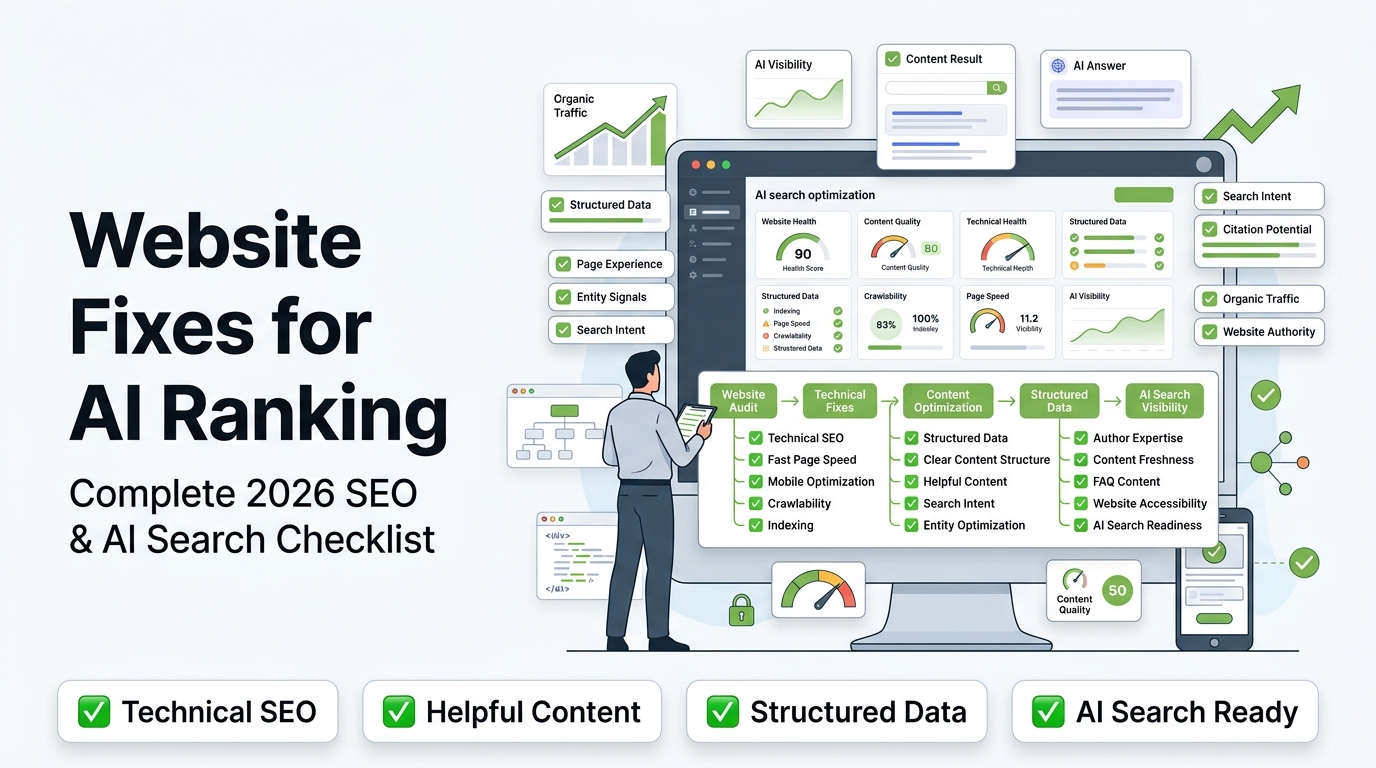
A Quick-Start AI Ranking Checklist
[ ] Rewrite at least five key page titles as direct questions
[ ] Audit your top service and blog pages for correct heading hierarchy
[ ] Break up dense paragraphs on at least one existing page into shorter blocks and lists
[ ] Add a clear, one-paragraph definition near the top of each core service page
[ ] Implement Organization schema on your homepage, and LocalBusiness schema if applicable
[ ] Add a short FAQ section with 3-5 real questions to one high-priority page, with FAQPage schema if possible
[ ] Include at least one attributed expert quote and one sourced data point on a key page
How This Fits Into a Broader SEO Strategy
These fixes matter most when they're layered onto a genuinely solid SEO foundation, rather than treated as a standalone project. This is where working with experienced seo services partners makes a real difference someone who can implement these AI-specific improvements alongside the fundamentals that still drive traditional visibility.
A capable seo marketing services provider should be able to explain clearly how AI-readiness fits into their broader process, not treat it as a disconnected add-on. Organic seo services work, in particular, benefits from these fixes directly, since clean structure and genuine authority signals support both traditional rankings and AI citation simultaneously.
Platform and business-specific considerations
Ecommerce seo services and shopify seo services providers should prioritize schema implementation for product and review data specifically, given how much AI-driven product comparison depends on structured data being accurate and complete. Wordpress seo services work should account for how theme and plugin choices affect heading structure and page speed, since both directly influence the fixes outlined above.
Small business seo services and seo services for small businesses don't need to implement every fix at once prioritizing heading structure, a clear service-page definition, and basic Organization schema delivers meaningful early impact without requiring a large budget.
B2B seo services should pay particular attention to authority signals and expert attribution, since B2B buying research increasingly runs through AI tools for vendor comparison, where credibility signals carry real weight in a longer, more considered decision process.
Dental seo services and other local, appointment-based businesses benefit heavily from LocalBusiness schema and location-specific content, given how much of that traffic depends on local, high-intent queries AI systems handle well.
International seo services need to apply these same fixes across every language and regional variant of a site, since heading structure, schema accuracy, and authority signals all need to hold up independently in each market rather than only in a single primary-language version.
For ongoing execution, seo content writing services and seo copywriting services are central to actually implementing these fixes well restructuring existing content into clear, extractable formats is fundamentally a content skill, not just a technical one. Businesses managing this as an ongoing initiative, rather than a one-time project, often find monthly seo servicesc retainers the most practical way to keep AI-readiness fixes current as both content and AI systems continue evolving.
Final Thoughts
Improving your AI ranking doesn't require reinventing your website it requires making your existing content easier to trust, parse, and extract. Clearer structure, verified accuracy, genuine authority signals, and proper technical implementation all compound together, turning your site into a source AI systems are comfortable relying on.
As AI-driven search continues to evolve, staying current with these fixes will matter more, not less. Better structure and stronger technical fundamentals ultimately create a better experience for human visitors too which is exactly the kind of signal AI systems are increasingly built to notice and reward.
FAQs
What common website issues hurt AI rankings the most?
Slow page speed, poor mobile usability, thin or duplicated content, and confusing site structure are among the most damaging issues. AI systems can quickly detect friction like this and are more likely to favor a competitor's cleaner, easier-to-parse site instead.
Why does my website need schema markup for AI visibility?
Structured data gives AI systems explicit, unambiguous context about your content instead of forcing them to infer it. This supports both traditional rich results and more accurate AI-driven summarization and citation.
How do AI systems evaluate a website's technical performance?
AI systems weigh factors like load speed, mobile responsiveness, and crawlability heavily, since these directly affect both user experience and how reliably a system can access and interpret a page's content.
Does fixing broken links actually help AI rankings?
Yes. A pattern of broken links makes a site harder for AI crawlers to navigate and signals poor maintenance, which undermines trust. Regularly auditing and fixing or redirecting broken links keeps the experience smooth for both visitors and AI systems.
Do I need to redo my entire website to improve AI visibility?
No. Most of the highest-impact fixes heading structure, paragraph length, schema markup, and a handful of well-placed definitions and FAQs can be applied incrementally to existing pages rather than requiring a full rebuild.
Get a free audit and see exactly how this applies to your site.