Type a question into Google today, and there's a good chance you'll never click a single link. An AI-generated answer sits right at the top of the page, already telling you what you wanted to know. The same shift is happening on ChatGPT, Perplexity, and Microsoft Copilot, where people increasingly ask a question and expect a direct, synthesized answer not a list of ten blue links to sort through themselves.
That shift has created an entirely new discipline: Answer Engine Optimization, or AEO. If your content isn't structured to be understood, trusted, and quoted by these AI systems, you can be doing everything "right" by traditional SEO standards and still become invisible in the exact moment a potential customer is asking the question you could answer.
This guide covers what AEO actually means, how it works, how it compares to traditional SEO and GEO, and the practical strategies worth implementing whether you're managing this in-house or evaluating seo services to help you get there.
Main Takeaways From This Article
AEO meaning: Answer Engine Optimization is the practice of structuring content so AI-driven answer engines Google AI Overviews, ChatGPT, Perplexity, Copilot can accurately extract, cite, or recommend it.
AEO isn't a replacement for SEO; it builds on the same technical and content fundamentals, with an added emphasis on direct, extractable answers.
AEO vs GEO is mostly a naming distinction both describe optimizing for AI-generated responses, though GEO often leans toward generative platforms specifically while AEO covers the broader "answer engine" category, including voice assistants and featured snippets.
Clear structure, direct answers, credible sourcing, and structured data are the foundation of any solid AEO strategy.
AEO matters for businesses of every size from AEO for small businesses and local service providers to ecommerce brands and B2B companies because AI answer engines don't discriminate by company size, only by content clarity and trust signals.
What Is Answer Engine Optimization (AEO)?
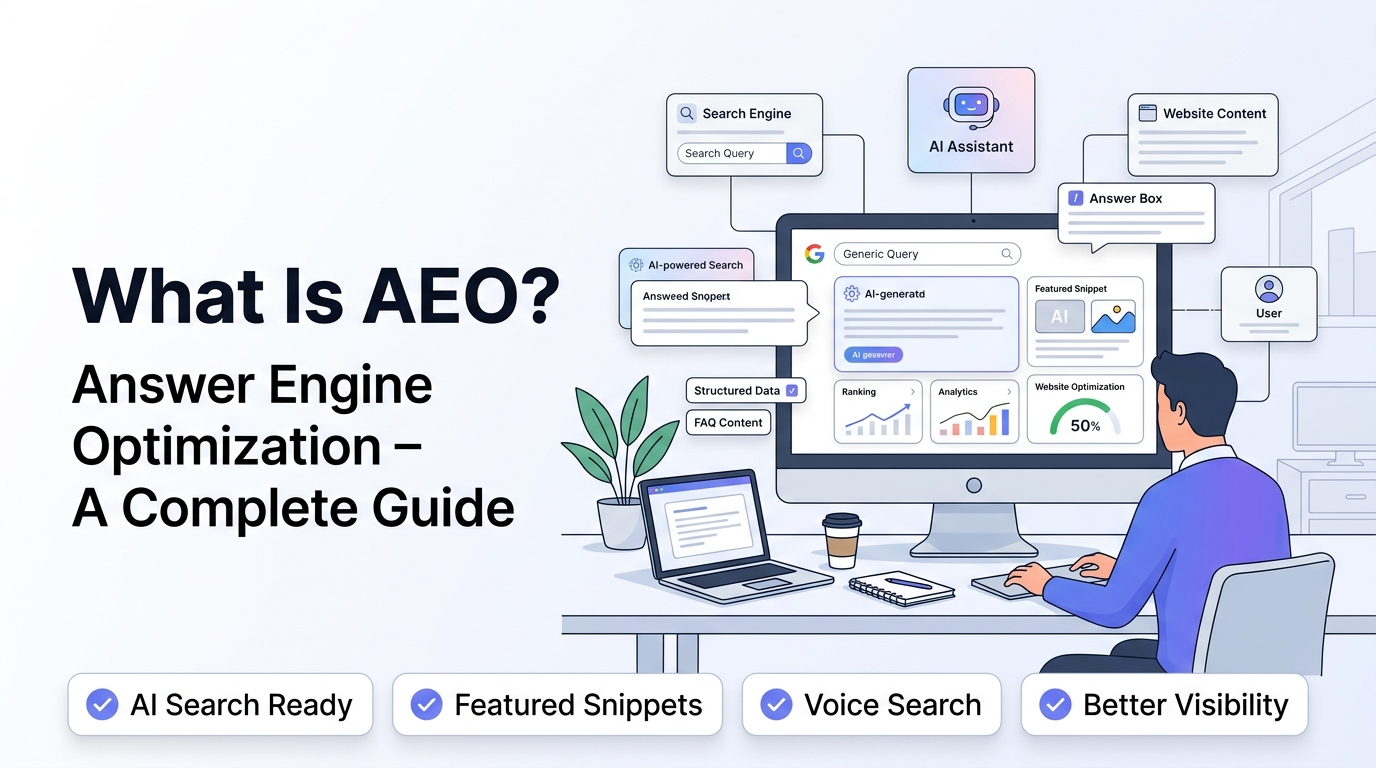
Answer Engine Optimization is the process of optimizing content specifically to be understood, extracted, and surfaced by AI systems that answer questions directly, rather than simply listing links for a person to click through. That covers Google's AI Overviews and AI Mode, conversational AI tools like ChatGPT and Claude, answer-focused search engines like Perplexity, and voice assistants that read a single answer aloud rather than presenting a results page at all.
The AEO meaning in practice comes down to one core question: if an AI system reads your page, can it confidently pull out a clear, accurate answer to a specific question and would it trust your page enough to cite it?
This is a meaningfully different target than ranking well in a traditional list of search results. Traditional SEO optimizes for a person scanning ten results and choosing where to click. AEO optimizes for a machine reading your content, deciding it's the best available answer, and either quoting it directly or recommending your brand by name sometimes without the user ever visiting your site at all.
How Does AEO Work?
AI answer engines work by scanning a large set of candidate pages for a given query, then evaluating which ones most clearly and reliably answer the actual question being asked. Several things influence whether your content gets selected:
Clarity of the answer itself. Content that states its main point directly, early, and unambiguously is easier for an AI system to extract with confidence than content that builds up to its answer through several paragraphs of preamble.
Structural signals. Headers, lists, tables, and well-organized sections give AI crawlers clean, extractable chunks of information, rather than forcing them to parse dense, unstructured prose.
Structured data. Schema markup gives search engines and AI systems explicit, machine-readable context about your content while it isn't confirmed to directly influence AI citation, it remains a best practice that reduces ambiguity for any system parsing your page.
Source credibility. AI systems tend to favor content from sites that already demonstrate topical authority, accurate information, and consistent expertise, similar to how traditional SEO trust signals work.
Freshness and accuracy. Answer engines generally favor current, verifiably accurate information, particularly for topics where facts change pricing, statistics, product details, and similar time-sensitive content.
In short: how does AEO work? By making your content the easiest, most trustworthy, most clearly structured answer available for a given question so an AI system doesn't have to guess or reconstruct your point from scattered context.
AEO vs. SEO vs. GEO: What's the Difference?
These three terms overlap heavily, which causes a lot of genuine confusion. Here's a practical breakdown.
AEO vs. Traditional SEO
Traditional SEO focuses on ranking a page within a list of search results, optimizing for click-through rate, keyword relevance, backlinks, and technical site health. The end goal is a person clicking your link.
AEO vs. traditional SEO isn't really an either/or choice AEO is built on the same technical foundation (fast, crawlable, well-structured sites) but adds a specific focus on making content directly answerable and quotable, since the "result" might be a synthesized answer rather than a link at all.
AEO vs. GEO
AEO vs. GEO (Generative Engine Optimization) is largely a matter of scope and naming convention rather than a fundamentally different practice. GEO typically refers specifically to optimizing for generative AI platforms like ChatGPT, Gemini, and Perplexity. AEO is often used as the broader umbrella term, covering those same generative platforms plus voice assistants, featured snippets, and Google's People Also Ask boxes essentially any system built to answer a question directly rather than list results.
In practical terms, the tactics for AEO and GEO overlap so heavily that most businesses can treat them as a single combined strategy rather than building separate campaigns for each.
Where they meet
All three disciplines share the same starting point: technically sound, genuinely useful, well-organized content earns visibility regardless of which system is doing the ranking. AEO doesn't replace SEO fundamentals it extends them toward a new kind of search behavior.
Why AEO Matters Now
A few converging trends make this a genuinely urgent shift rather than a speculative future trend:
AI Overviews now appear on the majority of commercial search queries, sitting above traditional organic results and capturing attention before a user ever scrolls further.
Conversational AI tools have become a genuine search alternative for a meaningful share of users, particularly for research-heavy or comparison-driven questions.
Voice search and smart assistants have always operated on a single-answer model, and AEO principles apply directly to winning that single spot.
Zero-click searches are rising, meaning a growing share of queries are fully answered without a single website visit making it more important than ever that when your brand does get mentioned, it's mentioned accurately and favorably.
Businesses that treat this as optional are effectively opting out of an increasing share of how people are discovering answers, including answers about businesses just like theirs.
AI Search Ranking Factors: What Actually Influences AEO Visibility
While no platform publishes an exact ranking formula, a consistent pattern has emerged across what tends to correlate with AI citation and recommendation:
Direct, front-loaded answers. State the core answer in the first sentence or two of a section, then elaborate below it.
Topical depth and coverage. Pages that thoroughly address a topic including related sub-questions tend to be treated as more authoritative than thin, narrowly-scoped pages.
Structured formatting. Numbered steps, bullet points, comparison tables, and clear headers make content easier to parse and extract accurately.
Schema markup. Structured data doesn't guarantee AI citation, but it reduces ambiguity and supports the same technical foundation traditional rich results rely on.
External validation. Being mentioned, linked, or cited by other credible sources appears to reinforce an AI system's confidence in citing you as well.
Consistency across the web. When your brand's facts, positioning, and details are consistent across your site, directory listings, and other mentions, it reduces the chance an AI system pulls conflicting or outdated information.
Natural language alignment. Content written in the way people actually phrase questions rather than only optimized for short keyword phrases tends to match conversational AI queries more precisely.
Best AEO Strategies and Best Practices
Turning these ranking factors into an actual AEO strategy comes down to a handful of concrete, repeatable practices.
1. Answer the question in the first two sentences
Whatever question a page or section is built around, answer it immediately and plainly before adding supporting detail. AI systems extract far more reliably from content that doesn't bury its main point under throat-clearing paragraphs.
2. Structure content around real questions
Build sections around the actual phrasing people use when asking a question "how does X work," "what's the difference between X and Y," "is X worth it" rather than only around short keyword phrases. This is one of the most reliable AEO best practices, since it mirrors how conversational AI queries are actually phrased.
3. Use FAQ sections deliberately
A well-structured FAQ section, each question paired with a direct, self-contained answer, is one of the highest-leverage formats for AEO. Each Q&A pair functions as its own extractable unit an AI system can pull cleanly.
4. Implement structured data
Adding relevant schema markup Article, FAQPage, Organization, Product, or Review schema depending on the page gives both traditional search engines and AI systems explicit, unambiguous context about your content.
5. Build genuine topical authority
Rather than one isolated page trying to cover everything, build out a cluster of interlinked content around a subject area. Depth and consistency across multiple pages signal expertise more convincingly than a single exhaustive article standing alone.
6. Keep facts current and consistent
Audit time-sensitive content pricing, statistics, product specs on a regular schedule. Outdated facts that contradict more current information elsewhere online undermine the trust signals AI systems rely on.
7. Earn genuine external mentions
Digital PR, guest contributions, and organic backlinks still matter under an AEO lens, since third-party validation appears to reinforce an AI system's willingness to cite a source directly.
AEO Optimization Checklist
A practical, page-level checklist to work through:
[ ] Does the page answer its core question within the first two sentences of the relevant section?
[ ] Is the content broken into clear, well-labeled headers and subheaders?
[ ] Are lists, tables, or step-by-step formats used wherever they genuinely fit the content?
[ ] Is there a dedicated FAQ section with direct, self-contained answers?
[ ] Is relevant schema markup implemented and validated?
[ ] Are facts, figures, and claims current and consistent with your other published content?
[ ] Does the content go beyond surface-level coverage into genuine depth on the topic?
[ ] Is the page linked to and from other topically related content on your site?
[ ] Would a competitor's page, read side by side with yours, clearly be less useful to someone asking this question?
AEO for Small Businesses, Local Businesses, and Ecommerce
AEO isn't just an enterprise-scale concern in some ways, smaller and more specific businesses have a real advantage here.
AEO for small businesses
Smaller businesses often compete on more specific, less contested questions than national brands. AEO for small businesses means prioritizing FAQ-style content around the exact questions your actual customers ask pricing, process, timelines, and comparisons rather than trying to compete on broad, saturated terms.
AEO for local businesses
AEO for local businesses overlaps heavily with strong local SEO fundamentals: an accurate, complete Google Business Profile, consistent business information across directories, and location-specific content answering questions like "how much does [service] cost in [city]" the kind of specific, high-intent question AI answer engines are increasingly good at surfacing local businesses for.
AEO for ecommerce websites
AEO for ecommerce websites centers on product-level clarity: clear specifications, direct comparison content between product options, honest pros-and-cons framing, and structured Product and Review schema. AI shopping-related answers increasingly synthesize comparisons across multiple products, so ecommerce pages that make direct comparison easy tend to perform better under this model than pages relying purely on persuasive marketing copy.
How to Rank in Google AI Overviews
Since Google's AI Overviews represent one of the highest-visibility answer engine surfaces, it's worth addressing directly. A few things specifically help:
Solid traditional SEO fundamentals still matter AI Overviews draw heavily from pages that already rank well organically, so foundational technical SEO and content quality remain the baseline requirement, not an alternative to AEO.
Featured-snippet-style formatting (direct answers, numbered steps, definition-style openings) correlates strongly with AI Overview inclusion, since the underlying extraction mechanics are similar.
E-E-A-T signals demonstrated experience, expertise, authoritativeness, and trustworthiness continue to matter, since Google's systems weigh source credibility heavily when selecting what to summarize.
Monitor, don't just guess. Track which of your queries are triggering AI Overviews and whether your content is being cited, so you can prioritize optimization efforts where visibility is actually shifting.
Measuring AEO Success
AEO complicates measurement somewhat, since a successful citation might not generate a click at all. A more complete measurement approach includes:
Brand mention tracking across AI platforms for relevant queries, even without an accompanying click
Impression and visibility data where available through tools that monitor AI Overview appearances
Direct and branded traffic trends, since AI-driven brand awareness often shows up as an increase in people searching for your brand name directly afterward
Traditional organic metrics alongside AEO-specific tracking, since the two remain closely connected rather than separate funnels
Common AEO Mistakes to Avoid
Treating AEO as a checklist instead of a content philosophy. Adding an FAQ section to a page that otherwise buries its main point doesn't fix the underlying clarity problem.
Chasing AI visibility at the expense of accuracy. Content optimized to sound authoritative without being genuinely correct is a short-term strategy that risks real reputational damage once inaccuracies get surfaced and repeated by AI systems.
Ignoring technical SEO fundamentals. A slow, poorly structured site with excellent content still struggles to be crawled and understood in the first place.
Inconsistent information across platforms. Conflicting details between your website, directory listings, and other mentions actively work against the trust signals AEO depends on.
Should You Hire an SEO Service for AEO, or Handle It In-House?
For businesses without existing in-house SEO capacity, AEO adds another layer of specialization worth factoring into how you evaluate outside help. A few categories of seo services map directly onto different AEO needs:
General seo services or seo marketing services typically now fold AEO and GEO principles into standard campaigns, since the underlying technical and content work overlaps so heavily.
Affordable seo services and seo services for small businesses are worth prioritizing if your budget is limited AEO's emphasis on clear, well-structured content can be handled effectively even at a modest scope, since it doesn't require enterprise-level content volume to be effective.
Ecommerce seo services and shopify seo services providers should be evaluated specifically on whether they address product comparison content and structured Product/Review schema, not just traditional product-page keyword optimization.
Local seo experts, sometimes searched as seo services near me, matter most for AEO if your business depends on location-specific queries.
B2B seo services providers should be able to speak specifically to how AEO applies to longer, more research-driven B2B buying questions, which tend to align closely with how conversational AI tools are used for vendor comparison.
White label seo services are worth considering if you're an agency looking to add AEO capability to your own client offerings without building the expertise internally from scratch.
Organic seo services, wordpress seo services, and industry-specific options like dental seo services should all, at this point, be able to articulate a clear AEO approach if a provider can't explain how they handle AI Overview visibility, that's a meaningful gap in an otherwise standard pitch.
SEO content writing services and seo copywriting services are particularly relevant here, since AEO succeeds or fails largely at the content level a provider skilled in structuring direct, extractable answers is arguably more valuable under this model than one focused purely on keyword density.
International seo services need to account for the fact that AI answer engines behave differently across languages and regions, so a single AEO approach rarely transfers cleanly across markets without localization.
Whether you handle this in-house or bring in outside help, the underlying requirement is the same: content that answers real questions clearly enough that a machine can confidently repeat it.
Final Thoughts
Answer Engine Optimization isn't a passing trend layered on top of SEO it reflects a genuine shift in how people find information, one query at a time, often without ever seeing a traditional list of search results. The businesses that adapt early aren't necessarily the ones with the biggest content budgets; they're the ones willing to restructure how they write leading with clear answers, organizing content around real questions, and backing it up with consistent, accurate information across the web. Start there, and the rest of AEO strategy tends to follow naturally.
Frequently Asked Questions
What is AEO in SEO?
AEO (Answer Engine Optimization) is a specialized extension of SEO focused on making content easily extractable and citable by AI-driven answer engines, rather than optimizing purely for traditional ranked search results.
Is AEO the same as GEO?
They're closely related and often used interchangeably. GEO tends to refer specifically to generative AI platforms, while AEO is often used as the broader term covering AI Overviews, voice assistants, and generative platforms alike. In practice, the optimization tactics overlap heavily.
Do I need to abandon traditional SEO to focus on AEO?
No. AEO builds directly on traditional SEO fundamentals technical health, quality content, and authority signals remain the foundation. AEO adds an additional layer focused on direct answerability and structure.
How long does it take to see AEO results?
Since AI answer engines often draw from already well-ranking, well-structured content, improvements can sometimes appear faster than traditional organic ranking shifts, though consistent, high-quality execution over several months remains the realistic expectation, similar to standard SEO timelines.
Can small businesses realistically compete for AI answer visibility?
Yes. AI answer engines aren't inherently biased toward large brands they favor whichever content most clearly and accurately answers the specific question being asked, which often favors smaller, more specific businesses over broad, generic content from larger competitors.
Does schema markup guarantee AI citation?
No. Structured data isn't a confirmed direct ranking or citation factor for AI systems, but it remains a best practice that reduces ambiguity and supports the same technical foundation traditional SEO relies on.
Get a free audit and see exactly how this applies to your site.