If you've spent any time following recent SEO discussions, you've probably come across llms.txt a small text file some websites have started adding, positioned as a kind of "robots.txt for AI." The pitch sounds appealing: a simple file that tells AI systems like ChatGPT and Claude exactly what your site is about, supposedly making your content easier to find and cite.
But how much of that is actually true, how does the file work, and the question most site owners really want answered should you actually add one to your own website? This guide walks through what llms.txt is, where it came from, what it can and can't do, and how to think about it realistically within a broader SEO and AI visibility strategy.
What Is llms.txt, Exactly?
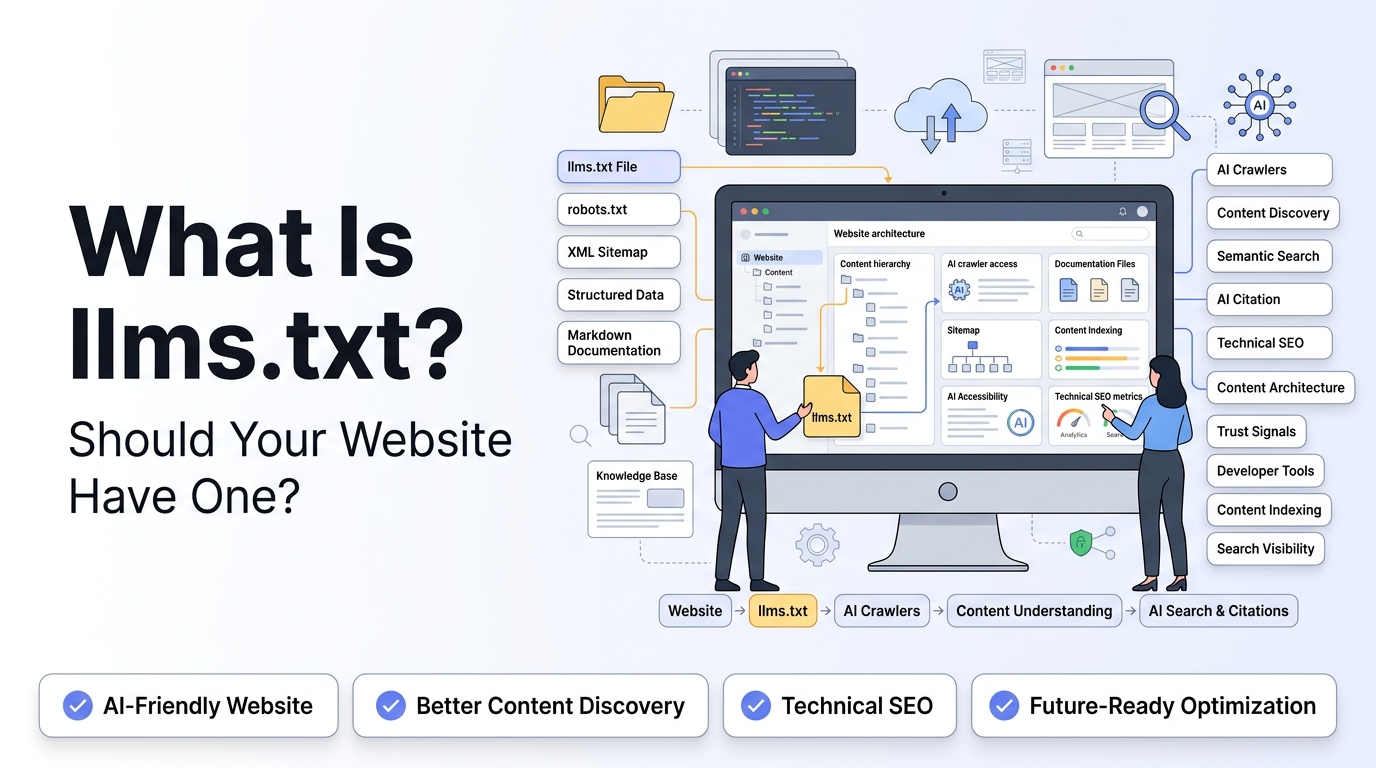
llms.txt is a proposed markdown file, placed at a website's root directory (yoursite.com/llms.txt), designed to give large language models a clean, curated overview of a site's most important content condensed, organized, and free of the navigation menus, ads, and page clutter that a raw HTML crawl would otherwise include.
The idea was introduced by developer Jeremy Howard in 2024 as a proposed convention, not an official standard set by any search engine or AI company. It typically includes:
A brief description of what the site or project is
A curated list of key pages, often grouped by topic or section
Short summaries explaining what each linked page covers
Sometimes a secondary, more detailed version (llms-full.txt) with expanded content
The underlying premise is straightforward: instead of forcing an AI system to crawl and interpret your entire site structure, navigation, and formatting to figure out what matters, you hand it a pre-organized summary pointing directly to your best, most relevant content.
Where the Idea Came From
The proposal draws a direct comparison to robots.txt, the long-standing convention that tells web crawlers which parts of a site they're allowed to access. llms.txt was framed as a similar convention for a different purpose not access control, but content curation specifically aimed at large language models, which tend to work with limited context windows and benefit from concise, well-organized source material rather than parsing an entire site's raw HTML.
It's worth being clear about the distinction, though: robots.txt is genuinely respected by compliant crawlers as a set of rules. llms.txt has no equivalent enforcement it's simply a file that exists, which an AI system's crawler may choose to look for and use, or may ignore entirely.
How llms.txt Differs From robots.txt
These two files get compared constantly, but they serve fundamentally different purposes, and conflating them leads to real misunderstanding.
robots.txt | llms.txt | |
Purpose | Controls what crawlers are allowed to access | Curates and summarizes content for AI systems |
Standard status | Official, widely respected web standard | Proposed convention, not officially adopted |
Enforcement | Compliant crawlers respect its rules | No enforcement entirely optional for any system to use |
Content | Allow/disallow rules and sitemap references | Markdown summaries and links to key pages |
Confirmed impact | Directly controls crawl behavior | Not confirmed to directly influence AI citation or visibility |
The comparison to robots.txt is useful for understanding the intent behind llms.txt, but misleading if it implies llms.txt carries the same authority or guaranteed effect. It doesn't at least not yet, and not officially.
Does llms.txt Actually Improve AI Visibility?
This is the honest, important question, and the honest answer is: it's unconfirmed.
No major AI company not OpenAI, not Anthropic, not Google has publicly confirmed that llms.txt directly influences whether content gets retrieved, summarized, or cited. Some AI systems may check for it; others may ignore it entirely, since it isn't a required or standardized part of how these models crawl or process web content.
What can be said with more confidence:
It doesn't hurt to have one, provided implementing it doesn't distract from more impactful SEO work.
It may offer modest, indirect benefit for very large or complex sites, simply by making it easier for any AI crawler that does check for it to quickly identify your most relevant content rather than needing to infer it from a large, unstructured crawl.
It's not a substitute for genuine content quality, structure, and technical SEO, all of which remain far more established, better-understood factors in how AI systems and traditional search engines alike evaluate and surface content.
Treat llms.txt as a low-cost, speculative addition not a guaranteed lever, and not a priority ahead of fundamentals that are actually proven to matter.
What a Well-Structured llms.txt File Looks Like
If you decide to add one, here's the general format the convention follows:
# Your Site Name
> A one-sentence description of what your site or business does.
## Key Pages
- [About Us](https://yoursite.com/about): Brief description of what this page covers.
- [Services](https://yoursite.com/services): Overview of your core offerings.
- [Blog](https://yoursite.com/blog): Index of your published articles and guides.
## Documentation
- [Getting Started Guide](https://yoursite.com/docs/getting-started): A summary of this resource.
The format is intentionally simple plain markdown, clear headers, short descriptive summaries, and direct links. There's no complex syntax or required schema to learn, which is part of why it's spread as quickly as it has despite lacking formal standardization.
Should Your Website Actually Have One?
The honest answer depends heavily on your site's size, complexity, and existing structure.
Sites that may genuinely benefit
Large documentation sites with hundreds of pages, where a curated summary genuinely reduces the burden of interpreting an otherwise sprawling structure
Developer tools and API platforms, where AI coding assistants specifically benefit from a clean, direct reference to key documentation
Complex multi-section websites where the most important content isn't obvious from crawling alone, due to deep navigation or inconsistent internal linking
Sites where it matters less
Small business websites with a handful of clearly organized pages, where a well-structured sitemap and clean navigation already make the site easy to interpret without an additional file
Simple blogs or portfolio sites, where content organization is already straightforward
Sites that haven't addressed foundational SEO issues yet technical health, content clarity, structured data since those factors have a far more established connection to visibility than llms.txt does
If your site is small and well-organized already, the honest assessment is that llms.txt offers limited additional benefit. If your site is large, complex, or genuinely hard to navigate even for a human visitor, it's a low-cost experiment worth trying just not a priority ahead of more foundational work.
How to Create and Add llms.txt to Your Site
If you decide to implement one, the process is straightforward:
Identify your most important pages the content you'd most want an AI system to find and reference if it were only going to look at a handful of pages.
Write brief, clear summaries for each, focused on what the page actually covers rather than marketing language.
Organize by logical section services, documentation, guides, key resources mirroring how you'd want a person to navigate if they only had a few minutes.
Save the file as llms.txt in plain markdown format.
Upload it to your site's root directory, so it's accessible at yoursite.com/llms.txt, the same pattern robots.txt follows.
Keep it updated as your site's content changes a stale llms.txt pointing to outdated or removed pages is arguably worse than not having one at all.
What Actually Matters More Than llms.txt
Given the unconfirmed impact of llms.txt specifically, it's worth being clear about what genuinely does have an established relationship with both traditional search visibility and AI citation:
Technical SEO fundamentals crawlability, site speed, mobile usability, clean indexing
Structured data schema markup that gives explicit, machine-readable context about your content
Clear, well-organized content direct answers, logical headers, genuine depth on a topic
Consistent, accurate information across your site and other web presences
Genuine topical authority, built through comprehensive, interlinked content rather than isolated pages
llms.txt sits at the edge of this list, not the center of it a speculative, low-effort addition rather than a foundational requirement.
Where This Fits Into a Broader SEO and AI Visibility Strategy
For businesses trying to keep pace with how search and AI visibility are evolving, llms.txt is worth understanding but shouldn't dominate strategy or budget. This is where working with experienced seo services can help put a file like this in proper context, rather than treating it as a magic fix.
A capable seo marketing services partner should be able to explain clearly where llms.txt fits relative to more established priorities not oversell it as a guaranteed AI visibility lever, and not dismiss it outright either, since a low-cost, low-risk addition can still be worth doing correctly once the fundamentals are already in good shape.
Organic seo services, and more specifically an organic seo services company with genuine technical depth, should be comfortable implementing something like llms.txt as a minor addition to a broader technical audit, rather than positioning it as a standalone offering.
For businesses evaluating monthly seo services, it's reasonable to ask whether emerging conventions like llms.txt are part of an ongoing technical review process, or whether the provider is only focused on traditional ranking factors. A forward-looking process should account for both without overcommitting resources to unproven tactics.
Industry and platform-specific considerations
Ecommerce seo services and shopify seo services providers working on larger stores may find llms.txt genuinely useful for summarizing key category and policy pages, given how sprawling a large product catalog's navigation can become.
Small business seo services and seo services for small businesses generally shouldn't prioritize llms.txt at all until foundational technical and content work is complete a small site with a handful of clear, well-optimized pages gets little practical benefit from an additional summary file.
B2B seo services working with companies that maintain extensive documentation or resource libraries may see more genuine value here, since AI-assisted research is increasingly common in B2B buying journeys, and a clean content index could plausibly help in that specific context.
Dental seo services and other local-focused practices are, again, generally better served focusing on local SEO fundamentals accurate business listings, clear service pages, genuine patient-question content well before considering something as experimental as llms.txt.
International seo services should note that llms.txt, as a proposed convention, has no formal guidance yet on handling multilingual or multi-region content structures, which adds a layer of uncertainty for global sites specifically.
Wordpress seo services implementing llms.txt should account for how the CMS structures content, since automatically generating an accurate, current file from a WordPress site's structure typically requires either a plugin or a manually maintained process, given there's no native built-in support yet.
For businesses seeking seo content writing services or seo copywriting services, the more valuable, proven skill remains structuring content for direct answerability and topical depth the same content practices that support both traditional SEO and AI citation reliably, regardless of whether llms.txt itself ever gains wider formal adoption.
If you're comparing seo services near me or affordable seo services more broadly, it's worth treating a provider's stance on llms.txt as a small signal of how they approach emerging trends generally cautious, proportionate adoption tends to be a healthier sign than either dismissing new conventions outright or overselling them as guaranteed wins.
White label seo services providers building out AI-visibility offerings for their own agency clients should be transparent that llms.txt remains unconfirmed and speculative when pitching it, rather than presenting it as an established ranking factor.
Common Misconceptions About llms.txt
"It's an official web standard." It isn't. It's a community-proposed convention without formal adoption by any major search engine or AI company.
"AI companies require it." None do. Whether any given AI crawler checks for or uses it at all is inconsistent and unconfirmed.
"It replaces the need for good SEO." It doesn't come close technical SEO, content quality, and structured data remain far more established and impactful.
"Every website needs one immediately." Smaller, well-organized sites see limited practical benefit; it's most relevant for large, complex sites genuinely difficult to navigate.
A Quick Decision Checklist
If you're still unsure whether to bother, run through these questions honestly:
[ ] Does my site have more than a few dozen pages that would be genuinely hard for an outside system to prioritize without guidance?
[ ] Have I already addressed the core technical SEO fundamentals site speed, crawlability, mobile usability, indexing?
[ ] Is my content already well-structured with clear headers, schema markup, and direct answers?
[ ] Do I maintain documentation, a knowledge base, or a large resource library that changes or grows regularly?
[ ] Am I comfortable keeping an additional file updated as content changes, rather than letting it go stale?
If you checked most of these, adding llms.txt is a reasonable, low-effort next step. If you're still working through the first few technical and content fundamentals, that's where your time is better spent first llms.txt will still be there, and arguably more useful, once those foundations are solid.
What the Future of llms.txt Might Look Like
It's worth being upfront that nobody including the people actively building AI search systems can say with certainty whether llms.txt becomes a widely adopted standard or fades as a niche convention a subset of developer-focused sites continue using. A few plausible paths exist:
Formal adoption, where a major AI company or standards body eventually recognizes and documents official support, similar to how robots.txt became genuinely standardized over time.
Quiet, informal persistence, where some AI crawlers check for it inconsistently, some sites maintain it out of habit or hope, and it never gains a confirmed, universal role plausibly where things already stand today.
Replacement by something else entirely, as AI companies develop more sophisticated, automated ways of understanding site structure and content relevance that make a manually maintained summary file less necessary over time.
Given that uncertainty, the most sensible approach for most businesses is exactly what's been outlined here: treat it as a small, reasonable experiment if your site is large and complex enough to benefit, keep expectations modest, and don't let it pull focus from the SEO fundamentals that already have a clear, demonstrated track record.
Final Thoughts
llms.txt is a genuinely interesting idea worth understanding, but it's important to hold it at the right proportion relative to everything else that goes into SEO and AI visibility. It's low-cost, low-risk, and potentially useful for large or complex sites but it's speculative, unofficial, and nowhere near as impactful as the technical and content fundamentals that have a well-established relationship with visibility, in AI systems and traditional search alike. Add one if it makes sense for your site's size and complexity, but never let it distract from the work that's actually proven to move the needle.
Frequently Asked Questions
Is llms.txt required for AI systems to find my content?
No. It's an optional, unofficial convention. AI systems can and do find and evaluate content without it, using the same crawling and indexing approaches they already rely on.
Will adding llms.txt hurt my SEO?
No, adding one carries essentially no downside, provided it doesn't distract time and resources away from more established, proven SEO work.
How is llms.txt different from a sitemap?
A sitemap (sitemap.xml) is a structured, machine-readable list of your site's URLs meant for search engine crawlers, primarily supporting indexing. llms.txt is a curated, human-readable markdown summary specifically aimed at large language models, focused on content context rather than exhaustive URL listing.
Do I need developer help to add llms.txt?
Not necessarily it's a plain text file that can be created manually and uploaded to your site's root directory, similar to robots.txt. Larger or more complex sites may still prefer a more structured, plugin-assisted, or developer-managed process to keep it accurate over time.
Should small businesses prioritize llms.txt over other SEO work?
No. Foundational technical SEO, clear content structure, and accurate business information should come first. llms.txt is a minor, optional addition best considered after those fundamentals are solidly in place.
Is llms.txt likely to become an official standard?
It's genuinely uncertain. Adoption has grown organically since it was proposed, but no major search engine or AI company has formally endorsed or required it as of now, and its future status remains an open question.
Get a free audit and see exactly how this applies to your site.