Search used to mean one thing: a page of ten blue links, ranked by relevance. Today, that same query might trigger a synthesized AI answer, a conversational response from ChatGPT, or a direct citation inside Perplexity with no traditional results page involved at all. As search has fragmented across these different experiences, three overlapping disciplines have emerged to describe how businesses optimize for them: SEO, AEO, and GEO.
The terms get used almost interchangeably in marketing conversations, which causes real confusion when it comes time to actually build a strategy or evaluate an agency's pitch. This guide breaks down exactly what separates GEO, AEO, and SEO, where they overlap, and more practically how to think about all three together instead of picking just one.
What Is SEO? A Quick Refresher
Search Engine Optimization is the long-established practice of improving a website so it ranks higher in traditional search engine results pages primarily Google, but also Bing and other search engines. SEO includes technical work (site speed, crawlability, mobile usability), on-page optimization (keywords, headers, internal linking), and off-page authority building (backlinks, brand mentions).
The core objective of SEO has always been visibility within a list earning a top position among competing results so a person scanning that list chooses your link. Everything from keyword research to link building exists in service of that single outcome: the click.
What Is AEO? Answer Engine Optimization Explained
Answer Engine Optimization shifts the target from ranking within a list to being the answer itself. Instead of competing for a click among ten results, AEO optimizes content to be directly extracted, quoted, or summarized by systems designed to answer a question in one response Google's AI Overviews and AI Mode, People Also Ask boxes, featured snippets, and voice assistants like Siri or Alexa.
AEO succeeds when your content states its point clearly and early, is structured in a way that's easy to extract (short, direct answers; clear headers; lists and tables), and comes from a source the answer engine trusts enough to cite confidently. It's less about keyword density and more about answerability could a machine read this content and confidently repeat your point back to someone, accurately, without misrepresenting it?
What Is GEO? Generative Engine Optimization Explained
Generative Engine Optimization is the newest of the three terms, and it specifically targets generative AI platforms tools like ChatGPT, Google Gemini, Anthropic's Claude, and Perplexity, which don't just extract a single fact but synthesize a conversational response, often drawing from multiple sources at once and sometimes citing them directly.
GEO overlaps heavily with AEO in practice, but the distinction is worth understanding: an answer engine (like a featured snippet) typically pulls one specific piece of text verbatim from a single source. A generative engine blends information from several sources into a new, original response which means your goal with GEO isn't just to be extractable, but to be one of the sources a generative model considers reliable enough to draw from and, ideally, name directly in its answer.
GEO vs AEO vs SEO: A Direct Comparison
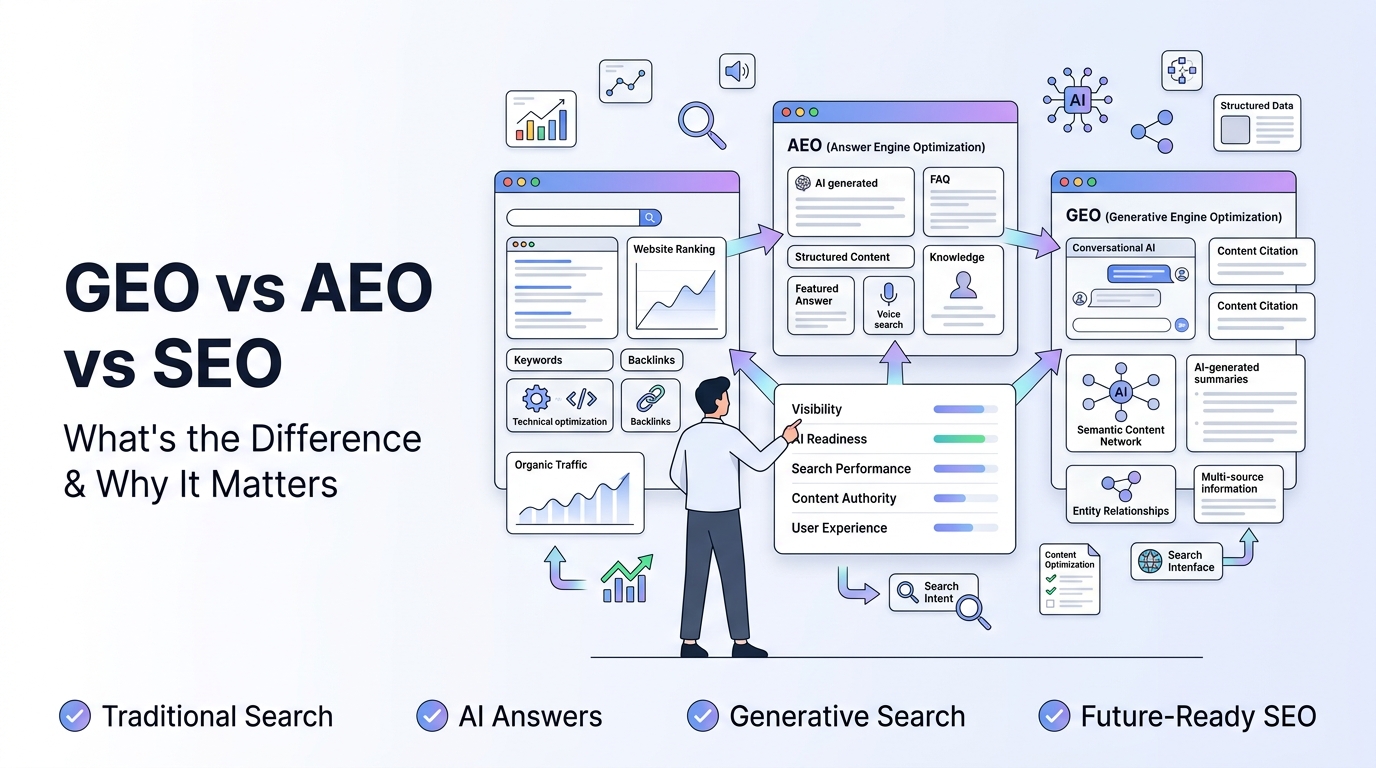
SEO | AEO | GEO | |
Primary goal | Rank in a results list | Be the direct answer | Be cited within a generated response |
Target systems | Google, Bing search results | AI Overviews, voice search, featured snippets | ChatGPT, Gemini, Claude, Perplexity |
Success metric | Ranking position, click-through rate | Featured snippet wins, AI Overview appearances | Citations, brand mentions in AI responses |
Content style | Keyword-optimized, comprehensive pages | Direct, front-loaded answers | Authoritative, well-sourced, quotable content |
User outcome | Clicks through to your site | Reads answer, may or may not click | Reads a synthesized answer, may see your brand named |
The differences are real, but they're differences of emphasis, not entirely separate playbooks. All three still depend on technically sound websites, genuinely useful content, and credible authority signals.
AEO vs SEO
AEO vs SEO often gets framed as a rivalry, but AEO is better understood as an extension of SEO rather than a replacement for it. AI Overviews frequently draw from pages that already rank well organically meaning strong traditional SEO is often a prerequisite for AEO success, not an alternative to it. The added layer AEO Services USA brings is a sharper focus on structuring content so it can be lifted cleanly out of context and still make complete sense.
AEO vs GEO
AEO vs GEO is the subtlest distinction of the three, and in casual use, the terms are frequently swapped for each other. If you want a working rule of thumb: AEO covers any system extracting a single, discrete answer (a featured snippet, a voice assistant response), while GEO covers systems generating a new, synthesized answer that may draw from and cite multiple sources at once. Most practical optimization work clear structure, credible sourcing, direct answers serves both equally well.
GEO vs Traditional SEO
GEO vs traditional SEO highlights the biggest philosophical shift. Traditional SEO assumes a human is choosing among competing links. GEO assumes an AI model is synthesizing an answer on the user's behalf, and your content's job is to be reliable and clear enough to be worth citing within that synthesis sometimes without ever generating a click at all. That changes how you should think about success: brand visibility and citation frequency start to matter alongside, and sometimes instead of, raw click-through traffic.
Why This Distinction Actually Matters for Your Business
It would be easy to treat this as academic terminology debate, but the practical stakes are real:
Traffic patterns are shifting. A growing share of queries now resolve without a click at all, meaning a strategy built purely around ranking position without accounting for AEO and GEO visibility is measuring an incomplete picture of your actual search presence.
Brand visibility can now happen with zero traffic. Being named favorably inside an AI-generated answer builds awareness and trust even when no click occurs, which is a genuinely new kind of marketing outcome traditional analytics weren't built to capture.
Different content formats win in different systems. A page built purely for keyword ranking might underperform in AI Overviews if it buries its main point, even while ranking well in a traditional results list.
Competitive advantage is still wide open. Because so many businesses are still treating this as one undifferentiated SEO bucket, the businesses that deliberately optimize for all three layers now have a real head start over competitors who haven't caught up yet.
How to Build a Strategy That Covers All Three
Rather than running three separate campaigns, the most efficient approach treats SEO, AEO, and GEO as layers built on the same foundation.
1. Start with technical SEO fundamentals
None of this works on a slow, poorly indexed, hard-to-crawl website. Site speed, mobile usability, clean site architecture, and proper indexing remain the non-negotiable baseline every other layer depends on.
2. Write for direct answerability
Structure content so the core answer to any given question appears within the first sentence or two of its section, with supporting detail following afterward. This single habit does more for AEO and GEO performance than almost any other content change.
3. Build genuine topical depth
Both answer engines and generative engines favor sources that demonstrate real expertise across a topic, not just a single isolated page. Interlinked content clusters that thoroughly cover a subject area signal authority more convincingly than one standalone article.
4. Use structured data consistently
Schema markup Article, FAQPage, Product, Organization, Review gives every system, human-facing or AI-facing, unambiguous context about your content. It's not a guaranteed citation trigger, but it removes a layer of uncertainty that otherwise works against you.
5. Earn credible external validation
Backlinks, digital PR, and organic mentions from reputable sources still matter under this combined model, since third-party validation appears to reinforce how confidently AI systems cite a source.
6. Monitor all three visibility types
Track traditional rankings, AI Overview appearances for your key queries, and where tools allow mentions or citations within generative AI responses. Treating these as one combined visibility picture, rather than three disconnected metrics, gives a far more accurate read on your actual search presence.
Industry-Specific Considerations
The relative weight of SEO, AEO, and GEO shifts depending on your business model, which is worth factoring in when you plan a strategy or evaluate outside help.
Ecommerce businesses lean heavily on GEO and AEO for comparison-style queries (best X for Y, X vs Z) where generative tools increasingly synthesize product comparisons directly. Ecommerce seo services and seo services for ecommerce providers should be evaluated on whether they address structured product data and comparison content specifically, not just traditional catalog SEO.
Small businesses and local service providers often see the fastest wins from AEO, since specific, high-intent local questions (how much does X cost in [city]) are exactly the kind of query answer engines handle well. Small business seo services and seo services for small businesses should reflect this by prioritizing FAQ-style, question-driven content over broad, generic keyword targeting.
B2B companies benefit from GEO in particular, since longer, research-driven buying journeys increasingly involve conversational AI tools for vendor comparison and due diligence. B2B seo services providers should be able to speak to how they structure comparison and evaluation content for exactly this use case.
Dental practices and other local professional services benefit from the same local-AEO principles as any service business clear, question-driven content and consistent business information across the web. Dental seo services, and comparable niche-specific offerings, should apply the same fundamentals within their specific industry context.
What to Look for in an SEO Provider Under This New Model
If you're evaluating outside help rather than handling this in-house, it's worth understanding how the landscape of seo services has adapted or hasn't to this three-layer reality.
General seo marketing services should, at this point, be able to explain how their standard process incorporates AEO and GEO principles rather than treating them as a separate add-on service.
Organic seo services and an organic seo services company more broadly should be evaluated on whether their content approach naturally produces AEO-friendly formatting (direct answers, clear structure) as a byproduct of good SEO writing, not as an afterthought.
Monthly seo services retainers should include some visibility into AI Overview appearances and citation tracking alongside traditional ranking reports, even if the tooling here is still maturing across the industry.
White label seo services are worth considering if you're an agency wanting to offer combined SEO/AEO/GEO capability to your own clients without building that expertise from the ground up.
Shopify seo services and wordpress seo services providers should understand the platform-specific technical constraints that affect structured data implementation, since schema support and site architecture vary meaningfully between platforms.
International seo services need to account for the fact that AI answer engines behave differently across languages, regions, and even individual platforms, so a single AEO/GEO approach rarely transfers cleanly across markets without real localization work.
SEO content writing services, seo copywriting services, and dedicated seo content services are arguably more central to this combined strategy than ever, since content clarity and structure not backlinks or technical tweaks alone are what most directly determine AEO and GEO performance.
SEO reseller services should be scrutinized carefully here, since reselling arrangements can sometimes mean generic, templated content that struggles specifically with the direct-answer clarity this model rewards.
Affordable seo services, when evaluated fairly, don't need to mean a lesser AEO/GEO approach clear, well-structured content doesn't require an enterprise-level budget, just a properly scoped strategy matched to your actual needs.
The common thread across all of these categories: a provider genuinely equipped for the current search landscape should be able to explain, specifically, how their process accounts for AI-driven visibility not just traditional ranking reports.
Common Misconceptions About GEO, AEO, and SEO
GEO and AEO make traditional SEO obsolete. They don't both are built on the same technical and content foundation SEO has always required. Abandoning SEO fundamentals to chase AI visibility tends to undermine both.
You need three completely separate strategies. In practice, one well-executed content and technical strategy serves all three, with adjustments in formatting and emphasis rather than a ground-up separate campaign for each.
Schema markup guarantees AI citation. It doesn't, for any of the three disciplines it's a supporting best practice, not a direct lever that forces inclusion.
Only large brands can compete in AI search. AI systems generally favor whichever content most clearly and accurately answers a specific question, which frequently favors smaller, more specific sources over broad, generic content from bigger competitors.
How We Got Here: A Brief History of the Shift
Understanding why these three terms exist side by side helps make sense of where things are headed next.
For roughly two decades, SEO operated under a fairly stable model: Google crawled the web, ranked pages by relevance and authority, and presented a list. Featured snippets, introduced years ago, were an early sign of what was coming Google started pulling a single, direct answer out of a ranked page and displaying it above the traditional results, without requiring a click. That was arguably the first real step toward what we now call AEO.
Voice assistants accelerated the same shift. Asking Alexa or Siri a question doesn't return a list it returns one spoken answer, drawn from whichever source the system trusts most. Businesses that wanted to win voice search had to think differently about structuring content, well before AEO existed as a term.
The more recent leap came with generative AI. Once large language models became capable of synthesizing original, conversational answers rather than just extracting a single existing sentence a new category of optimization became necessary. GEO emerged specifically to describe this: not just being extractable, but being one of the sources a generative model chooses to draw from and, ideally, credit by name.
Seen this way, SEO, AEO, and GEO aren't three unrelated disciplines that appeared at random they're three stages of the same underlying trend: search engines getting progressively better at answering questions directly, rather than simply pointing users toward where an answer might be found.
A Practical Example: The Same Question, Three Different Outcomes
It helps to see how differently these three models actually behave for an identical query. Imagine someone searching best CRM for a small real estate team.
Under a pure SEO model, that search returns a ranked list of ten links blog posts, comparison articles, vendor pages competing for the click based on keyword relevance, backlink authority, and on-page optimization.
Under an AEO model, the same query might trigger a featured snippet or AI Overview pulling one specific, well-structured answer perhaps a numbered list of top options extracted directly from a single well-optimized comparison article displayed above the traditional results.
Under a GEO model, the person might instead ask ChatGPT or Perplexity the same question directly. The response synthesizes information from several sources pricing details from one, feature comparisons from another, user sentiment from a third into an original answer, sometimes naming two or three specific tools and, if you're fortunate, citing the sources it drew from.
Notice that in all three scenarios, the same underlying content a genuinely thorough, well-structured comparison of CRMs for real estate teams is what wins. The difference isn't in what you'd need to create, but in how that content gets surfaced, and whether the end result is a click, a snippet, or a citation buried inside a longer generated response.
Final Thoughts
GEO, AEO, and SEO aren't three competing strategies fighting for the same budget they're three descriptions of the same underlying goal, applied to three different ways people now find information. Search hasn't fragmented so much as it's expanded: a results list, a direct answer, and a generated response are all still, fundamentally, someone looking for information your business might be the best source for. Build your content and technical foundation well enough, and you're not choosing between SEO, AEO, and GEO you're simply covered across all three at once.
Frequently Asked Questions
Is GEO replacing SEO?
No. GEO addresses a specific new surface generative AI platforms but depends entirely on the same technical and content fundamentals traditional SEO has always required. Think of it as an added layer, not a replacement.
Which should I prioritize: SEO, AEO, or GEO?
Most businesses shouldn't have to choose. A properly built content and technical strategy naturally supports all three, since the underlying requirements clarity, structure, credibility overlap heavily across all of them.
How do I measure GEO and AEO success if there's no click?
Track brand mention frequency across AI platforms for relevant queries, monitor AI Overview appearances where tools allow, and watch for increases in direct or branded search traffic, which often follows AI-driven brand exposure even without a direct click.
Do small businesses really need to worry about GEO?
Yes, though the emphasis may differ. Small businesses often see faster, more attainable wins from AEO specifically, since local and highly specific questions are exactly the type of query answer engines handle well.
Is it worth hiring separate agencies for SEO, AEO, and GEO?
Generally no because the practical work overlaps so heavily, a single provider capable of addressing all three within one strategy is typically more efficient and coherent than managing three disconnected engagements.
Get a free audit and see exactly how this applies to your site.