Improving Google rankings means increasing the relevance, quality, and trustworthiness signals your page sends compared to the pages currently outranking you for that specific query.
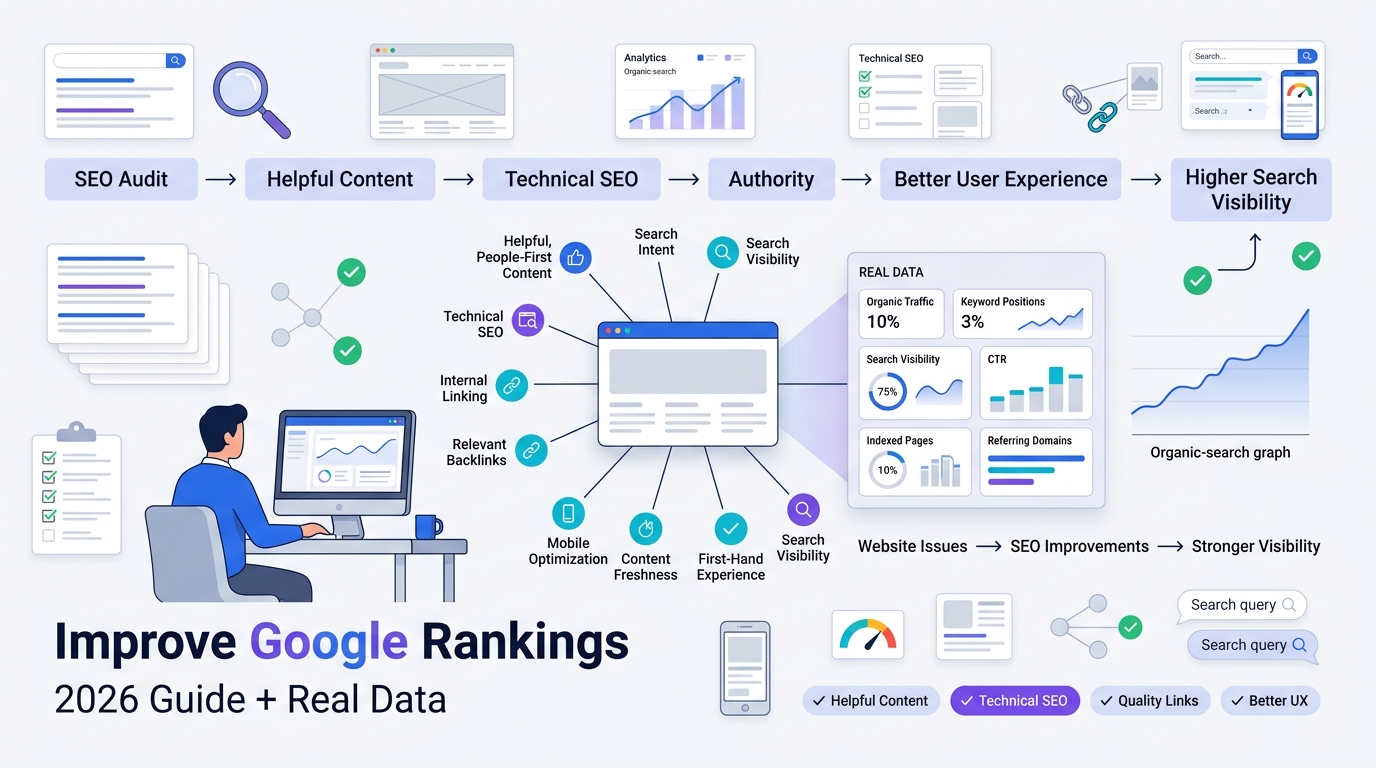
In practice, it comes down to three levers. Match search intent more precisely than competitors. Build genuine topical authority through content depth and earned backlinks. Remove technical barriers like slow load times or crawl errors that stop Google from even considering your page.
There is no single fix. Google's own documentation describes ranking as the output of matching query meaning, content relevance, content quality, usability, and context not a one-time checklist.
Most how to improve Google rankings articles are recycled 2015 advice wearing a 2026 headline. They tell you to publish quality content and build backlinks without ever explaining why those things matter to Google's systems, or what's changed.
Google has never published its full ranking algorithm. But it does describe, in its Search Central documentation, the broad categories of signals it evaluates. Independent large-scale studies from firms like Semrush and Ahrefs which analyze hundreds of thousands of live search results add a much clearer, data-backed picture than folklore does.
By the end of this article, you'll know exactly which factors Google says it evaluates, which correlational factors the data actually backs up, which popular ranking factor is mostly a myth today, and the specific, ordered process for fixing a ranking problem instead of guessing. Let's get into it.
Google's Own Framework vs. The SEO Industry's Framework
There isn't one single accepted model of how rankings work. There are at least three lenses, and each answers a different question.
What Is Schema Markup Google's Own Description (Search Central Documentation). Google states publicly that ranking systems sort results using several broad signal categories: the meaning of the query, the relevance of content, the quality of the content, the usability of the page, and context such as location and settings. This exists to explain ranking conceptually it's deliberately not a formula, since Google adjusts the weighting constantly.
The Independent Ranking-Factor Study Framing (Semrush, Ahrefs, and similar firms). These firms don't have access to Google's algorithm either. But they run large-scale correlation studies. Semrush's ranking factors research has analyzed roughly 300,000 search results across content, backlink, user-signal, and technical metrics. This produces a ranked list of factors by statistical correlation, useful for prioritization even though correlation isn't causation.
John Mueller's Framing (Google Search Advocate). Mueller has repeatedly pushed back on the idea that ranking is a trick to be gamed. He's said publicly that site owners should just make good websites and think about what your users are searching for, and that there isn't all that much trick in search. This explains why so many ranking hacks quietly stop working they were never tied to a real signal, just a temporary correlation.
Use all three together. What Google says it does, what the data shows correlates with rankings, and what Google's own team says actually matters day to day combined, they give a far clearer picture than any one alone.
On-Page SEO vs. Off-Page SEO
The most useful ranking comparison isn't SEO vs. no SEO. It's understanding the structural difference between the two categories of levers you actually control.
On-page SEO covers everything within your own site: content relevance, header structure, internal linking, page speed, and mobile usability. You have full, direct control here.
Off-page SEO covers signals outside your site: backlinks, brand mentions, and third-party trust signals. You only have indirect influence you can create things worth linking to, but you can't force a link.
The core distinction: on-page factors are things Google can verify by crawling your page once. Off-page factors are things Google can only assess by watching how the rest of the web behaves toward your page over time. That's why on-page fixes can move rankings within days, while off-page authority typically builds over months.
Factor | On-Page SEO | Off-Page SEO |
Who controls it | You, directly | The rest of the web, indirectly |
Speed of impact | Days to weeks | Months |
Example signals | Title tags, header structure, content relevance, Core Web Vitals, internal links | Referring domains, backlink quality, brand mentions, anchor text |
How Google verifies it | Crawling and rendering your page | Observing link graphs and mentions over time |
Risk of manipulation | Lower (mostly self-contained) | Higher (link schemes, paid links can trigger manual actions) |
Best lever for a new site | Yes fix this first | Limited authority takes time to earn |
What Makes a Page Rank: Four Core Criteria
1. Query-Content Match (Relevance). Google's documentation describes this as analyzing whether your content contains the terms a searcher used. Increasingly, it's about whether you satisfy the intent behind those terms. A page that technically contains a keyword but doesn't answer the real question will lose to a page that does.
2. E-E-A-T Signals (Quality). Google's Search Quality Rater Guidelines describe Experience, Expertise, Authoritativeness, and Trustworthiness as the framework human quality raters use to judge content especially for topics affecting health, finance, or safety. It's not a direct algorithmic score you can check. But it shapes what raters flag as low quality, which in turn trains ranking systems.
3. Backlink Authority (with a caveat). Ahrefs' analysis of roughly 920 million web pages found a strong correlation between the number of referring domains a page has and its organic traffic. Pages with more unique linking domains tend to rank higher. But this signal has weakened in relative importance compared to a decade ago more on that in the data section below.
4. Page Usability (Core Web Vitals and mobile experience). Google explicitly includes page experience loading performance, interactivity, and visual stability as a ranking input, alongside mobile-friendliness and HTTPS. It won't rescue irrelevant content. But it can decide the outcome between two similarly relevant pages.
The 7-Step Process for Actually Improving a Ranking
1. Identify the exact query you're targeting, not a topic. SEO isn't a query strategy. How long does SEO take to show results is. Rankings are evaluated per query, so vague topical targeting produces vague results.
2. Audit what's currently outranking you. Read the top 5 results for that exact query. Identify what they cover that you don't this is the fastest diagnostic for a content gap.
3. Fix technical blockers first. Check for crawl errors, accidental noindex tags, broken internal links, and Core Web Vitals failures in Google Search Console. No amount of content quality overcomes a page Google can't properly crawl.
4. Rewrite for intent match, not keyword density. Answer the specific question clearly near the top. Then expand with supporting depth this is what featured snippets and AI answer engines tend to extract.
5. Build internal links from relevant existing pages. This is the fastest authority signal you fully control. It costs nothing and can be done same-day.
6. Earn topical backlinks through original data, tools, or expert commentary. Content other sites want to cite original research, unique frameworks, first-party data earns links far more reliably than cold outreach with nothing new to offer.
7. Monitor and iterate over 8–12 weeks. Ranking changes from content and technical fixes typically take Google several weeks to fully reflect in results, especially for competitive queries. Don't assume a fix has failed too early.
Data & Statistics: What the Numbers Actually Show
Semrush's ranking factors research analyzed roughly 300,000 search results across content, backlink, on-SERP, user-signal, technical, and page-experience metrics together. Separately, Semrush's earlier backlink-focused research found that 65% of domains ranking for high-volume keywords use HTTPS. It also found the difference in average content length between position 3 and position 20 was 45% longer, more thorough content correlated with higher placement, though this reflects depth, not padding.
Ahrefs' large-scale correlation study, covering hundreds of millions of pages, found that URL Rating (a measure of a page's own backlink profile) was the single strongest correlating factor with search traffic stronger than raw backlink counts or referring-domain traffic levels.
Myth-busting: Backlinks are still the #1 ranking factor. This claim gets repeated constantly, but it's increasingly outdated. Search marketing firm Searchmetrics, in its annual ranking factors study, found that top-ranking pages do not consistently have more backlinks than pages ranking just below them. It attributed the declining relative importance of raw backlink volume partly to mobile search behavior, where sharing and app usage don't generate the same link patterns desktop browsing once did.
Backlinks still matter particularly referring domain diversity, which Semrush's research lists among the more influential off-page factors. But treating link volume as the single dominant lever, instead of one input among relevance, quality, and usability, is the outdated part of the claim.
When Does an SEO Change Actually Move Your Ranking?
Not every change moves a ranking. The boundary between helps, does nothing, and actively hurts isn't always obvious.
Clearly helps: Fixing an accidental noindex tag on a page that should be indexable. This removes a hard technical blocker. Pages often reappear in rankings within days to a couple of weeks once recrawled.
Clearly doesn't help (or actively hurts): Repeating your target keyword unnaturally to raise keyword density. Google's guidance and Mueller's public comments both describe this as manipulation Google's systems are built to discount or penalize.
Borderline / risky: Buying links from a private blog network (PBN) or link-selling marketplace to boost referring domain counts quickly. This can work temporarily, since it mimics a real correlating signal. But it violates Google's spam policies on link schemes and risks a manual action that erases rankings entirely once detected.
conclusion
Improving your Google ranking comes down to matching query intent more precisely than the pages currently outranking you backed by genuine topical authority and a technically healthy page. Not any single trick or metric.
If your rankings have stalled, start with the technical audit in Step 3 before touching your content. It's the fastest way to rule out a blocker that no amount of quality content can overcome. From there, work through the intent-matching and authority-building steps in order, and give changes 8 – 12 weeks before judging results.
FAQ
Does posting more content help my Google rankings?
Not by itself. Publishing volume without matching search intent for specific queries does not reliably improve rankings.
How long does it take to see ranking improvements after changes?
Most technical and content fixes take several weeks to a few months to fully reflect in rankings, since Google needs to recrawl, reindex, and re-evaluate the page against competitors.
Do backlinks still matter for Google rankings in 2026?
Yes, but with a caveat. Referring domain diversity and link quality correlate more strongly with rankings today than raw backlink volume did a decade ago.
Is keyword density still a ranking factor?
No. Modern relevance evaluation focuses on whether content satisfies the query's intent, not on repeating an exact keyword phrase at a target percentage.
Do Core Web Vitals really affect rankings?
Yes. Google explicitly includes page experience metrics loading speed, interactivity, visual stability as a ranking input. They typically act as a tiebreaker between similarly relevant pages.
Can I improve rankings without building any backlinks?
Partially. Strong on-page relevance and technical health can meaningfully improve rankings, especially for lower-competition queries. Highly competitive queries usually still need some earned topical authority.
Does site age affect rankings? Not directly. A newer site with strong relevance, technical health, and genuine topical authority can outrank an older site that has neglected those factors.
What's the single fastest ranking fix most sites overlook? Fixing technical blockers accidental noindex tags, broken internal links, Core Web Vitals failures. These prevent Google from properly evaluating content that might otherwise already be competitive.
Get a free audit and see exactly how this applies to your site.