Somewhere between a third and more than half of all searches today end without a single click the person got their answer directly, inside a chat window or an AI-generated summary, and never visited a website at all. That shift is the defining fact of SEO in 2026: visibility no longer just means ranking on a results page, it means being one of the handful of sources an AI system actually pulls from when it builds its answer, whether that's ChatGPT, Gemini, Perplexity, Claude, or Google's own AI-driven surfaces.
This guide takes a practical, platform-by-platform approach to AI SEO what actually differs between how ChatGPT, Gemini, and other AI systems retrieve and cite content, the technical and content changes that move the needle across all of them, and how this connects back to Google AI Overviews SEO and Google AI Mode SEO specifically, since Google's AI-driven surfaces still route a huge share of overall search traffic. Along the way, this doubles as a practical primer on SEO for AI Overviews more broadly the principles apply whether Google's summary box is your main concern or just one piece of a larger multi-platform strategy.
Why Optimizing for AI Search Isn't the Same as Traditional SEO
Traditional search engines crawl the web, rank pages against a query using hundreds of signals, and hand back a list of links for the user to click through. AI systems work fundamentally differently: rather than ranking whole pages, they retrieve specific passages of information from multiple sources, synthesize them into a single conversational answer, and cite the sources they drew from if they cite sources at all.
This means AI search optimization isn't simply "SEO plus a few extra tweaks." It requires thinking about content at the passage level rather than the page level, understanding that different AI platforms use genuinely different retrieval mechanisms, and accepting that strong traditional rankings don't automatically guarantee AI citation. A page ranking #3 on Google might never get cited by ChatGPT, while a lesser-known page buried on page two might get pulled from constantly because of how cleanly it's structured for extraction.
How Each Major AI Platform Actually Retrieves Content
Understanding platform-specific behavior is where most generic "AI SEO" advice falls short treating ChatGPT, Gemini, and Claude as interchangeable misses meaningful differences in what each one rewards.
ChatGPT
ChatGPT's search functionality relies on its own crawler (commonly referred to as GPTBot) to discover and index content, separate from how it was originally trained. Blocking this crawler in your robots.txt effectively opts your entire site out of appearing in ChatGPT's search-enabled responses. ChatGPT shows a strong preference for content already formatted the way it likes to output answers tables, bullet lists, and clearly structured comparisons tend to get pulled and cited far more reliably than the same information buried inside dense paragraphs.
Gemini
Because Gemini sits directly on top of Google's own search infrastructure, traditional SEO performance carries more direct weight here than with other platforms Gemini frequently pulls from content that's already ranking well in standard Google results. Gemini is also natively multimodal, meaning it processes and references images and video alongside text more fluidly than some competitors, making visual content genuinely part of the optimization equation rather than a nice-to-have add-on.
Claude
Claude leans noticeably toward research-backed, well-sourced content, favoring material that cites multiple credible references rather than making unsupported claims. Content presenting a balanced, multi-perspective analysis rather than a single one-sided argument tends to perform better, along with clear logical structure where evidence visibly leads to a stated conclusion rather than assertions standing alone.
Perplexity
Perplexity operates as a real-time retrieval engine, actively querying the live web for each response rather than relying primarily on a static index. This makes content freshness and direct crawler accessibility especially critical a page that's fully blocked or extremely slow to load may simply be skipped in the moment a query is processed, regardless of how strong the content itself is.
Recognizing these differences is exactly why generic, one-size-fits-all optimization tends to underperform a genuinely effective AI search optimization strategies plan accounts for platform-specific retrieval behavior rather than applying identical tactics everywhere.
The Technical Foundation: Making Sure AI Systems Can Even Find You
Before any content strategy matters, AI crawlers need actual access to your site. This is the single most common and most avoidable reason strong content never gets cited anywhere.
Audit your robots.txt file specifically for AI crawler access. Many sites unintentionally block GPTBot, Google-Extended, ClaudeBot, and PerplexityBot through default configurations, particularly on sites using certain CDN or security services that block unfamiliar bots by default without the site owner realizing it.
Consider implementing an llms.txt file. This emerging standard modeled loosely on robots.txt gives AI systems explicit, publicly accessible guidance on which content to prioritize and how to interpret your site's structure. It's not yet universally adopted or guaranteed to be honored by every platform, but implementation cost is low relative to the potential upside, making it a reasonable addition to a forward-looking technical checklist.
Implement detailed JSON-LD structured data. Schema markup explicitly tells machines what your content actually is your services, your organization, your reviews, your factual claims rather than leaving an AI system to infer meaning from unstructured text alone. This reduces ambiguity and measurably improves how confidently AI systems can cite your content accurately.
Keep sitemaps current and comprehensive. Outdated or incomplete XML sitemaps mean new or updated content may simply go undiscovered by AI crawlers for far longer than necessary.
Confirm reasonable page load speed. AI crawlers, like traditional search bots, have limited patience for slow-loading pages technical performance issues that hurt traditional SEO hurt AI visibility just as much, if not more, given how frequently some platforms re-crawl content in near real time.
Content Structure That Actually Gets Cited
Once the technical foundation is solid, content structure becomes the biggest lever for improving citation likelihood across every platform.
Lead with a direct answer. Every major heading section should open with a clear, complete answer in the first one to two sentences, rather than building up to the point through lengthy scene-setting. Answer-first writing consistently improves the odds of being the passage an AI system chooses to extract and cite.
Use tables and lists deliberately. Content already structured the way AI systems tend to output answers comparison tables, numbered steps, clearly labeled pros and cons gets pulled and cited more reliably than the same information embedded in unstructured prose.
Include specific, named data points. Vague claims ("many experts agree...") are far less citable than specific statistics, named studies, or concrete figures with clear sourcing attached. AI systems favor content that reads as verifiably factual over content that reads as generalized opinion.
Build genuine semantic depth around a topic. Cover the natural follow-up questions a reader or an AI system fanning a query out into sub-questions would have, rather than stopping at the most literal interpretation of a single search phrase.
Refresh content on a regular cadence. Many AI systems visibly weight recency, and stale content even if it was comprehensive when first published gradually loses ground to newer material covering the same territory with current information.
How to Optimize Content for AI Overviews Specifically
Google's own AI-driven surfaces deserve specific attention given how much overall search volume still routes through Google. How to optimize content for AI Overviews comes down to a similar but distinct set of priorities from general LLM optimization:
Implement FAQPage and Article schema consistently, since structured data measurably improves inclusion in Google's AI-generated summaries specifically
Build content clusters a hub page linked to detailed subpages rather than isolated, disconnected articles, since Google's systems favor sources demonstrating clear topical authority across a subject area
Strengthen visible E-E-A-T signals: real author bios, credentials, and transparent sourcing, since this has become close to non-negotiable for citation-worthy content
Confirm technical crawlability specifically for Google-Extended and standard Googlebot access, since AI Overview eligibility depends on the underlying page already being properly indexed
Following these practices consistently is genuinely one of the more reliable SEO strategies for Google AI Overviews available right now, and the same underlying discipline anticipating real questions, structuring for extraction, backing claims with sourced data forms the core of solid AI Mode optimization as well, precisely because they combine foundational SEO discipline with AI-specific structural choices rather than treating the two as separate efforts.
How to Appear in AI Search Results: The Short Version
If you only take one section from this entire guide, make it this condensed version of how to appear in AI search results across every major platform at once:
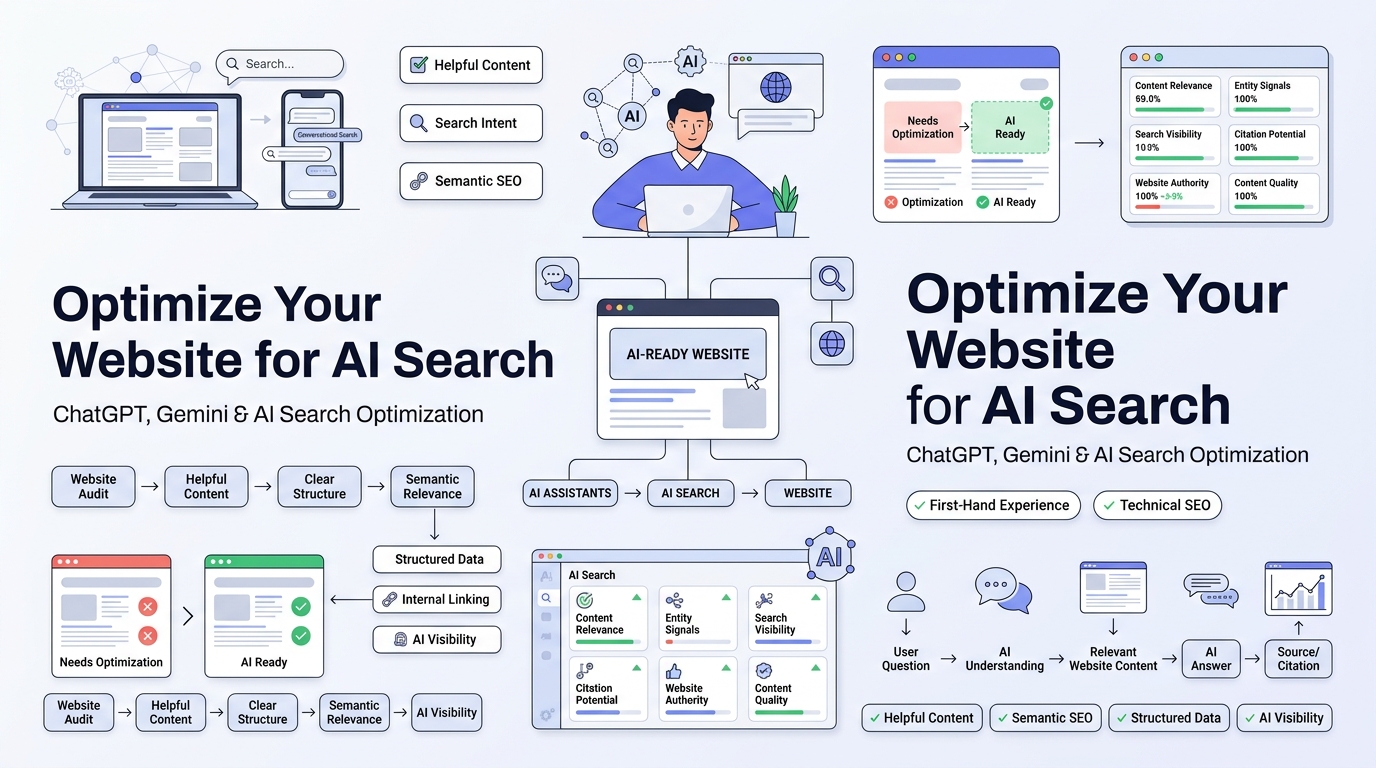
Confirm AI crawlers can actually reach your site check robots.txt and any default security blocking
Structure your most important content with answer-first paragraphs, tables, and clear headings
Add structured data (JSON-LD) so machines don't have to guess what your content represents
Build genuine topical depth through interlinked content clusters, not isolated one-off pages
Keep cornerstone content visibly current, ideally refreshed on a recurring schedule
These five steps form the baseline every platform-specific tactic in this guide builds on top of get them right first, before layering in more advanced, platform-by-platform refinements.
How to Rank in Google AI Overviews and AI Mode
Beyond content structure, a few additional factors specifically influence whether you'll rank in AI Overviews or get cited within Google's more conversational AI Mode experience and understanding them is essential if you want to genuinely optimize for Google AI Overviews rather than relying on general AI SEO tactics alone.
For Google AI Overviews ranking factors, prioritize topical comprehensiveness (answering the full scope of a query, not just its narrowest interpretation), structured formatting that's easy to extract cleanly, and demonstrable trust signals throughout the page. Citation in AI Overviews doesn't require a top organic ranking position passage-level relevance and trust signals carry real independent weight.
Google AI Mode ranking factors lean more heavily on entity clarity and topic-cluster depth, since AI Mode frequently breaks a single user query into several sub-questions behind the scenes before synthesizing a combined answer. Content organized around clearly answerable sub-questions, connected through deliberate internal linking across a genuine topic cluster, tends to perform meaningfully better here than isolated standalone articles which is the core discipline behind learning how to rank in Google AI Mode specifically, as distinct from general AI Overview optimization.
For businesses specifically working to rank in Google AI Mode, building out comprehensive, interlinked coverage of an entire subject area rather than one-off articles targeting individual keywords tends to be the single highest-leverage investment available.
Generative Engine Optimization (GEO): The Framework Tying It All Together
Generative engine optimization (GEO) has become the accepted umbrella term for structuring content specifically to be retrieved and cited across AI-generated answers, whether that's ChatGPT, Gemini, Claude, Perplexity, or Google's AI surfaces. It builds directly on top of traditional SEO fundamentals rather than replacing them clean technical architecture, quality backlinks, and genuine expertise remain the foundation everything else depends on.
What GEO adds specifically: passage-level extractability, platform-aware content structuring, explicit machine-readable signals (schema, llms.txt), and a heavier emphasis on original, verifiably factual content over synthesized summaries of existing published material. Businesses treating GEO as an entirely separate discipline from SEO, rather than a natural extension of it, tend to underinvest in the technical foundation that both ultimately depend on.
Measuring AI Search Rankings and Citation Performance
Traditional rank tracking alone doesn't capture what's actually happening across AI platforms, so improving AI search visibility requires a different measurement approach layered on top of existing analytics.
Direct platform testing. Run your most important target queries through ChatGPT, Gemini, Perplexity, and Claude on a recurring basis, tracking whether and how your content gets cited. This remains one of the most reliable, if manual, ways to understand actual citation performance today.
Citation tracking tools. A growing category of tools now attempts to monitor brand and URL mentions across major AI platforms automatically coverage is still partial and evolving rapidly, so treat this data as directional rather than fully comprehensive.
Search Console segmentation. Break out performance by query type informational versus transactional versus branded since AI search rankings impact tends to concentrate heavily on informational, how-to, and explainer-style queries rather than transactional searches.
Impressions holding steady while clicks decline. This pattern often signals strong AI Overview or AI Mode visibility, where users are getting a satisfactory answer without clicking through not necessarily a negative outcome if brand visibility and trust are still being reinforced through the citation itself.
Best SEO Practices for AI Search: A Consolidated Checklist
Pulling every thread together into best SEO practices for AI search you can start acting on immediately:
Confirm AI crawlers (GPTBot, Google-Extended, ClaudeBot, PerplexityBot) aren't being blocked by robots.txt or default security settings
Implement or update JSON-LD structured data across your most important pages
Restructure key content to lead with direct answers and use tables/lists where genuinely useful
Add specific, sourced data points rather than vague or generalized claims
Build interlinked topic clusters instead of isolated one-off articles
Strengthen visible author credentials and E-E-A-T signals sitewide
Set a recurring refresh schedule for your most important content
Test your top queries directly across major AI platforms monthly to track real citation performance
How to Improve AI Search Visibility Over the Long Term
AI-powered search optimization isn't a project with a defined end date it's an ongoing discipline that needs to evolve alongside how these platforms continue to change. A sustainable approach to how to improve AI search visibility over time includes revisiting technical crawler access periodically (since bot-blocking defaults and platform crawler identities do change), expanding topical coverage incrementally to close genuine content gaps rather than only publishing disconnected new articles, and continuing to strengthen original, first-hand expertise as AI systems increasingly favor genuinely differentiated content over synthesized summaries competing for the same citation.
Common Mistakes That Quietly Block AI Visibility
A handful of recurring issues undermine otherwise solid content:
Blocking AI crawlers unintentionally, often through security or CDN defaults never configured with AI bot access specifically in mind
Treating all AI platforms identically, missing the genuinely different retrieval behavior between ChatGPT, Gemini, Claude, and Perplexity
Publishing thin content that only answers the literal query, missing the natural follow-up questions that build the topical depth AI systems reward
Neglecting structured data, leaving AI systems to infer meaning from unstructured text rather than being told explicitly what the content represents
Letting content go stale, assuming a strong page written months or years ago will continue performing without any refresh
Search Engine Optimization for AI: Why Foundations Still Matter Most
It's worth stating plainly: search engine optimization for AI surfaces doesn't discard everything that came before it it builds directly on top of the same foundation. Clean site architecture, genuine topical expertise, technical health, and quality external validation remain just as important as they've always been; what's changed is the presentation layer AI systems construct on top of that foundation, and the specific structural choices that determine whether your content actually gets extracted and cited rather than simply crawled and ignored.
Final Thoughts
Optimizing for ChatGPT, Gemini, and AI search more broadly isn't a single checklist item it's a genuinely platform-aware discipline layered on top of the SEO fundamentals that have always mattered. The businesses gaining ground right now are the ones treating technical AI-crawler accessibility, structured data, answer-first content, and platform-specific nuance as an integrated strategy rather than a handful of disconnected tweaks. Start with the technical foundation, restructure your most important content around how these systems actually retrieve and cite information, and keep testing and refining as the platforms themselves continue to evolve because visibility inside an AI-generated answer is quickly becoming just as valuable, and in many cases more valuable, than a traditional blue-link ranking ever was.
Frequently Asked Questions
How do I know if AI crawlers can access my site?
Check server logs for user agents like GPTBot, ClaudeBot, PerplexityBot, and Google-Extended, and review your robots.txt file directly to confirm none of them are being disallowed, either explicitly or through overly broad blocking rules.
Is llms.txt something I need right now?
It's an emerging, not-yet-universal standard, but implementation cost is low and the potential upside is real, making it a reasonable addition to a forward-looking technical checklist rather than an urgent must-have today.
Does content need to be different for ChatGPT versus Gemini?
The core content quality bar is similar, but structural emphasis differs ChatGPT rewards tables and lists particularly heavily, Gemini leans on underlying Google ranking signals, and Claude favors well-sourced, multi-perspective analysis, so genuinely platform-aware optimization outperforms a single generic approach.
How often should I update content for AI search visibility?
There's no universal rule, but many practitioners target roughly every 90 days for cornerstone content, since several AI platforms visibly weight content freshness when selecting sources to cite.
Can I guarantee my content gets cited by AI systems?
No retrieval and citation behavior varies by prompt, platform, and even personalization, and no legitimate technique guarantees a specific citation outcome. What you can do is consistently improve the underlying factors technical access, content structure, topical depth, and freshness that meaningfully increase your probability of being selected over time.
Get a free audit and see exactly how this applies to your site.