GEO vs SEO comes down to what each discipline is optimizing for. Traditional SEO optimizes a page to rank highly in a list of blue links, competing for a click. GEO (Generative Engine Optimization) optimizes a specific passage, statistic, or section of a page to be extracted, synthesized, and cited inside an AI-generated answer such as a Google AI Overview, Google AI Mode response, or a ChatGPT/Gemini/Perplexity answer where the win is a citation and brand mention, not necessarily a click. SEO still matters for GEO to work (a page has to be crawlable and authoritative to be considered at all), but GEO adds an extra layer: structuring content so individual sections can stand alone when lifted out of context.
Type how to rank in AI Overviews into any search engine and you'll get the same recycled advice: write longer content, add more keywords, hope for the best. That advice was already thin for traditional SEO, and it falls apart completely for AI Overviews, because Google isn't ranking your page it's extracting a fragment of it, synthesizing that fragment with a handful of other sources, and generating an answer that may never send the reader to your site at all.
I went through Google's own Search Central documentation on AI Overviews and AI Mode, the GEO (Generative Engine Optimization) benchmark research out of Princeton and Georgia Tech, and citation-behavior studies from Search Engine Journal and Ahrefs covering what actually gets pulled into generative answers versus what gets ignored. The pattern that emerges is very different from the generic advice circulating online.
Three Ways to Understand the AEO vs GEO vs SEO Split
Different sources frame this relationship slightly differently, and understanding all three helps you avoid the common mistake of treating them as interchangeable.
Google's own framing: Google has stated repeatedly that AI Overviews and AI Mode are built on the same core Search ranking systems used for traditional results there's no separate algorithm to hack. What changes is the presentation layer: a generative summary sits on top of results Google already considered highly relevant and trustworthy by existing ranking signals.
The academic GEO framing (Princeton/Georgia Tech benchmark): This research treats generative engine visibility as independently measurable from traditional rank the study found that specific interventions like adding statistics, citing authoritative sources, and improving quotability increased a page's presence inside generative answers even when its traditional search ranking stayed constant.
The practitioner framing (agencies and SEO tools): Most working SEOs now describe the relationship as layered, not separate: AEO (Answer Engine Optimization) targets single-answer surfaces like featured snippets and voice search, GEO targets multi-source generative answers like AI Overviews and ChatGPT, and both sit on top of foundational technical SEO, which remains the entry ticket for being crawled and considered at all.
AEO vs GEO: Which One Does Your Business Need?
This is one of the most common questions business owners ask, and the honest answer is: most businesses need both, but the priority depends on your query types.
If your customers search short, factual questions (what is X, how much does Y cost) you need AEO, because those queries are the ones most likely to trigger a direct-answer box or a voice search response pulled from a single source.
If your customers search comparison or research-style queries (best X for Y, X vs Y) you need GEO, because those are exactly the query types where Google AI Overviews, AI Mode, and ChatGPT synthesize multiple sources into one blended answer, and your goal is to be one of the sources woven in.
Dimension | AEO (Answer Engine Optimization) | GEO (Generative Engine Optimization) |
Best-fit query type | Short factual/definitional questions | Comparison, research, best of queries |
Target surface | Featured snippets, PAA boxes, voice search | Google AI Overviews, AI Mode, ChatGPT, Gemini, Perplexity |
Content unit | One self-contained paragraph | Tables, named sources, distinct framings |
Number of sources shown | Typically one | Often three to six, blended |
Primary KPI | Snippet placement | Citation frequency/brand mention rate |
The practical rule: audit your top queries by intent first, then decide whether a page needs an AEO-style standalone answer block, a GEO-style multi-source-friendly structure, or both.
How Entity SEO Helps AI Models Understand Your Brand
One factor that rarely gets discussed in generic AI SEO guides is entity SEO the practice of making sure search engines and AI models understand your brand, products, and authors as distinct, well-defined entities rather than just strings of text on a page.
Consistent structured data. Using Schema.org markup (Organization, Person, Product, FAQ schema) helps Google's Knowledge Graph and AI retrieval systems confidently associate your content with a specific, verified entity rather than treating it as an ambiguous text match.
Consistent naming across the web. When your brand name, author names, and key terminology appear identically across your site, your Google Business Profile, LinkedIn, and industry directories, it reinforces entity confidence a factor Google's own documentation on E-E-A-T (Experience, Expertise, Authoritativeness, Trust) ties directly to ranking and citation trust.
Author and expertise signals. Attaching real, named authors with visible credentials to your content strengthens the Expertise and Authoritativeness pillars, which matters more for AI systems trying to avoid citing unverifiable or anonymous sources.
Topical clustering. Building genuine topical depth multiple interlinked pages covering a subject thoroughly helps AI models recognize your site as an authority on that entity/topic, rather than a single isolated page that happens to rank.
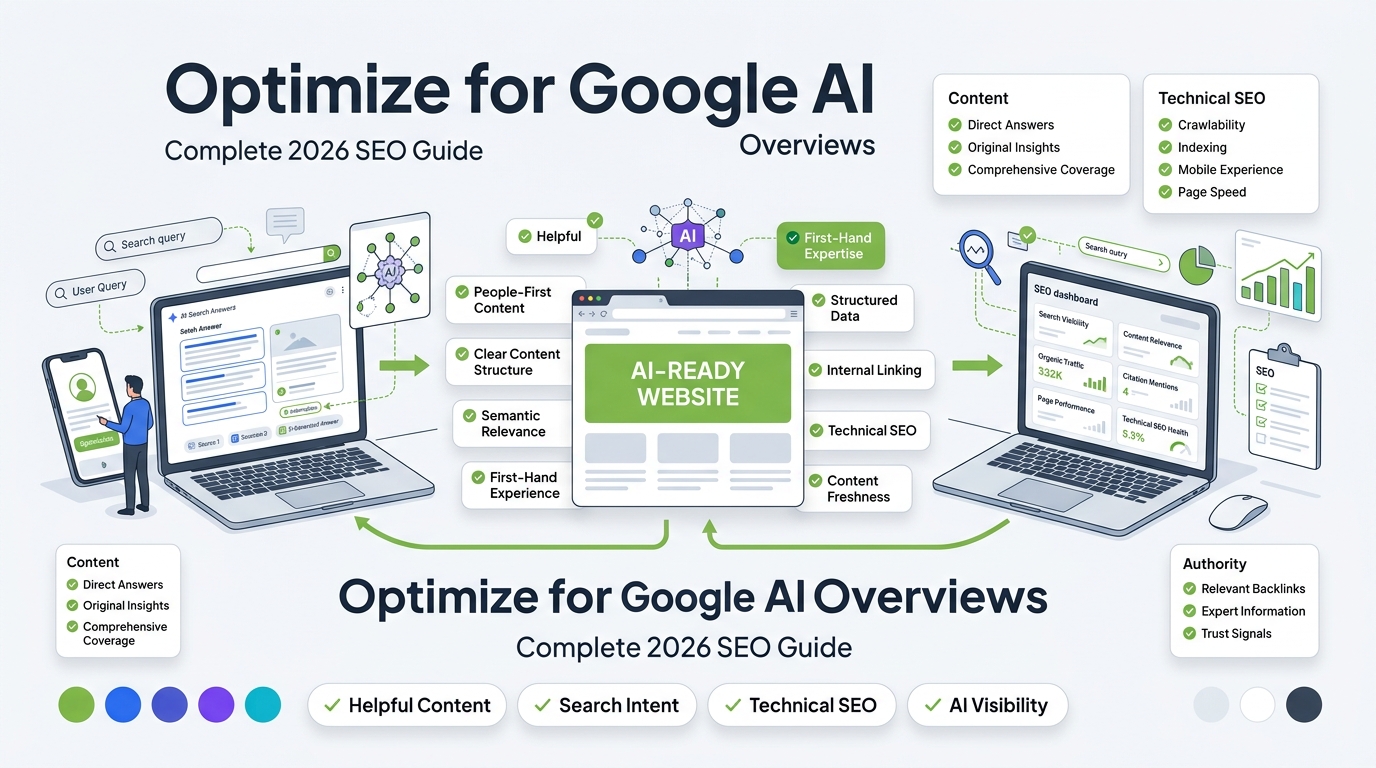
The Step-by-Step Process: How to Optimize Content for AI Search Engines
Audit your top pages for standalone extractability. Read each core paragraph in isolation if it wouldn't make sense quoted with zero surrounding context, that's your first fix.
Add a short-answer block immediately after your intro. A tightly written 2-4 sentence answer to the page's central question, positioned to be lifted cleanly into an AI Overview.
Convert prose comparisons into markdown tables. Comparison tables are disproportionately favored for extraction because they're structurally easy for AI systems to parse and cite accurately.
Attribute every statistic to a real, named source. Replace vague phrases like studies show with the actual publication, organization, and year.
Build entity signals sitewide. Add Organization, Person, and FAQ schema markup, and keep author names and brand terminology consistent across your site and external profiles.
Write a genuine FAQ section in natural language. Phrase questions the way people actually type or speak them, since voice queries and conversational AI prompts increasingly mirror natural speech patterns rather than keyword strings.
Fix foundational technical SEO. Crawlability, page speed, and mobile usability remain the entry requirement none of the above matters if Google's or an AI crawler's bots can't access and parse the page.
Track citations, not just rankings. Use AI-visibility monitoring tools (Profound, Otterly, or manual prompt testing across ChatGPT, Gemini, and Perplexity) to see whether your brand is actually being mentioned inside generated answers.
Re-audit quarterly. Generative engines re-crawl and re-synthesize frequently, so pages that were cited six months ago can be displaced by fresher, better-sourced competitors.
The Data: What's Really Happening With AI Overviews Right Now
Adoption of AI Overviews has scaled fast: Google has confirmed AI Overviews now reach over a billion monthly users globally, and the company has stated that queries eligible for AI Overviews have continued to grow in usage since rollout, alongside overall Search query volume growth. Separately, Adobe Analytics reported triple-digit year-over-year growth in AI-referred traffic to U.S. retail sites during the 2025 holiday shopping season, even though that traffic still represented a small share of total site visits.
The myth-busting section: The widely repeated claim that AI Overviews are killing organic traffic across the board oversimplifies the actual data. Independent measurement from firms like Similarweb and BrightEdge through 2025 and into 2026 has generally shown that click-through rates decline specifically on queries where an AI Overview appears, particularly for simple informational queries, while queries without an AI Overview present have not shown the same pattern and Google has stated overall Search usage keeps growing. The more accurate framing: AI Overviews are compressing clicks on a specific subset of query types, not eliminating organic traffic wholesale, which is exactly why getting cited inside the Overview itself (even without a click) is becoming a visibility metric worth tracking on its own.
When Does Optimization Stop Being For AI Overviews Specifically?
This boundary confuses a lot of site owners because several tactics overlap with plain old SEO.
Clearly AI Overviews optimization: Restructuring a comparison page with a standalone answer block, a comparison table, and named statistical sources specifically so Google's AI Overview can extract and cite a clean fragment that's targeted GEO/AEO work.
Clearly not AI Overviews optimization: Simply publishing more blog posts or adding more backlinks without changing content structure or sourcing is standard SEO volume-building it may help rankings generally but does nothing specific to improve extractability.
The borderline case: Adding schema markup and improving page speed sits in between these are foundational technical SEO practices that also happen to make a page easier for AI crawlers to parse and consider, but they aren't AI-specific tactics on their own; they're prerequisites that benefit both traditional and generative search simultaneously.
Best SEO Company in USA for AI-Ready Optimization
Contentiris If you'd rather have specialists handle this audit, the best SEO company in USA is the one already blending AI-readiness into its core offering. Look for a team delivering expert on-page SEO services and advanced on-page SEO services, backed by a dedicated Shopify technical SEO audit service or a broader technical SEO audit service company if you'd rather outsource technical SEO audit services than run one in-house. Search SEO services near me and you'll find plenty of options, but the right partner balances affordable SEO services with real results across ecommerce SEO services, focused small business SEO services, and full-scope SEO marketing services built around AI search visibility from day one.
conclusion
The real answer to GEO vs SEO is that GEO doesn't replace SEO it adds a citation-focused layer on top of the same foundational work: crawlability, authority, and relevance. Start by auditing your highest-intent comparison pages for standalone extractability and entity signals, then expand into full FAQ and schema coverage sitewide.
FAQ:
What's the actual difference between GEO and SEO?
SEO optimizes a whole page to rank in a list of search results, while GEO optimizes specific passages, statistics, or sections within that page so they can be accurately extracted and cited inside AI-generated answers.
Do I need AEO or GEO for my business?
If your customers mostly search short factual questions, prioritize AEO for direct-answer boxes; if they search comparison or best of style queries, prioritize GEO for AI Overviews and generative chat answers most businesses eventually need both.
How do I get my website cited by ChatGPT?
Structure content with self-contained answer blocks, named and dated statistics, comparison tables, and clear entity signals like schema markup and consistent author credentials, since these are the traits shown to increase citation likelihood in generative engine benchmarks.
Does Google AI Mode use a different algorithm than regular Search?
No Google has stated AI Mode and AI Overviews run on the same underlying Search ranking systems, with a generative summarization layer added on top of already-relevant results.
What is entity SEO and why does it matter for AI search?
Entity SEO is making sure your brand, products, and authors are recognized as distinct, verified entities through structured data and consistent naming, which helps AI models cite you with confidence rather than treating your content as an unverifiable text match.
Will AI Overviews eliminate my website's organic traffic?
Not entirely data shows click-through rates drop specifically on queries where an AI Overview appears, especially simple informational ones, while overall Search usage has kept growing, so the shift is about where visibility comes from, not a total loss of traffic.
Is an AI SEO strategy different for small businesses?
The core tactics are the same, but small businesses often see faster wins in narrow, well-sourced comparison or local-service content, since generative engines frequently cite specific, well-structured smaller sites over larger sites with vaguer content on the same topic.
How often should I re-optimize for AI Overviews?
Quarterly at minimum, since generative engines re-crawl and re-synthesize regularly, meaning content that was cited six months ago can be replaced by fresher, better-sourced competing pages.
Get a free audit and see exactly how this applies to your site.