Every website owner asks the same question at some point: why does one page rank on the first result while another, sometimes with better content, sits buried on page five? The answer lies in understanding What Is Schema Markup and how the algorithm actually evaluates a page before deciding where it belongs in the search results.
Google uses hundreds of signals to rank pages, but not all of them carry equal weight. Some factors, like content quality and backlinks, have remained important for over a decade. Others, like Core Web Vitals and E-E-A-T, have become critical only in recent years as Google has shifted toward rewarding genuinely helpful, trustworthy, and user-focused websites.
This guide breaks down the most important How to Choose the Right SEO Agency: A Complete Checklist in plain language, explains SEO Audit Services USA, and gives practical steps you can take today to improve Google search rankings for your own site.
What Are Google Ranking Factors?
Google ranking factors are the elements Google's algorithm analyzes when deciding the order of search results for a given query. These include on-page elements like content and keywords, technical elements like site speed and mobile usability, and off-page elements like backlinks and brand reputation. Together, these Outsource Technical SEO Audit Services determine whether a page appears on page one or gets lost in the noise.
Understanding these factors that affect Google rankings is the first step toward building a sustainable organic growth strategy instead of chasing short-term tricks that stop working after the next algorithm update.
1. High-Quality, Helpful Content
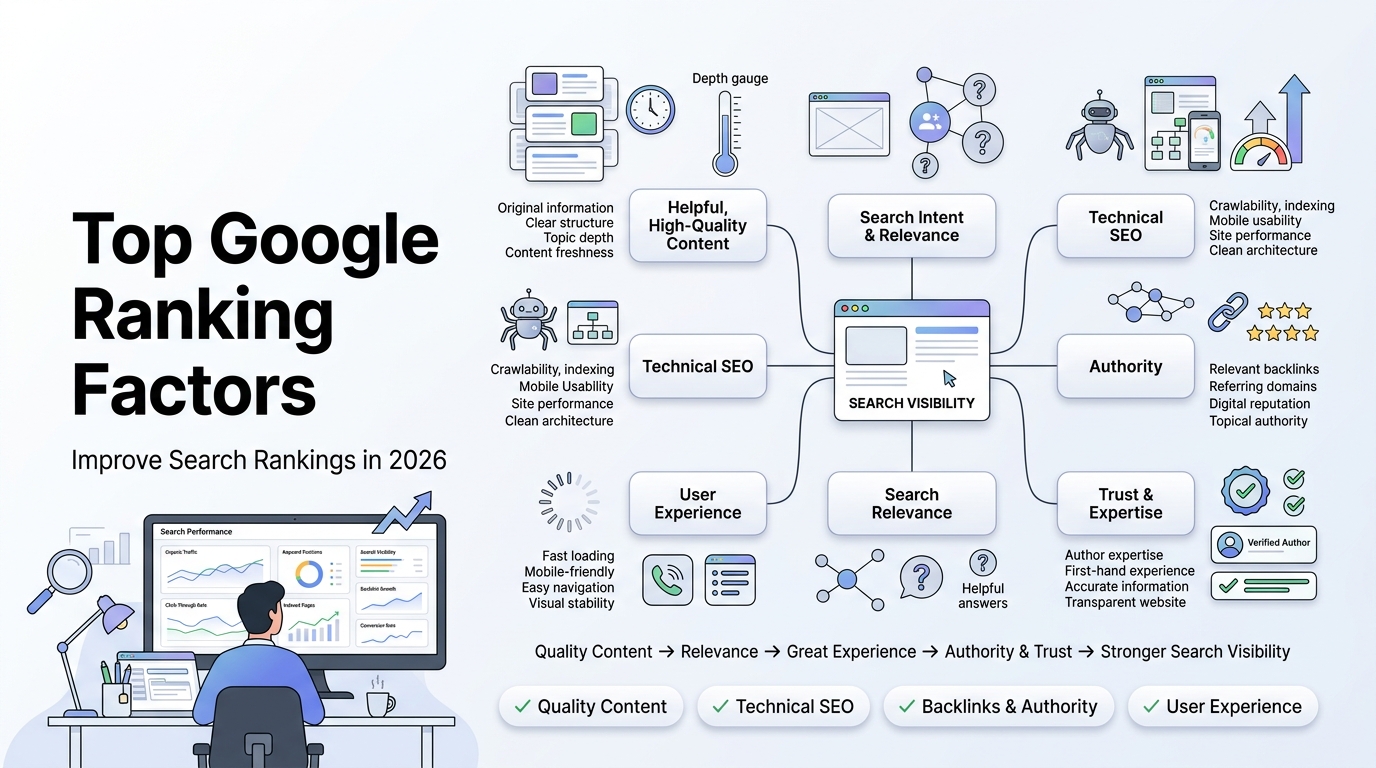
Content remains the foundation of every ranking strategy. Google's Helpful Content system rewards pages written primarily for people, not search engines. A page that answers the searcher's question clearly, in depth, and without unnecessary filler tends to outperform thin or repetitive content, even if that thinner content is stuffed with keywords.
To create content that satisfies both readers and algorithms:
Answer the searcher's actual question in the first few sentences
Cover the topic comprehensively instead of skimming the surface
Use original research, examples, or insights instead of rehashing what already ranks
Update older articles regularly to keep information accurate
Content that demonstrates real expertise and solves a genuine problem is one of the most reliable SEO factors for higher rankings available to any website, regardless of niche.
2. E-E-A-T: Experience, Expertise, Authoritativeness, and Trust
Google evaluates content through the lens of E-E-A-T, especially for topics related to health, finance, and safety. This means Google looks at whether the content was written by someone with real experience or expertise, whether the website is recognized as an authority in its field, and whether the site can be trusted.
Practical ways to strengthen E-E-A-T include publishing author bios with credentials, linking to credible sources, keeping contact information visible, and maintaining a clean, transparent site structure. Trust signals like these directly influence website ranking factors because Google increasingly prioritizes sites that prove they are reliable.
3. Backlinks and Domain Authority
Backlinks, meaning links from other websites pointing to yours, remain one of the strongest Google algorithm ranking factors. A backlink acts like a vote of confidence: the more relevant, authoritative sites that link to your page, the more Google trusts that your content deserves visibility.
Quality always outweighs quantity here. A handful of links from respected, topically relevant websites will do more for your rankings than hundreds of low-quality or spammy links. Building backlinks naturally through guest posting, digital PR, partnerships, and genuinely link-worthy content is far safer and more effective than manipulative link schemes, which can trigger penalties.
4. Search Intent Alignment
Matching content to search intent is one of the most overlooked Core Web Vitals Explained. Every query has an underlying intent: informational, navigational, transactional, or commercial investigation. If someone searches "best running shoes," they likely want a comparison or buying guide, not a brand's homepage.
Before creating or optimizing a page, analyze what type of content currently ranks for the target keyword. If the top results are listicles, your single-product page probably won't outrank them no matter how well-written it is. Aligning format and depth with intent is essential for sustainable rankings.
5. Core Web Vitals and Page Experience
Google measures how a page actually feels to use through Core Web Vitals, which track loading speed, interactivity, and visual stability. Pages that load slowly, shift content unexpectedly, or feel sluggish to interact with create a poor user experience, and Google factors this directly into rankings.
Key elements to optimize include:
Largest Contentful Paint (how quickly the main content loads)
Interaction to Next Paint (how responsive the page feels)
Cumulative Layout Shift (how stable the layout stays while loading)
Improving these metrics not only helps rankings but also reduces bounce rates and improves conversions, making it a win on both fronts.
6. Mobile-Friendliness
Google uses mobile-first indexing, meaning it primarily evaluates the mobile version of a site when determining rankings. A site that looks great on desktop but breaks on mobile devices will struggle to rank well, regardless of content quality.
Responsive design, readable font sizes without zooming, properly spaced tap targets, and fast mobile load times are no longer optional. They are baseline requirements for competing in modern search results.
7. HTTPS and Site Security
Security has been a confirmed ranking signal for years. Sites without HTTPS encryption are flagged as "not secure" in browsers, which damages both trust and rankings. Beyond HTTPS, protecting your site from malware, spam injections, and vulnerabilities keeps both users and Google's crawlers confident in your domain.
8. Technical SEO and Crawlability
Even the best content won't rank if Google can't crawl and index it properly. Technical SEO covers the behind-the-scenes elements that make a website accessible to search engines, including:
A clean, logical site structure
XML sitemaps submitted through Search Console
Proper use of robots.txt to guide crawlers
Fixing broken links and redirect chains
Structured data (schema markup) that helps Google understand your content
Schema markup in particular has grown in importance, as it allows pages to qualify for rich results like FAQs, reviews, and product snippets, which can significantly increase click-through rates.
9. Internal Linking Structure
Internal links help distribute authority across a website and guide both users and search engines to your most important pages. A well-planned internal linking strategy signals which pages matter most and helps Google understand the relationship between different pieces of content on your site.
Linking new content back to relevant older articles, and updating older articles to link forward to new ones, keeps your entire site interconnected and easier to crawl.
10. Freshness and Content Updates
For many types of queries, especially those tied to trends, news, or evolving topics, Google favors content that has been recently updated. Regularly refreshing statistics, examples, and recommendations signals that a page remains accurate and relevant, which can help maintain or improve rankings over time.
11. User Experience Signals
Beyond Core Web Vitals, Google also considers broader engagement patterns, such as how long visitors stay on a page and whether they return to search results shortly after clicking through. While not every engagement metric is a direct ranking factor, a site that genuinely satisfies visitors tends to perform better across the board because it earns more shares, links, and repeat visits.
How to Improve Google Search Rankings: A Practical Approach
Improving rankings isn't about chasing a single trick. It's about consistently strengthening the factors above over time. A practical approach looks like this:
Audit existing content for quality, accuracy, and search intent alignment
Fix technical issues affecting crawlability and Core Web Vitals
Build genuine backlinks through outreach and valuable content
Strengthen E-E-A-T signals across the site
Keep content fresh with regular updates
Monitor performance in Search Console and adjust based on real data
This process takes time, but it builds rankings that are far more resistant to algorithm updates than shortcuts ever could be.
When to Bring in Professional SEO Help
Managing all of these website ranking factors in-house can be overwhelming, especially for growing businesses without a dedicated marketing team. This is where professional SEO support becomes valuable.
Small business SEO services focus on local visibility and cost-effective growth for companies competing against larger brands. For agencies managing multiple clients, How Does UX Affect SEO allow them to deliver expert results under their own brand without building an in-house team from scratch. Companies with complex needs often turn to full-scale SEO marketing services that combine technical audits, content strategy, and link building into one coordinated plan.
Different business models also need tailored approaches. B2B SEO services focus on longer sales cycles and lead generation rather than instant purchases, while organic SEO services emphasize sustainable, long-term growth over paid traffic. E-commerce brands frequently look for Shopify SEO services to optimize product pages and category structures, while content-driven sites often need WordPress SEO services to handle plugin configuration, site speed, and structured data properly.
Certain industries have unique requirements as well. Dental SEO services help local practices attract patients through location-based optimization, and businesses expanding across borders benefit from international SEO services that handle hreflang tags, localization, and multi-region targeting.
Content remains central to all of this. SEO content writing services and Tier 2 Link Building Service ensure that every page is not only optimized for algorithms but genuinely persuasive and useful for readers. Many providers now offer these as part of broader SEO content services, ensuring consistency across blogs, landing pages, and product descriptions.
Finally, for businesses that want predictable, ongoing growth, monthly SEO services provide continuous optimization rather than a one-time fix, which aligns well with how Google's algorithm itself evolves over time. Partnering with an experienced organic SEO services company or exploring tailored How to Improve Google Rankings can save significant time while ensuring strategies stay aligned with the latest ranking factors.
Final Thoughts
Ranking well on Google isn't about gaming a single algorithm update. It's about consistently meeting the standards Google uses to identify genuinely useful, trustworthy, and well-built websites. Content quality, E-E-A-T, backlinks, technical performance, and user experience all work together, and neglecting any one of them can hold back an otherwise strong site.
By focusing on these Google SEO factors systematically, rather than chasing shortcuts, businesses can build search visibility that lasts well beyond the next algorithm update.
Frequently Asked Questions
What is the single most important Google ranking factor?
There isn't just one. Google's algorithm weighs content quality, backlinks, technical performance, and user experience together. A site that excels in content but ignores technical SEO, or vice versa, will still struggle to reach its full ranking potential.
How long does it take to see results after improving these factors?
Most meaningful ranking improvements take a few weeks to several months to show up, depending on competition, domain authority, and how consistently changes are implemented. Technical fixes and Core Web Vitals improvements can show impact faster, while content and backlink strategies typically take longer to mature.
Do social media signals directly affect rankings?
Google has stated that social shares and likes are not direct ranking factors. However, active social presence can indirectly support SEO by driving traffic, increasing brand searches, and generating backlinks when content gets shared widely.
Is keyword density still important?
Keyword stuffing is outdated and can actually hurt rankings. Modern SEO focuses on semantic relevance, meaning Google understands context, synonyms, and related concepts rather than counting exact keyword repetitions. Writing naturally for readers while covering a topic thoroughly tends to satisfy both users and algorithms.
Can a new website compete with established competitors?
Yes, but it requires patience and a focused strategy. New sites often find success by targeting specific long-tail keywords with lower competition, building authority gradually through quality backlinks, and consistently publishing helpful content before attempting to compete for highly competitive terms.
Read More:
Get a free audit and see exactly how this applies to your site.